Most "best attachments" lists for Arena Breakout: Infinite are wrong in the same way: they hand you a fixed parts list and call it done. Arena Breakout: Infinite does not work like that. The game splits weapon handling into separate stats — vertical recoil, horizontal recoil, ergonomics and accuracy — and almost every attachment that improves one of them quietly costs you another. The "best" attachment is the one that fixes the stat your weapon is actually losing fights on, at a weight and ADS cost you can live with.
This guide explains the Arena Breakout: Infinite tuning system the way the firing range teaches it, gives you a category-by-category breakdown of what each attachment slot does, and lays out three build templates you can copy. Everything here is checked against the Season 7: Utopia build (live since September 16, 2026), because Season 7 changed effective ranges and several weapons' recoil behavior — which is exactly why attachment choices matter more now than they did a season ago.
Quick answer: the best attachments in Arena Breakout: Infinite
- There is no universal "best" attachment. Build around the four handling stats — vertical recoil, horizontal recoil, ergonomics and accuracy — not a copied parts list.
- Recoil first, for most guns. A muzzle device (compensator/muzzle brake) and a grip are the two highest-impact slots for keeping your sight on target during a burst.
- Ergonomics is the hidden cost. Stability mods add weight and slow your ADS; a gun that can't get on target fast loses close-range fights even with perfect recoil.
- Tune to your range. A long-range Airport or Valley kit and a close-quarters TV Station kit should not share an attachment list.
- Season 7 context: the official Utopia notes increased effective range and removed low-probability penetration against Class V/VI armor, so holding your crosshair steady at distance is worth more than it was in earlier seasons.
- Test it yourself. Use the firing range, change one attachment at a time, and watch both the sight picture and the impacts — not just how the stat bar moves.
The four stats every attachment is really changing
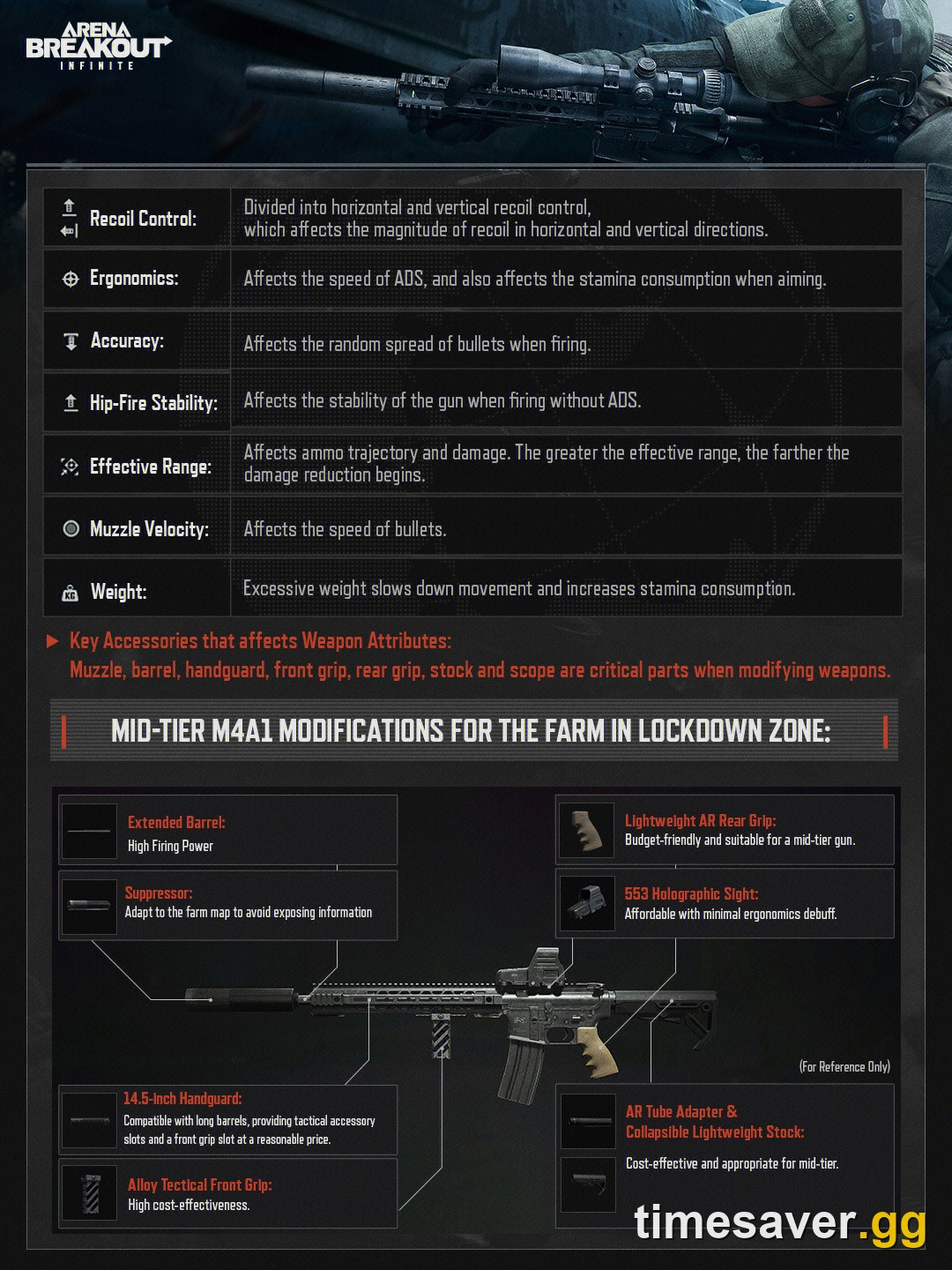
Arena Breakout: Infinite's own weapon-customization messaging describes gun attributes as recoil control, ergonomics and accuracy, with attachments used to "fine-tune these stats to fit your playstyle" (Arena Breakout: Infinite, official @ArenaBreakoutPC). In practice the customization screen separates handling into four readable numbers, and understanding them is the whole game:
- Vertical Recoil — how far the muzzle climbs upward during sustained fire. High vertical recoil is what pulls your shots over an enemy's head on the third or fourth round.
- Horizontal Recoil — how far the muzzle swings left and right. Horizontal recoil is harder to correct by pulling down, which is why it feels "random" to new players.
- Ergonomics — how quickly and smoothly you handle the weapon: ADS speed, how fast the sight settles, how little it sways while you hold aim. This is the stat that stability mods eat into.
- Accuracy — how tight the weapon's base spread is, most relevant for first-shot placement and single-fire at range.
You can read all four straight off the Weapon Assembly screen. A stock FAL Default Build, for example, shows V. Recoil Control 70, H. Recoil Control 66, Ergonomics 49 and Accuracy 27 — a gun that already handles recoil fairly well but has mediocre ergonomics and low base accuracy. That read-out tells you instantly where attachments will pay off (accuracy and handling) and where you'd be wasting weight (piling on even more recoil control).
The one rule that makes you better instantly. Every point of recoil control you buy tends to cost you ergonomics and weight. A perfectly stable brick that takes half a second to shoulder will lose a doorway fight to a twitchy carbine that's already on target. Build for the fight you expect, not for the prettiest stat bars.
As reputable extraction-shooter coverage puts it, you should "combine parts to tune a weapon to your engagement distance rather than adding every stability mod blindly" (Game Truth, Mechanics Explained, Season 7 notes checked October 4, 2026).
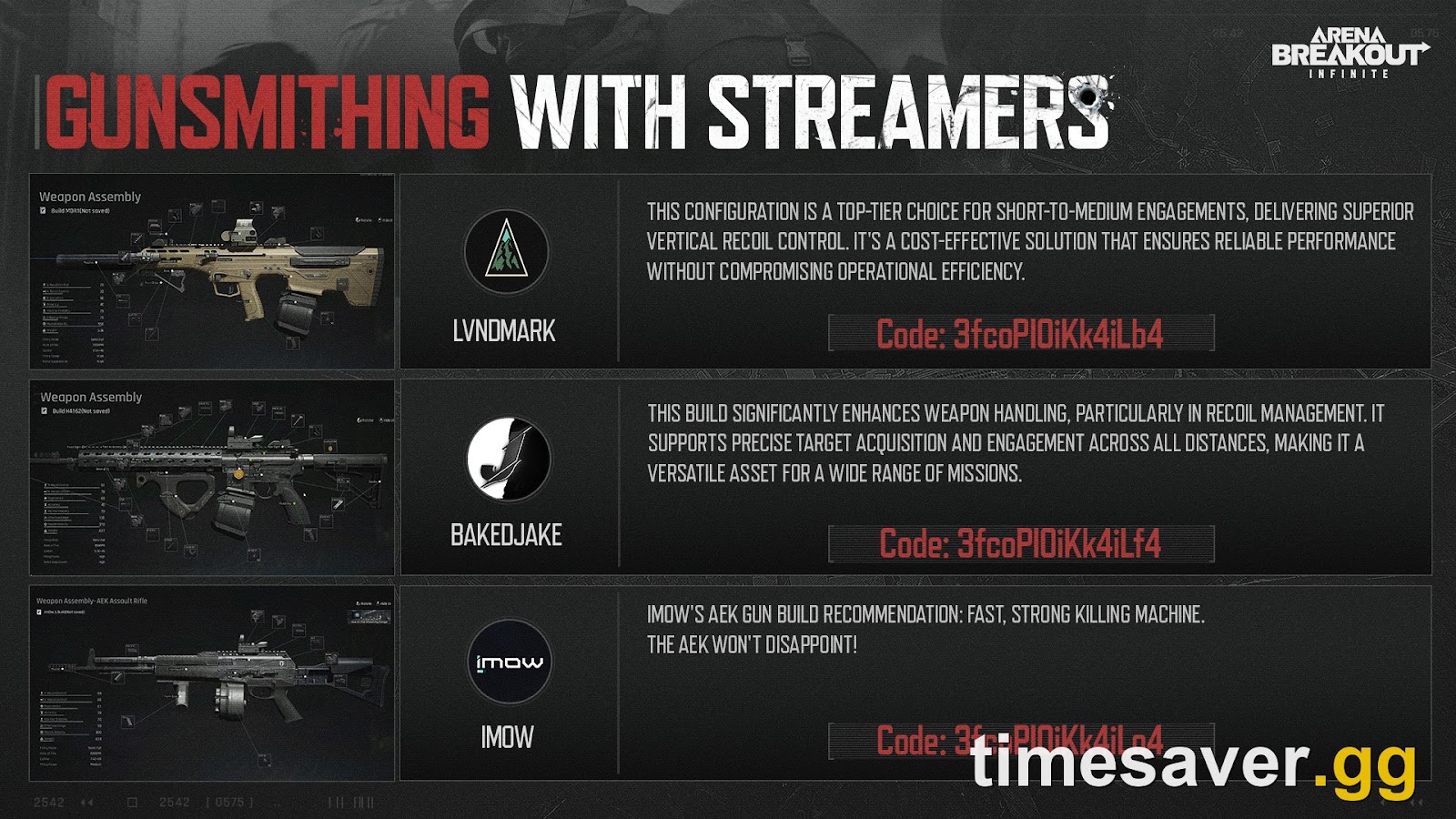
Attachment categories, slot by slot
Arena Breakout: Infinite advertises 75+ weapons, 900+ mods and 20+ attachment slots on its official Steam store page, so no two players' guns look identical. But the slots fall into a small number of jobs. Here is what each category is actually for.
Muzzle devices (compensators, muzzle brakes, suppressors)
The single most impactful recoil slot on most rifles.
- Compensators / muzzle brakes primarily shave vertical recoil, keeping the muzzle down during a burst. This is usually the first part you add to any full-auto rifle.
- Suppressors cut your sound signature and muzzle flash — a genuine advantage in solo raids where getting third-partied is the main way you die — and some also help recoil, but they add weight and can slow handling. Pair a suppressor with subsonic rounds when you want to stay quiet, and accept that you're trading some ergonomics for stealth.
- Barrels feed into this too: a longer barrel raises muzzle velocity (flatter shots, more reliable hits at range) and helps recoil, but adds length and weight; a short barrel trades some stability for faster handling in tight spaces.
Grips (vertical, angled, and horizontal control)
- Vertical and angled foregrips are your main tool against horizontal recoil — the hardest recoil to correct manually. If your sprays feel like they "wander" sideways, this is the slot to fix first.
- Grips also usually help ergonomics slightly compared with a bare rail, so they're one of the rare low-cost upgrades.
- Pistol grips and the handguard/rail you mount the grip on affect ergonomics and which other parts you can attach, so check the whole chain, not just the grip itself.
Stocks
- Stocks lower overall sway and recovery time — how fast your sight re-settles between shots and how little it drifts while you hold aim. A good stock is what turns a controllable gun into a laser on the second and third burst.
- The trade-off is weight and sometimes ADS speed. On a close-range SMG you may prefer a lighter, faster-handling stock (or a folded/short one) over maximum stability.
Optics
- Match magnification to range, not to looks. A red dot or low-power sight keeps ADS fast for close and mid fights; a higher-magnification scope is for Airport sightlines and Valley fields, where Season 7's increased effective ranges reward you for being able to actually see and hold a distant target.
- Some scopes are night-vision or thermal capable for dark-weather raids; those are situational and heavy, not a default.
Magazines, handguards and rails
- Extended or faster-reload magazines are quality-of-life and sustained-fire upgrades rather than recoil fixes, but a faster reload wins more fights than people admit in a mode where a single reload mid-fight can get you killed.
- Handguards and rails mostly exist to unlock other attachment slots and adjust weight/ergonomics — plan them as part of the whole build.
Three build templates to copy
These are starting points, not fixed shopping lists. Adjust to the exact weapon and to what you can afford on the Market or through barter trades.
Budget Normal-zone AR (keep it cheap, keep it fast)
Goal: win Normal-zone fights without sinking Koen you can't afford to lose.
- Muzzle: a basic compensator for vertical recoil.
- Grip: a cheap vertical or angled foregrip for horizontal control.
- Stock: whatever lightweight stock you own — prioritize ergonomics over squeezing out the last recoil point.
- Optic: red dot or iron sights.
- Skip the heavy, expensive stability parts. A budget kit's job is to be disposable and still functional — the same philosophy behind our best budget loadout.
Mid-range all-rounder (the one you'll use most)
Goal: a balanced rifle that holds its own from mid Normal to Lockdown.
- Muzzle: compensator or muzzle brake (vertical recoil).
- Grip: vertical foregrip (horizontal recoil).
- Stock: a full stock for sway and recovery.
- Barrel: standard or slightly longer for velocity if the weapon allows it.
- Optic: 1–3x or a low-power variable so you aren't blind at range but can still brawl.
- Feed it mid-tier ammo that matches the armor you expect — see the ammo and Pierce Level guide and the Season 7 best ammo breakdown.
Long-range Airport / Valley kit (lean into the S7 range buff)
Goal: control the long sightlines that Season 7's increased effective ranges opened up.
- Muzzle: a muzzle device that favors vertical control, plus a longer barrel for velocity and recoil.
- Grip: angled grip for horizontal stability on long holds.
- Stock: maximum stability stock — you want the sight to settle fast between precise shots.
- Optic: a higher-magnification scope.
- Accept the weight and slower ADS: this kit is for engagements you choose, not doorways you're surprised in.
How Season 7 changed what matters
Three Season 7: Utopia changes feed directly into attachment choices, and all three are from the official Steam announcements:
- Increased effective range. Weapons reach further, which rewards accuracy, velocity and the ability to hold a steady sight at distance — so barrels, stocks and optics gained value.
- Removed low-probability penetration against Class V/VI armor (the old T5/T6 "lucky pen RNG" is gone), with a durability threshold before consistent penetration. You can no longer count on a fluke round punching a top-tier plate, which makes landing your shots — i.e. recoil control — more decisive than hoping for an armor fluke. (See our headshot and helmet changes breakdown for the armor side.)
- Reworked recoil behavior on several weapons. Because individual guns were re-tuned, last season's "best attachments" muscle memory may no longer match the pattern on screen. Re-test your mains.
The takeaway: in Season 7 you win more fights by reliably hitting a target at the new longer ranges than by chasing exotic parts. Recoil control and a steady sight beat a gimmick build.
How to actually test a build (and beat the content farms)
The reason most online "best attachments" lists are useless is that they never tested anything on the current patch. You can do better in ten minutes:
- Go to the firing range with the exact weapon, ammo, optic and stance you'll raid with.
- Fire a burst without correcting first, to see the weapon's raw behavior. Then repeat while controlling it.
- Change one attachment, keep everything else identical, and compare. If you change two things at once you've learned nothing.
- Watch the impacts, not just the sight. A clearer sight picture is not the same as a tighter group.
- Don't force every assault rifle into the same "3-to-5-round burst" rule — shorten the burst until your follow-up shots stay on target, and that's your weapon's honest controllable length.
Practicing in a no-risk mode also means you're not learning recoil with your real kit on the line, which is the fastest way to lose gear you spent real time earning.
FAQ
What are the best attachments in Arena Breakout: Infinite? There is no single best set — it depends on the weapon and the range you fight at. For most full-auto rifles the two highest-impact slots are a muzzle device (compensator/muzzle brake) to control vertical recoil and a foregrip to control horizontal recoil, then a stock for recovery. Build around the four handling stats (vertical recoil, horizontal recoil, ergonomics, accuracy), not a copied parts list.
Does Arena Breakout: Infinite have vertical and horizontal recoil separately? Yes. The game tracks vertical recoil (muzzle climb) and horizontal recoil (left-right sway) as separate stats. Compensators and muzzle brakes mainly address vertical climb, while vertical/angled foregrips are your main tool against horizontal sway.
What is ergonomics in Arena Breakout: Infinite? Ergonomics is how quickly and smoothly you handle the weapon — ADS speed, how fast the sight settles, and how little it sways while aiming. Heavy stability attachments lower ergonomics and add weight, so a gun tuned purely for recoil can be too slow to shoulder in a close fight.
Is it worth putting a suppressor on your gun? In solo raids a suppressor is often worth it: it cuts your sound and muzzle flash so you're harder to locate and third-party, which is a leading cause of death when playing alone. The trade-off is added weight and some handling loss, and you'll usually pair it with subsonic rounds to stay quiet.
Did Season 7 change weapon recoil? Yes. The official Season 7: Utopia notes increased effective ranges and reworked several weapons' recoil behavior, alongside removing low-probability penetration against Class V and VI armor. If your mains feel different, re-test them in the firing range rather than trusting a pre-Utopia build.
Should I just copy a "best build" from a guide site? Use them as a starting point only. Many third-party sites publish untested parts lists or numbers that don't match the live patch. The firing range will always tell you the truth faster: change one attachment at a time on the current Season 7 build and watch where the rounds land.
Facts verified against the official Arena Breakout: Infinite Steam store page (app 2073620), the official @ArenaBreakoutPC weapon-customization messaging, and the Season 7: Utopia announcements (live September 16, 2026). Season 7 recoil, range and Class V/VI armor-penetration changes cross-checked October 15, 2026. Attachment stat relationships are game-mechanic descriptions, not per-part percentage claims. Looking for more? Browse our full library of Arena Breakout: Infinite guides.