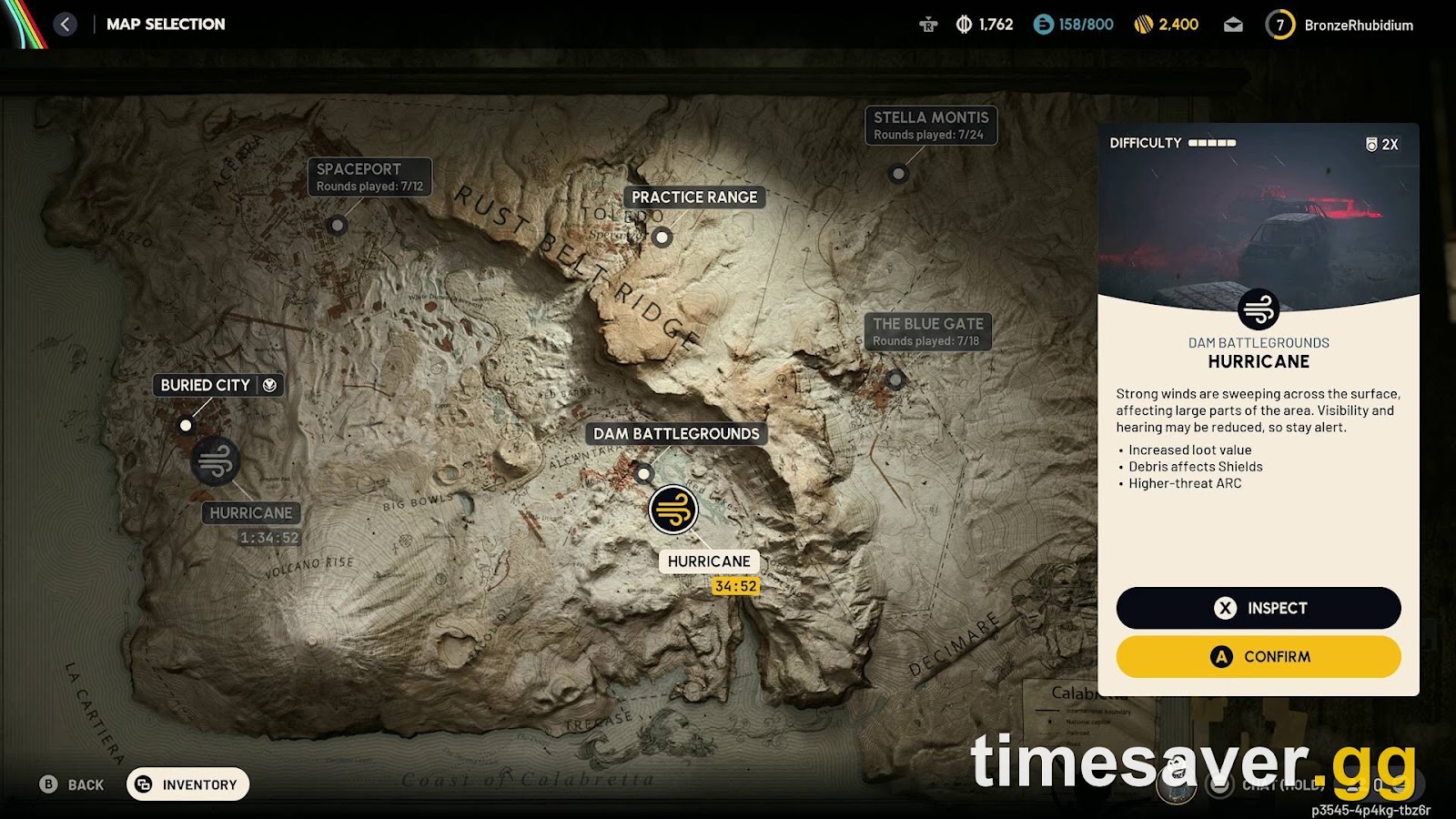
When a Hurricane rolls across Topside in ARC Raiders, the smart Raiders stop fighting and start farming. The storm's 2× loot modifier and its exclusive First Wave Caches turn a chaotic raid into the single best blueprint farm in the game right now — roughly 60% of First Wave Caches hold at least one weapon blueprint, including Tempest, Bobcat, and Vulcano.
This guide ranks exactly where to farm, how to spot a First Wave Cache by sound, what drops from them, and the "naked run" method squads are using to pull rare blueprints on repeat. Answer-first, then the full breakdown.
ARC Raiders - Blueprints
Get blueprints in 10 minutes
Quick answer: how to farm ARC Raiders Hurricane Caches
- What: First Wave Caches are upgraded Raider Caches that only spawn during the Hurricane map condition (added in the Shrouded Sky update).
- Where: They use regular Raider Cache spawn points on Dam Battlegrounds, Buried City, Blue Gate, and Spaceport (not indoor Stella Montis).
- How to find them: Listen for a rhythmic electric hum (not the normal mechanical tick). Turn on Night Mode in Audio Settings so it cuts through the wind.
- Why bother: ~60% contain a blueprint (Tempest, Bobcat, Vulcano, Bettina) plus tier-4 weapons like Renegade 4 and Anvil 4. The Hurricane also applies a 2× loot value modifier map-wide.
- Best strategy: The naked run — deploy with only Adrenaline Shots, grab a blueprint into your Safe Pocket, surrender, redeploy. Zero-loss blueprint farming.
First Wave Cache loot table (what actually drops)

First Wave Caches are visually bigger than normal Raider Caches and hold up to three full rows of loot. Based on community farming data since the Hurricane dropped, here is the realistic breakdown:
| Loot tier | Examples | Notes |
|---|---|---|
| Weapon blueprints (~60% of caches) | Tempest, Bobcat, Vulcano, Bettina | Bobcat blueprint appears to drop slightly more often than Tempest or Vulcano |
| Tier-4 weapons | Renegade 4, Anvil 4, Tempest 4 | High-tier guns straight out of the box — useful even on a naked run |
| Premium healing | Vitashots, Sterilized Bandages | Top-end recovery items |
| High-tier mods & attachments | Muzzles, stocks, mag mods | Same rarity bump as the rest of the cache |
Because roughly 60% of First Wave Caches carry a blueprint — and you can pull multiple blueprints in a single raid if you hit enough caches — the math is simple: the more caches you crack per run, the faster your odds compound. That is why cache farming, not PvP, is the correct Hurricane play.
Why this is the best blueprint farm in ARC Raiders
Before the Hurricane, several of these blueprints were locked behind specific, restrictive map conditions — Tempest and friends were tied to the likes of the Hidden Bunker and Locked Gate, meaning you needed the right condition on the right map and then still had to clear a defended location. First Wave Caches collapse all of that into one rotating event:
- Same blueprints, far more attempts. Instead of one gated bunker per raid, you get every Raider Cache marker on the map as a potential blueprint source.
- 2× loot everywhere. The map-wide modifier means even the loot you grab between caches is upgraded, so a "dry" cache run still pays.
- No key or condition dependency. You are not hunting a keycard or a specific locked room — you are just running caches. That is why it rewards volume and speed over careful, slow looting.
The takeaway: while a Hurricane is live, it is almost always your highest expected-value activity for weapon blueprints in ARC Raiders.
"Raiders have reported finding tier four weapons and rare blueprints… They are usually around a mass of debris and make a digital ticking sound. The Hurricanes have, for some reason, drawn more ARC to the locations, so watch your backs — even though you can't see them, they can definitely see you."
— In-game Hurricane briefing, ARC Raiders wiki
Where do First Wave Caches spawn in ARC Raiders?
First Wave Caches share the exact same spawn markers as regular Raider Caches, so any Raider Cache map already tells you where to look. The catch: not every marker spawns one. In practice, roughly 1 in every 5–10 Raider Cache markers actually contains a First Wave Cache in a given raid, and they are spread out rather than clustered — though players occasionally find two within ~100 m of each other, so never skip a nearby marker.
The Hurricane rotates across every outdoor map. Ranked by cache density (best farm first):
- Dam Battlegrounds — the highest Raider Cache density in the game. Open terrain lets you sprint between markers fast, and the Testing Annex area is a hotspot with multiple nearby spawns.
- Buried City — very high density with vertical layout; plenty of caches within short distances of each other.
- Blue Gate — lower density but viable if you spawn near a known cluster.
- Spaceport — lower density; workable when your drop-in lands close to markers.
- Stella Montis — the Hurricane does not hit this map because it is indoors. Skip it for cache farming.
How to identify a First Wave Cache by sound

The most reliable way to find caches in the storm is your ears, not your eyes:
- Regular Raider Cache: the familiar mechanical ticking/whine.
- First Wave Cache: a distinct rhythmic electric hum with a repeating pattern. Once you hear it a couple of times, it is unmistakable.
The wind is loud, so stack the odds:
- Go to Audio Settings → turn on Night Mode. It compresses the dynamic range and makes the cache hum pop over the storm.
- When you think you hear it, stop moving completely and listen. If the sound repeats in a pattern, it is a First Wave Cache.
- Turn side to side slightly to triangulate the direction, then follow it. Caches sit near masses of debris, so scan the rubble.
This audio method is far faster than visually checking every Raider Cache marker on the map.
ARC Raiders - Materials
Get materials in 10 minutes
How to survive the Hurricane map condition
Farming only pays off if you extract (or reset) alive. The Hurricane changes the rules Topside:
Take your shield off in the open
The storm's winds carry debris that collides with your shield, making it spark. Those sparks do two bad things: they broadcast your position to other Raiders, and they chip your shield's HP and durability. Out in the open, unequip your shield entirely — you trade protection for stealth and stop wasting shield charges.
The moment you get indoors, swap the shield back on. Quick-swap it by double-clicking the shield in your inventory (mouse), or pressing X (Xbox) / Square (PlayStation) with it highlighted.
Because most players run shield-off outdoors, open-field fights have a higher time-to-kill, and most real gunfights happen indoors — so bring a close-to-mid-range loadout for the Hurricane.
Ride the wind
The winds blow in one direction at a time. Move with the wind for a movement-speed boost (it also buffs jumping, sliding, and dodge-rolling); move against it and you get slowed. Check the wind on spawn, then chain caches that sit downwind so you cover ground faster. With the 2× loot modifier live, even unpopular locations are worth looting — you rarely need to sprint across the whole map.
Watch for extra ARC
Per the in-game briefing, Hurricanes draw more ARC to cache sites. Expect company at the good spawns, and remember other Raiders are hunting the same caches you are.
Best strategy: the naked run
The most efficient blueprint farm right now is the naked run:
- Deploy with almost nothing — just Adrenaline Shots. No augment, no weapon.
- You still keep your Safe Pocket, which is all you need to secure a blueprint.
- First Wave Caches drop tier-4 weapons (Renegade 4, Anvil 4), so you can arm up off the ground if a fight finds you.
- Found a blueprint? Pocket it, then surrender and redeploy — no need to spend time extracting.
- Landed in a picked-clean lobby? Surrender immediately and re-queue. Because you brought nothing, you lose nothing.
Naked runs turn blueprint farming into a near-zero-risk loop: you are only ever risking Adrenaline Shots, and every successful pocket is pure profit.
A clean 3-cache Dam Battlegrounds run
Here is a repeatable loop for the highest-density map:
- Spawn and read the wind. Note which way it is blowing and pick a cache marker that sits downwind for the speed boost.
- Shield off, weapon holstered. Sprint the open ground, stop near each debris field, and listen for the electric hum.
- Hit the Testing Annex cluster. Multiple markers sit close together here — check them all before moving on, since spawns can double up within ~100 m.
- Pocket and decide. Blueprint in the Safe Pocket? Surrender and requeue immediately. Nothing good after 2–3 markers? Same call — reset rather than risk the walk to extract.
- Repeat. Because you carry nothing, back-to-back resets cost you nothing but time, and the odds stack in your favor the more caches you open.
Turn Hurricane blueprints into gear, fast
Pulling a blueprint is step one — you still need the materials and workbench level to craft and upgrade it (a Bobcat blueprint means nothing until you can build a Bobcat IV). If you would rather skip the grind and jump straight to the finished kit, Timesaver has you covered:
Get the gear without the storm:
- ARC Raiders Blueprints — from $0.99 — 60+ blueprints, unlock rare weapons, fast & secure delivery
- ARC Raiders Materials — from $0.02 — every rarity, instant delivery, trusted
- All ARC Raiders services — carries, leveling, currency and more
Prefer to farm it yourself? Pair this with our Tempest blueprint location guide and Bobcat IV guide to know exactly what to do with the blueprints you pull, and read our ARC Raiders map conditions guide to know when the next Hurricane is coming.
Frequently Asked Questions
Should I bring a shield during a Hurricane in ARC Raiders? Not in the open. The storm's debris makes your shield spark, which gives away your position and drains its durability. Keep the shield off while outdoors and quick-swap it back on the moment you head inside, where most Hurricane gunfights actually happen.
What sound do First Wave Caches make? A rhythmic electric hum with a repeating pattern — clearly different from a regular Raider Cache's mechanical tick. Turn on Night Mode in Audio Settings, stop moving to listen, and turn slightly side to side to pinpoint the direction.
Which map is best for farming Hurricane caches? Dam Battlegrounds has the highest Raider Cache density and open terrain for fast movement, with the Testing Annex as a hotspot. Buried City is a strong second. Stella Montis never gets a Hurricane because it is indoors.
What blueprints drop from First Wave Caches? The pool includes Tempest, Bobcat, Vulcano, and Bettina, with roughly 60% of caches holding at least one blueprint. The Bobcat blueprint seems to appear a little more often than the others, but drops are otherwise random.
Is the naked run strategy actually worth it? Yes — it is the most efficient blueprint farm available. You deploy with only Adrenaline Shots, keep your Safe Pocket to secure any blueprint, and surrender/redeploy instead of extracting. Since you risk almost nothing, every blueprint you pocket is pure gain.
How long does the Hurricane condition last? The Hurricane is a rotating major map condition, not a permanent mode — it cycles across the outdoor maps rather than staying on one indefinitely. When it is active, prioritize cache farming; when it rotates off, come back for the next window.