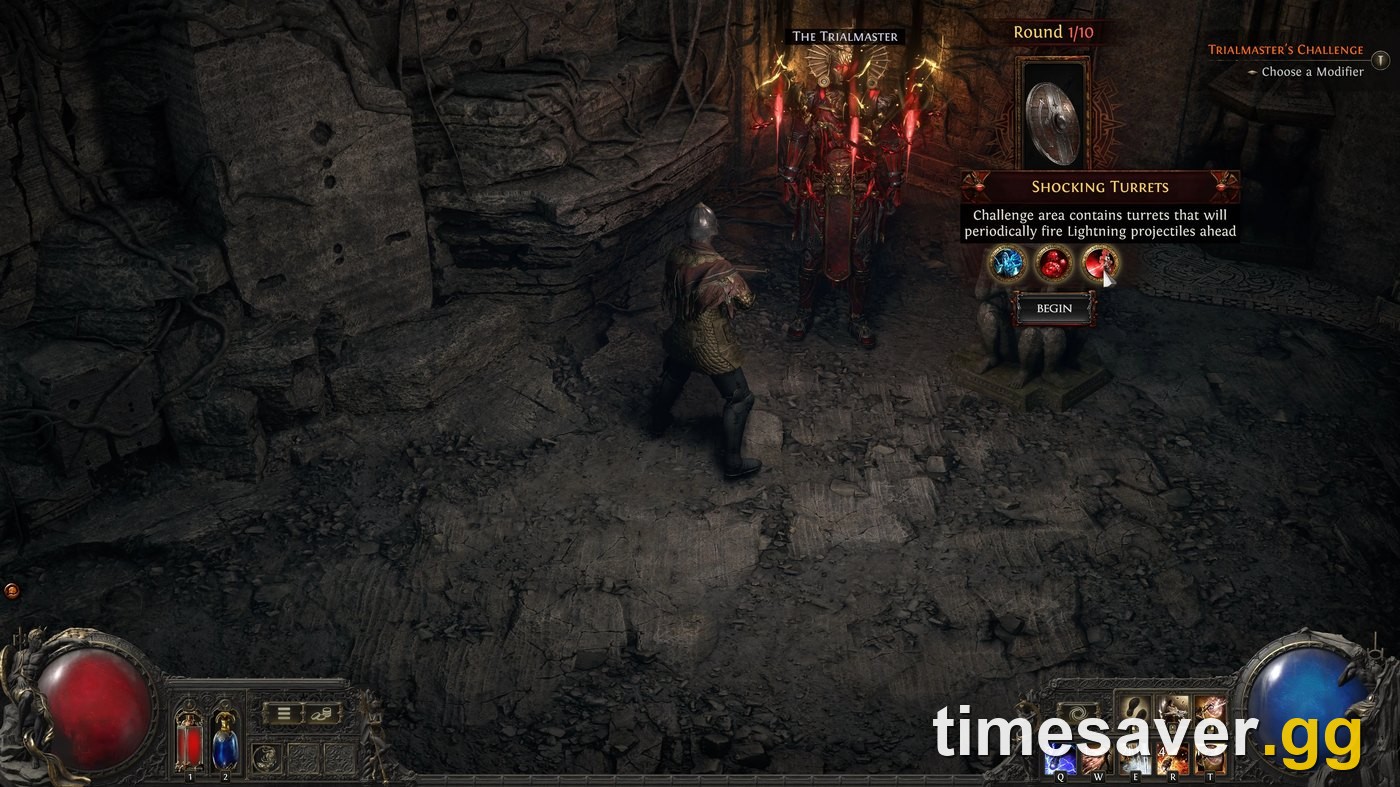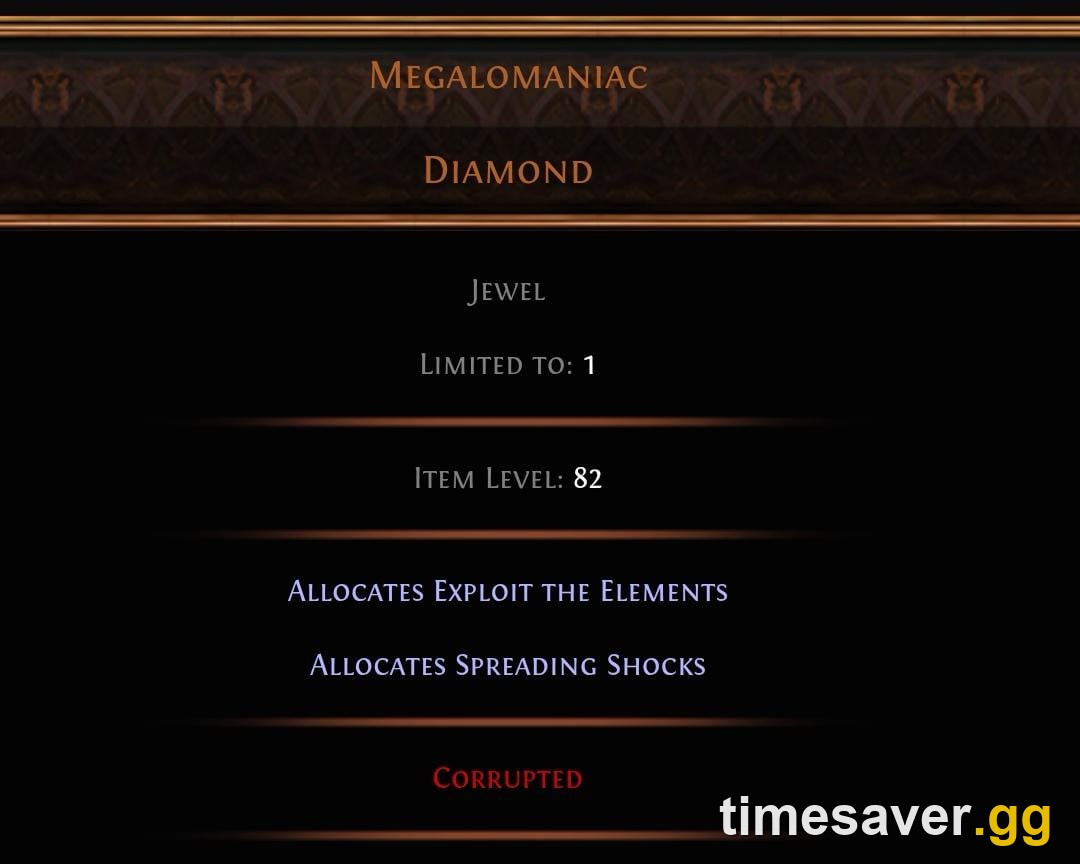
The Megalomaniac is the closest thing Path of Exile 2 has to a lottery ticket you can wear. It's a corrupted Diamond jewel that hands you 2–3 random notable passive skills for free — no travel points, no pathing, no cost beyond the socket. Roll the right three and you've effectively bought back 40–60 passive points. Roll the wrong three and it's worth less than a Regal Orb.
This guide covers exactly how to get one in 0.5 "Return of the Ancients," which notables actually matter, how to read a Megalomaniac before you buy it, and what a good one is really worth right now.

PoE2 - Divine & Exalted Orbs
Skip the grind — get Divine & Exalted Orbs
Quick answer: what is a Megalomaniac and how do you get it?
TL;DR — The Megalomaniac Diamond is a unique jewel that reads "Allocates 2-3 random notable passive skills" and is always Corrupted (you can never modify it). It only drops from the Simulacrum — PoE2's Delirium endgame encounter — from its bosses Omniphobia, Fear Manifest and Kosis, the Revelation. If you're grinding for another high-value Simulacrum drop, also check our guide on voices poe2 — it drops from the same encounter and is even rarer. It's Limited to 1, so you can only ever socket a single Megalomaniac. Its value is entirely down to the roll: a clean set of three meta-build notables can sell for hundreds of Divine Orbs, while an off-build roll is near-worthless. Higher Simulacrum difficulty (unlocked with Delirium Atlas points) improves your odds of a strong drop.
Three numbers to anchor on before we go deeper:
- 2–3 notables allocated per jewel (the in-game text caps it at three).
- 1 — the equip limit. You cannot stack two Megalomaniacs.
- ~5% community-reported drop chance per qualifying Simulacrum clear — rare, not guaranteed. Multiple players report double-digit high-wave runs with zero drops.
What exactly does a Megalomaniac do?
Straight from the in-game item (via poe2wiki):
"Megalomaniac Diamond — Limited to: 1 — Allocates 2-3 random notable passive skills — Corrupted. If you're going to act like you're better than everyone else, make sure you are."
Socket it into an allocated jewel socket on the passive tree and it immediately grants the effects of whatever 2–3 notables it rolled — as if you'd walked to each of those notables and spent the points yourself. You keep those points to spend elsewhere.
That's the whole pitch, and it's a big one. Notables in PoE2 are the fat, named passives (the ones with icons and multi-line text). Reaching three good ones on the tree can cost anywhere from a handful of points to 20+ each if they're buried in a far cluster. A Megalomaniac collapses all of that into one socket.
Two rules make it a gamble rather than a crafting target:
- It's Corrupted on drop. You cannot use a Vaal Orb, a Chaos Orb, or anything else to change the notables. What it drops with is what it is, forever.
- The notables are fully random. The jewel rolls from a wide pool of tree notables, and it does not care about your build. It can roll minion notables on a crit caster, or melee notables on a bow build.
Because of rule 2, most Megalomaniacs that drop are junk for you specifically — but a "junk for me" jewel can be a "perfect for someone else" jewel, which is why the trade market for them is huge.
How do you get a Megalomaniac in PoE2 0.5?
There is exactly one source: the Simulacrum. It is a drop-restricted item, meaning it cannot appear from normal map monsters, chests, or any other mechanic. Per poe2wiki's acquisition line, it "Drops in the Simulacrum" and nowhere else.

The Simulacrum is PoE2's Delirium endgame arena — a wave-based survival encounter you open with Simulacrum Splinters (combine 300 splinters into a Simulacrum). You fight through escalating waves of Delirium-fogged monsters to the boss encounters at the end. The Megalomaniac drops from the Simulacrum's Delirium bosses — Omniphobia, Fear Manifest and Kosis, the Revelation — not from the trash waves.
If you're new to running it, start with our full PoE2 Simulacrum farming guide for the splinter economy, wave strategy and boss mechanics — this article assumes you can already clear it.
Does higher difficulty give better Megalomaniacs?
Yes. You raise Simulacrum difficulty by spending Delirium Atlas passive points, which you earn by completing the Simulacrum. Each higher difficulty tier increases both the challenge and the reward quality — including the odds and quality of a Megalomaniac drop. In practice:
- Low difficulty: a Megalomaniac can still drop, but strong three-notable rolls are rarer.
- High difficulty: better shot at a clean, three-notable jewel — which is where all the value is.
If your goal is specifically to farm Megalomaniacs to sell, push Simulacrum difficulty as high as your build reliably clears, then farm volume. It's a volume game: at roughly a 1-in-20 drop rate, you're looking at many clears per jewel, and many jewels per good jewel.
Is a Megalomaniac the same as a From Nothing Diamond?
No — they're sister items, easy to confuse. From Nothing is also a corrupted, always-random Diamond, but it grants a random keystone (a build-defining passive) instead of notables, and it drops from a different source (the Ritual pinnacle fight, King in the Mists, on high Crux of Nothingness difficulty). Megalomaniac = 2–3 notables from the Simulacrum. From Nothing = one keystone from Ritual. Don't shop for one expecting the other. Another corrupted jewel category worth knowing: the PoE2 Undying Hate Timeless Jewel, which allocates five Abyssal keystones rather than random notables.
Which Megalomaniac notables should you chase?

This is the part that decides whether a jewel is a 300-Divine chase item or vendor trash. Because the roll is random, "best" always means best for a specific build, but a few principles hold across the board:
- Chase the notables you'd otherwise pay the most points to reach. The whole value of a Megalomaniac is points saved. A notable sitting one node off your path is barely worth anything; a notable deep in a far cluster you'd never realistically travel to is where the jewel prints value. As one veteran put it on the r/PathOfExile2 megalomaniac threads: saving 5–7 points is good, saving 60+ points is what makes the jewel disgusting.
- Damage and defense multipliers over flat stats. A notable that gives you a big increased or more modifier your build already scales (crit multi, a damage-type multiplier, life/ES %) is worth far more than a flat +attributes or utility notable.
- Two-of-three that matter is usually enough. A three-notable jewel where two notables are strong for your build and one is filler is still an excellent buy — you're getting two notables' worth of points back plus a real stat spread.
- Build-defining keystone-adjacent notables (the ones that gate a mechanic — e.g. a notable that enables an ailment, a conversion, or a big archetype lever) can be worth a fortune to the exact build that wants them.
The economic reality, straight from the trade market: "A Megalomaniac with 3 Notables which are useful for a meta build can be worth hundreds of Divine Orbs, whereas if a Megalomaniac only offers Notables that don't complement a build, it's worth less than a Regal Orb." Same item, two-hundred-Divine swing — all in the roll.

PoE2 - Items
Skip the grind — get Items
How do you read a Megalomaniac before you buy it?
A recurring, genuine question from players browsing trade: you can see the notable names on the jewel, but not what each notable actually does. Here's the fix.
- Open the trade listing in your web browser. The web version of the official trade site shows the full notable descriptions on hover — the in-game client is the one that only shows names. This is the single easiest way to vet a jewel before spending.
- Cross-reference on poe2db / poe2wiki. Search the exact notable name; both sites list what the notable grants and where it sits on the tree, so you can judge how many points it would have cost you to reach.
- Ignore the jewel's own name. Every Megalomaniac is called "Megalomaniac." The only thing that matters is the rolled notable list, so always read the mods, never the title.
For buyers, this turns Megalomaniac shopping into a "snipe" game: filter for the specific notable your build wants, sort by price, and grab the underpriced ones. Players routinely report picking up build-transforming Megalomaniacs for ~5 Divine Orbs simply because most sellers price them lazily.
Is a Megalomaniac worth buying, and what does it cost?
For most endgame builds, yes — if you buy the right roll, not a random one.
- As a buyer: target a jewel with the specific notable(s) your build needs and treat the extra rolled notables as a bonus. A well-sniped Megalomaniac is one of the best point-efficiency upgrades in the game — you're converting a modest currency spend into 20–60 reclaimed passive points. Because value is roll-dependent, prices range from a few Chaos (off-meta rolls) to hundreds of Divine (perfect meta three-stacks). Always price-check live on the trade site and poe.ninja before you commit — never trust a static number for a chase item.
- As a farmer: Megalomaniacs are a legitimate reason to grind high-difficulty Simulacrum, but understand the variance. At ~5% per clear and a random roll on top, most jewels you drop won't be your build's dream item — they're inventory to sell. The money is in volume + selling to other builds, then buying the exact roll you want with the proceeds. If you'd rather skip the grind entirely, a Simulacrum or boss carry gets you the clears, and stocking up on PoE2 Divine Orbs lets you buy the jewel you actually want outright.
The honest verdict: a Megalomaniac is a luxury point-efficiency item, not a starter upgrade. Get your build online first, then snipe one to squeeze 40+ free points out of the tree.
Get the currency and carries to chase it
You can't craft a Megalomaniac and you can't reroll it — you either grind high-tier Simulacrum for the drop or buy the exact roll you want. Both roads run on Divine Orbs and clear speed.
Skip the RNG grind — gear up fast:
- PoE2 Divine Orbs — instant delivery, best rate, buy the Megalomaniac roll you actually want
- PoE2 Currency (all orbs) — divine · chaos · exalted · more
- PoE2 Simulacrum & Boss Carries — skip the grind, farm the drops with pro players
- PoE2 Leveling — get to Simulacrum-ready endgame fast
Frequently Asked Questions
Where does the Megalomaniac drop in PoE2? Only in the Simulacrum, PoE2's Delirium endgame encounter. It's a drop-restricted item that comes from the Simulacrum's Delirium bosses (Omniphobia, Fear Manifest and Kosis, the Revelation), not from normal maps or waves. Higher Simulacrum difficulty — unlocked with Delirium Atlas passive points — improves your drop odds and roll quality.
Can you equip more than one Megalomaniac? No. The jewel is Limited to: 1, so you can only ever have a single Megalomaniac socketed at a time, no matter how many jewel sockets you have allocated. Buying a second one to double up is wasted currency.
Can you reroll or modify a Megalomaniac's notables? No. It always drops Corrupted, which means no Vaal Orb, Chaos Orb, Divine Orb or any other currency can change it. The 2–3 notables it rolled with are permanent — the only way to "reroll" is to get a different jewel.
How rare is a Megalomaniac? Community testing puts it around 5% per qualifying Simulacrum clear, with heavy variance — some players report ten or more high-wave runs with no drop. On top of that, the notable roll is random, so a good-for-your-build Megalomaniac is much rarer than the base drop rate suggests.
How much is a Megalomaniac worth? Entirely roll-dependent. A jewel with three notables that suit a meta build can sell for hundreds of Divine Orbs; one with notables nobody wants is worth less than a Regal Orb. Always check live prices on the official trade site and poe.ninja rather than trusting a fixed value.
How do I see what a Megalomaniac's notables actually do? In the in-game client you only see the notable names. Open the trade listing in a web browser to see full notable descriptions, or search the notable name on poe2db/poe2wiki. Vet the jewel this way before buying — it's the only reliable way to judge a roll.