Applies to Valheim patch 0.221.12 (default branch, released February 19, 2026). Valheim is still in Early Access; the full 1.0 release lands September 9, 2026 with the final Deep North biome, which Iron Gate's announcement promises will bring "new enemies to kill, bases to build and weapons to craft." Deep North build pieces are not yet confirmed. Building mechanics are stable across recent patches, but structural-integrity and comfort values below are pulled from the Valheim Wiki for the current 0.221.12 build — re-check them after 1.0.
Building is why a lot of people never put Valheim down. Iron Gate pitches it directly on the official site: "Raise your own viking mead halls, houses, castles, and more with our powerful construction interface. From knarrs to imposing warships, build legendary vessels to conquer the seas." But the interface has real rules underneath the fantasy — physics that make towers collapse, rain that rots your walls, and a comfort system that quietly decides how fast you heal.
This guide covers the mechanics that actually matter: how structural integrity works, which crafting stations unlock which materials, how to stop your base from rotting and getting flattened by trolls, and a build order that stops you from starting over three times. All numbers are for patch 0.221.12.
Quick answer: Valheim building in 60 seconds
- You build with the Hammer, and only inside the working radius of a Workbench. A Workbench costs just 10 wood and is the first thing to place at any new base.
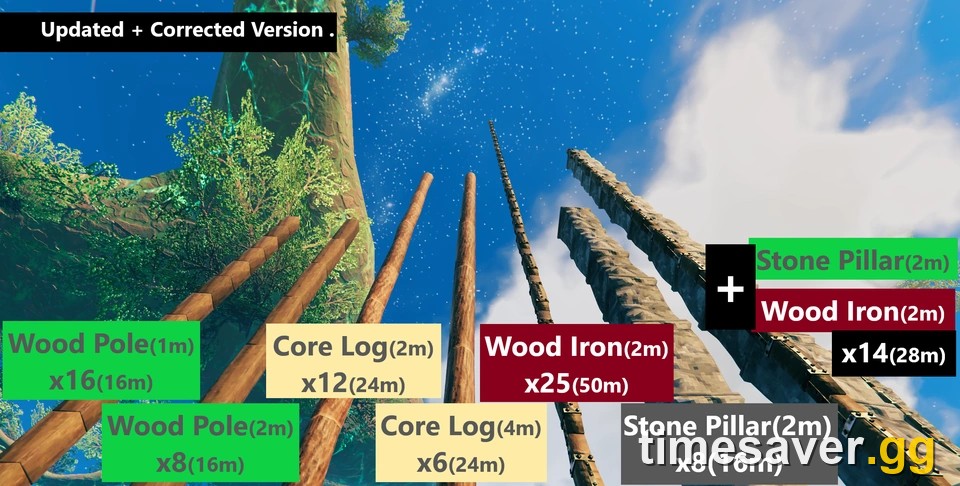
- Structural integrity is a support system, not a decoration. Every piece inherits stability from what holds it up. A vertical wood or stone pole can only rise 16m off the ground; a core-wood log pole reaches 24m; a wood-iron pole reaches 50m. Past that, nothing will stay attached above it.
- Stone is not stronger for height. It resists decay and weapon damage, but it gives no extra vertical stability than wood — height comes from iron cores, not stone.
- Rain rots wood down to 50% durability unless it's under a roof. Stone, black marble and crystal never decay.
- Comfort drives the Rested buff, which speeds up health and stamina regeneration. Furniture pushes comfort up to 17 normally (18 by a Maypole), stretching Rested from 8 minutes to about 24.
- Leave a gap around your walls. Trolls in raids will smash your house from outside a moat if your walls are too close.
How does building work in Valheim?
You build with the Hammer, and you can only place most pieces inside the working area of a Workbench. The Workbench is available from the very start and costs 10 ordinary wood, which is why it's the first structure every guide tells you to drop.
The core controls (mouse and keyboard):
- Right mouse opens the build menu.
- Q / E cycles between build-piece categories (walls, floors, roofs, furniture, and so on).
- Left mouse places the selected piece; middle mouse removes it (refunding the materials).
- Scroll rotates the piece.
- Hold Shift temporarily disables snapping for free placement; Shift + middle mouse copies the piece you're looking at so you can place more of it.
Every piece snaps to the ones around it by default, which is what makes clean, aligned builds fast. Turn snapping off with Shift only when you need to angle something manually.
What crafting stations do you need to build?
Materials in Valheim unlock in tiers, and each tier of building piece needs a specific crafting station nearby to place it. This is gated to the boss ladder — you can't build stone or metal structures until you've mined the ores those tiers require.
| Station | What it unlocks | How to build it | When you get it |
|---|---|---|---|
| Workbench | Most wood pieces (walls, floors, roofs, doors, basic furniture) | 10 wood | Immediately, from the start |
| Forge | Metal building parts and fittings | Requires copper | After you can mine and smelt copper (Black Forest) |
| Stonecutter | Stone walls, floors, pillars, arches | Requires iron | After you refine scrap iron from the Swamp |
| Artisan table | A handful of late crafting stations | Requires Dragon Tears | After beating Moder, the fourth boss |
The practical takeaway: your first base is all wood. Stone construction — the material most people picture when they think "Viking castle" — doesn't open up until you've cleared the Swamp for iron and can craft a Stonecutter. If you want to see the full biome-by-biome unlock path, our Valheim boss order guide lays out which boss gates which tier.
How does structural integrity work in Valheim?
This is the system that makes builds collapse, and the one most new players fight blindly. When you mouse over a placed piece with the Hammer, it shows a colour: blue means it's grounded — directly supported by terrain and essentially 100% stable. From there it runs blue → green → red, and the redder a piece is, the less stable it is. Try to attach a new piece to one that's fully red and the new part snaps off and drops its materials.
The rules that govern it:
- Stability is inherited. Every piece takes its maximum stability from whatever supports it. Attach to a piece that's 50% stable and the new piece can be at most 50% stable. Stability degrades the further a piece sits — horizontally and vertically — from a grounded anchor.
- Horizontal reach is the killer. A piece jutting far out to the side from its support loses stability fast; heavy stone placed off the side of a support often won't stick at all unless something holds it from directly below.
- Stone doesn't buy you height. Despite being a stronger material, stone pieces provide no more vertical stability than wood as a structure grows upward.
The hard ceilings on a purely vertical column, straight up from the ground:
| Support type | Max vertical height |
|---|---|
| Wood or stone (wall, pole, pillar) | 16 m |
| Core-wood log pole | 24 m |
| Wood-iron pole | 50 m |
Terrain and nature count as ground. Raising the earth under your floor with the Hoe so pieces highlight blue is the single most reliable way to make a big base stable — the floor and walls sitting on raised ground read as 100% grounded. Trees (including ones you plant) and boulders also count as terrain for support, which is how people build absurdly tall structures anchored to a trunk.
So the reliable recipe for anything tall: raise the terrain, run iron-core supports straight down to the ground by the shortest, most vertical path possible, and reinforce the top from directly below — not from the side.
How do you stop your Valheim base from rotting?
Wood decays. If a wooden piece is left uncovered in the rain, isn't linked to a roof, or is submerged in water, it rots down to a maximum of 50% durability and takes on a visibly weathered look until you fix it. That's not cosmetic — a decayed piece is weaker and more easily destroyed.
How to beat decay:
- Build the roof first. Get the roof and its supports up early so everything underneath is sheltered; a covered build can stand for days or weeks of in-game rain.
- Use decay-proof materials where it counts. Stone, black marble and crystal never decay, wet or submerged. That's a strong reason to run stone foundations and lower walls.
- Repair is free. Repairing with the Hammer costs no materials, only stamina — you just need to be in range of the matching station (Workbench for wood, Stonecutter for stone). Sweep your base with the Hammer occasionally and top everything back up.
Comfort and the Rested buff: why interiors matter
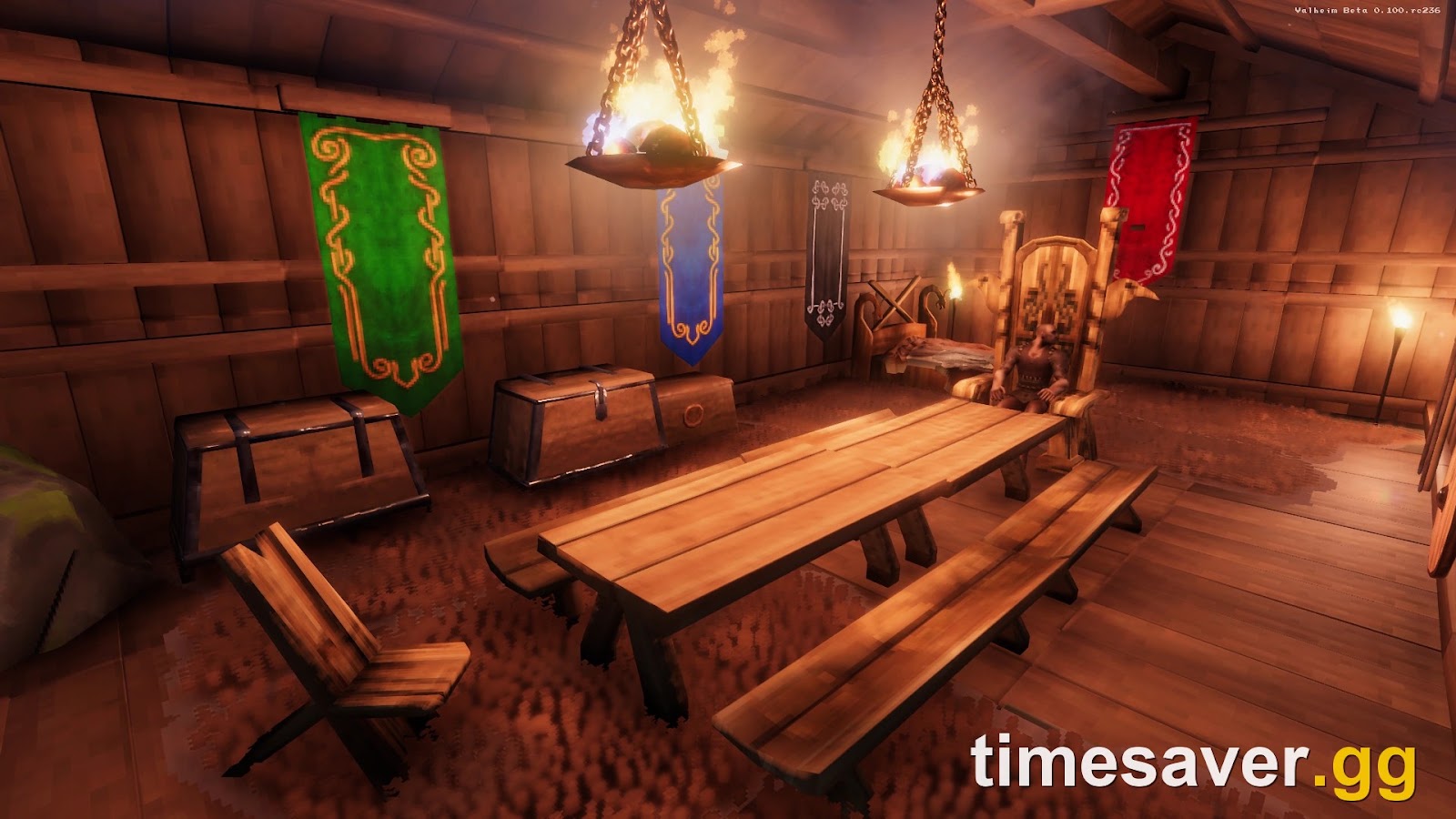
A pretty interior in Valheim isn't vanity — it's a stat. Furniture raises your comfort level, and comfort sets the duration of the Rested buff, which boosts your health and stamina regeneration. Sleep or sit in a comfortable, sheltered, warm room and you walk out regenerating far faster than a naked character in the rain.
The numbers, for the current build:
- Comfort 1 gives roughly 8 minutes of Rested; every extra comfort level adds about 1 minute, up to around 24 minutes with normal furniture (26 with rare seasonal items).
- The maximum comfort you can normally reach is 17; standing near a Maypole pushes it to 18, and the seasonal Yule tree to 19.
The catch that trips people up: only the highest-comfort item in each category counts. Two rugs don't stack — only the best rug gives its point. The same goes for fires, tables, chairs, beds and banners. So the way to max comfort is one of each category: a fire source (a Hearth gives 2, more than a plain campfire's 1), a rug, a table, a chair, a bed, banners, and so on — inside a shelter, near the fire. Pair a high-comfort room with strong food and your regen and effective survivability climb together; our Valheim best food guide covers the other half of that equation.
How do you defend a Valheim base from raids?
Bases get attacked. Once you've killed a boss, the world periodically throws raids at you, and the early ones — troll raids in particular — are what flatten first-timers. Trolls hit hard and have long reach, so a wall right up against your house is no protection: a troll standing at the edge of your defences can swing a log and knock the building down from outside.
The fixes players learn the hard way:
- Keep a buffer. Leave a healthy gap — many experienced builders use roughly 8–10 metres — between your outer defensive wall or moat and any actual building, so ranged and reaching enemies can't damage your structures from the perimeter.
- Dig a moat. A dug earth trench is the most reliable defence in the game — most ground enemies can't cross or climb it, and it costs nothing but time with the Pickaxe.
- Stake walls and raised earth stack on top of the moat for enemies that jump or fly, and give you a shooting platform.
- Mind what biome you settle near. A base on a Meadows/Black Forest border is convenient early; parking your home base inside the Plains before you're geared invites Fuling and deathsquito raids you can't yet handle.
A step-by-step base-building workflow
New builders start with walls and end up demolishing everything when the roof won't line up. A cleaner order, drawn from how experienced builders on the Valheim community actually work:
- Lay the footprint. Place floors (and 1×2 walls as a measuring guide) to mark out the full outline before committing to anything vertical. A common trick is a stone footprint, which lets you attach smooth wood walls on both sides and gives windows real depth.
- Raise the terrain under the footprint with the Hoe until the floor reads blue/grounded — do this before you build up, not after.
- Frame the roof supports. Decide your pillar and beam layout now; if there are multiple floors, sort your stairs at this stage because they dictate everything above.
- Put the roof on early so the interior is sheltered against decay from day one.
- Add heat and smoke management. Place your Hearth or fire and make sure smoke can escape through a hole or chimney, or you'll take smoke damage indoors.
- Fill in floors, furniture and storage last — this is where you chase comfort for the Rested buff and lay out chests. A storage wall accessible from both sides (workshop on one side, kitchen on the other) is a neat, popular layout.
Building for Valheim 1.0 and the Deep North
With 1.0 arriving September 9, 2026, a lot of players are wondering whether their base and world survive the update. Per Iron Gate's official 1.0 FAQ, your old saves stay exactly where they are and you can keep playing them — a new world is recommended, but not required, and the new Deep North content generates in unexplored areas of the far north. Zones you've already fully explored won't retroactively change.
That means your existing base is safe. The sensible prep is simple: back up your world file before September 9 (`%USERPROFILE%/AppData/LocalLow/IronGate/Valheim` on Windows), and if you want the cleanest Deep North experience, leave the northern reaches of your map unexplored so the new biome can generate there. For the full breakdown of what carries over, see our Valheim 1.0 and Deep North save-carryover guide. If you're just starting out, the Valheim beginner's guide covers your first hours before you commit to a permanent base.
Frequently Asked Questions
Why does my Valheim base keep falling down? Because a piece exceeded its structural support. Stability is inherited and drops the further a piece sits from grounded terrain — and pure wood or stone can only rise 16m vertically before it stops supporting anything above. Fix it by running iron-core support poles straight down to the ground, raising the terrain under the build so the base reads blue (grounded), and reinforcing the tallest points from directly below rather than off to the side.
Is stone stronger than wood for building in Valheim? For durability, yes — stone resists weapon damage and never decays in rain. But for height and stability, no: stone provides no more vertical support than wood. Tall builds get their height from core-wood log poles (24m) and especially wood-iron poles (50m), not from stacking stone.
How do I stop my wooden buildings from rotting? Keep wood under a roof and out of standing water — exposed wood decays to 50% durability. Build the roof and supports first so the interior is sheltered from the start, use stone, black marble or crystal for parts that must sit in the open, and sweep the base with your Hammer to repair (repairing costs stamina but no materials).
How do I raise my comfort level for the Rested buff? Place one item from each comfort category inside a sheltered, warm room — a fire source (a Hearth counts as 2), plus a rug, table, chair, bed and banners. Duplicates in the same category don't stack, so variety is what raises the number. Max comfort is normally 17 (18 by a Maypole), which stretches Rested to around 24 minutes.
How do I protect my base from troll and enemy raids? Dig a moat, and — critically — leave roughly 8–10 metres between your outer wall or moat and any building, so trolls can't reach in and smash your structures from the perimeter. Add stake walls and raised earth for flyers and jumpers, and don't build your main base inside a high-tier biome like the Plains before you're geared for it.
Will my base and world survive the Valheim 1.0 update? Yes. Iron Gate's official 1.0 FAQ states your old saves stay where they are and you can keep playing them; a new world is recommended but not required. The Deep North generates in unexplored northern zones, so already-explored areas stay as they were. Back up your world file before September 9 as a precaution.