In Path of Exile 2, currency is your power. Every meaningful upgrade — a better weapon, a clutch crafting hit, a build-enabling unique — is bought or crafted with orbs. So the players who climb fastest aren't the ones who grind the longest; they're the ones who farm currency efficiently and know exactly which orbs to spend, hoard, or trade.
This guide covers the whole loop: what each currency actually does in PoE2, the highest-profit farming methods at every stage, how to turn a stash full of junk into Divine Orbs, and the quiet mistakes that bleed your currency away. No fluff — just what moves your stash tab.
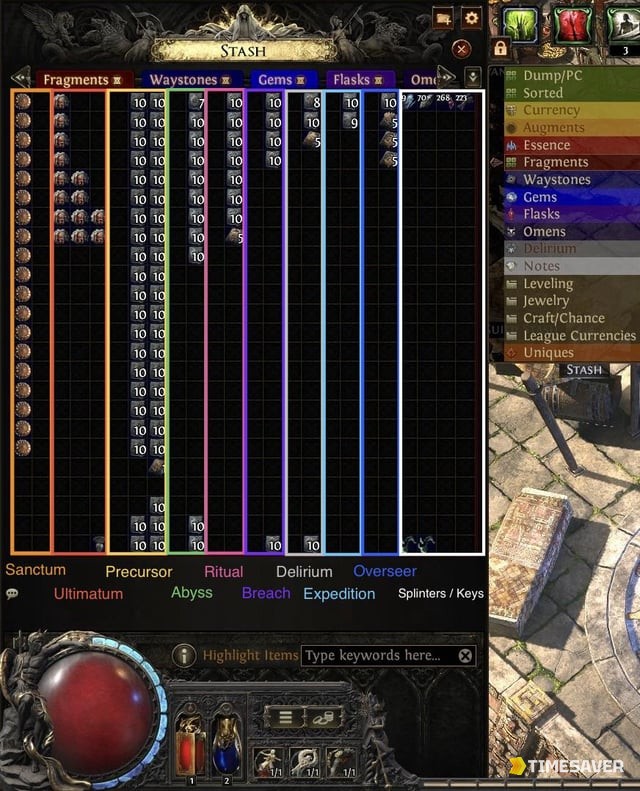
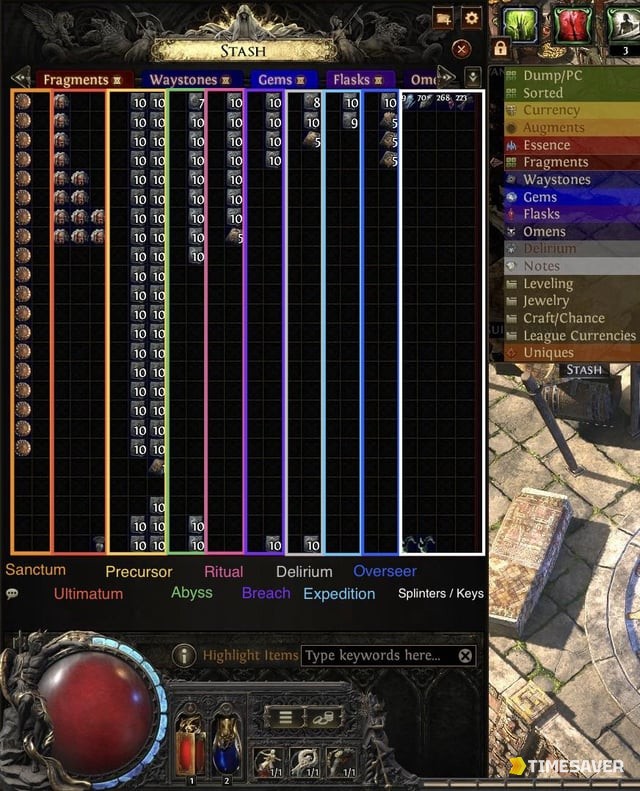 A well-organized PoE2 currency stash — the league mechanics down the side (Abyss, Breach, Expedition, Ritual) are exactly where the farming happens. (Image: r/PathOfExile2, u/tmncx0)

PoE2 - Divine & Exalted Orbs
Skip the grind — get Divine & Exalted Orbs
PoE2 currency that actually matters
PoE2's economy runs on a handful of orbs. Know these cold before you farm, because the farming is only half the game — using and trading currency correctly is the other half.
| Currency | What it does | How to treat it |
|---|---|---|
| Exalted Orb | Adds one new random modifier to a Rare item. The everyday crafting + trade baseline currency (PoE2's common denominator). | Your "cash." Most trades are priced in Exalted. Spend on crafting, keep a working stack. |
| Divine Orb | Rerolls the numeric values of an item's existing modifiers. High-value. | The "savings account." Worth roughly 80–90 Exalted each (rate fluctuates — check poe.ninja). Sell into them to store wealth. |
| Chaos Orb | Removes one random modifier from a Rare and adds one new random modifier. | Targeted crafting + fractional trade currency (~a few Exalted). Don't hoard blindly. |
| Regal Orb | Upgrades a Magic item to Rare, adding a modifier. | Crafting stepping-stone. |
| Orb of Alchemy | Upgrades a white (Normal) item to Rare. | Used heavily to roll Waystones for mapping. |
| Vaal Orb | Corrupts an item for a high-risk, high-reward outcome. | Gambling currency — use deliberately. |
| Mirror of Kalandra | Creates a perfect copy of an item. | The lottery ticket. You'll trade, not drop, these. |
The mental model: Exalted = spending money, Divine = stored wealth, everything else = crafting tools. Farming is the act of converting your time into these orbs as fast as possible.
The 3 golden rules before you farm a single map
Most "I can't make currency" problems aren't a farming-method problem — they're an efficiency problem. Fix these first:
- Run a tuned loot filter. A strict filter is the single biggest currency multiplier in the game. It hides the trash so you instantly see the drops worth picking up. Farming without one means you're either grabbing garbage or walking past Exalted.
- Clear fast, then move on. Currency-per-hour beats currency-per-map. A map you blitz in 3 minutes at slightly lower yield out-earns a 9-minute slog you "fully cleared." Speed compounds.
- Decide trade vs. craft before you use an orb. Dumping Exalted into a random rare "to see what happens" is how new players stay broke. If you're not crafting toward a specific, sellable outcome, bank the currency instead.
Best PoE2 currency farming methods (endgame)
Once you're mapping the Atlas, these are the highest-return strategies — roughly ordered from lowest-investment/low-variance to higher-investment/higher-ceiling.
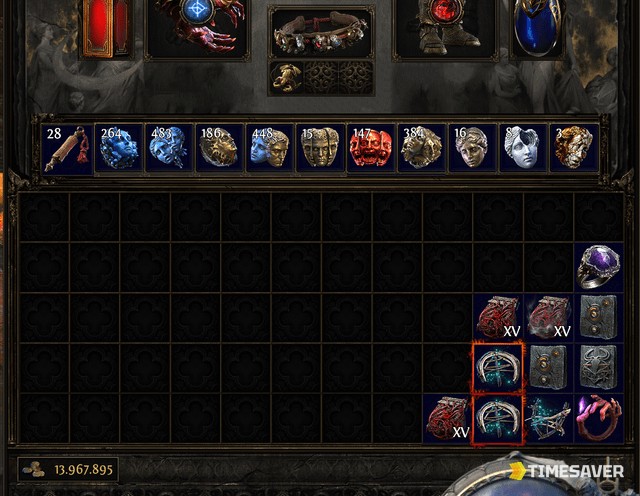 Currency and Soul Cores stacking up from efficient mapping — the gold counter bottom-left funds respecs and vendor flips. (Image: r/PathOfExile2, u/v1ns)
1. Strongboxes — the best "set and forget" farm
Strongboxes are the most reliable beginner-to-mid farm: low investment, low variance, steady Exalted. Build your Atlas tree toward Strongboxes, run Ambush support on your maps, and corrupt boxes for extra juice. You can comfortably farm these the moment you can clear low-tier maps, and the income is consistent rather than swingy. It's the method that quietly funds your first Divines.
2. Abyss — rare-monster density that double-dips
Abyss spawns dense packs of rare monsters, and currency rewards scale with rare-monster modifiers and pack size. If you build your Atlas around buffing rares, Abyss double-dips — more rares, each worth more. It's been a dependable currency engine in the franchise for years and remains one of the strongest density farms in PoE2.
3. Pick ONE league mechanic and specialize
Breach, Ritual, Expedition, and Delirium are all viable, but spreading your Atlas thin across all of them is a trap. Specialize your passive tree into one mechanic you enjoy and can run fast:
- Breach — raw monster density and splinters; great for build that clear packs instantly.
- Ritual — reroll for valuable rewards; strong for deterministic, high-value buys.
- Expedition — vendor-based, lets you target-buy specific currency and crafting bases.
- Delirium — high risk, high reward; scales hard with clear speed.
Going deep on one mechanic means more juice per map and a cleaner Atlas tree than dabbling in four.
4. The vendor / Chaos recipe — steady baseline income
Selling a full set of unidentified Rare items (item level 60–74) to a vendor returns Chaos Orbs — a steady, AFK-proof income floor that runs in the background while you farm everything else. Always identify rares worth selling individually, but funnel the dross into recipes instead of vendoring for nothing.
5. Bosses, Trials & Soul Cores
Map bosses, pinnacle bosses, and the Trial of the Sekhemas (Ascendancy) drop high-value uniques and crafting materials. Boss-rushing is a higher-skill farm, but a single good unique or boss-exclusive drop can be worth more than an hour of mapping. Learn the fights you can do safely and fold them into your route.
6. Off-Atlas income that runs in the background
Not all currency comes from killing things. Two passive streams every farmer should run:
- Vendor recipes — beyond the Chaos recipe, specific base + quality combinations return useful currency. Funnel your unsellable rares here instead of dropping them on the floor.
- Gold-funded flipping — gold isn't just for respecs; use it to buy out underpriced bulk currency and resell, especially early in a patch when prices are still settling.
How much currency can you actually farm?
Setting expectations matters, because "make currency fast" means different things at different gear levels. As a rough benchmark, community testing of a focused Strongbox setup (around 100 low-tier maps with Ambush support) has produced on the order of 140+ Divine equivalents after vendoring and quick sales — but that assumes a tuned Atlas, a strict filter, and fast clears. A fresh character with a half-built Atlas earns a fraction of that.
The takeaway: your currency-per-hour scales with your gear and Atlas investment, not just the method. The first stack is the slowest; every upgrade you buy makes the next stack faster. That compounding curve is exactly why so many players choose to skip the slowest early stretch entirely.
Early-game currency (Acts 1–3)
You won't farm Divines while leveling — and you shouldn't try. Early on:
- Gold matters more than orbs: it funds vendor buys and passive respecs, so don't overspend it.
- Pick up and sell early orbs, but save your Exalted and Regal for a deliberate craft once you hit maps, not random campaign gear you'll replace in an hour.
- Use Orbs of Alchemy to roll Waystones the moment you reach the Atlas — that's where real currency farming begins.
The campaign's job is to get you to maps efficiently. The fastest players treat Acts 1–3 as a sprint to endgame, not a place to grind.
Turning drops into Divine Orbs (trading)
Farming generates a messy pile of low-value currency and items. Converting that into Divine Orbs (stored wealth) is the step most players neglect:
- Price-check on poe.ninja before you sell anything. It's the live economy — it tells you the real Exalted/Divine value of every orb and unique.
- Bulk-sell low-value currency (Chaos, splinters, fragments) in stacks rather than one at a time. Your time is the cost; batch it.
- Flip toward Divines. As your Exalted pile up, convert into Divines so your wealth is compact and stable instead of sitting in a hundred tabs of fractional currency.
- Sell uniques/bases individually when poe.ninja shows real demand — that's where the big single hits come from.

PoE2 - Items
Skip the grind — get Items
Common currency-farming mistakes to avoid
- No loot filter (or a loose one). You're leaving currency on the floor, literally.
- Over-clearing maps. Currency/hour is the metric. Blitz and move.
- Gambling Exalted into random rares. Craft toward a sellable goal or bank it.
- Hoarding Chaos and fragments. Convert to Exalted/Divine on a schedule; don't let wealth rot in fractional currency.
- Spreading the Atlas across every mechanic. Specialize. Depth beats breadth.
- Skipping poe.ninja. Selling blind means selling cheap.
Why your currency stack decides how far you climb
Here's the uncomfortable truth of PoE2: the endgame is gated by currency. The best gear, the perfect crafted weapon, the build-defining unique — they exist on the trade market right now, priced in Divines and Exalted. Players stall not because they lack skill, but because they lack the stack to buy the upgrade that unlocks the next tier of farming. Currency is the flywheel — more currency buys better gear, which farms currency faster.
That's exactly why so many players skip the slow part. Farming a stack of Divines from scratch is dozens of hours of mapping; buying the currency to gear up instantly turns a week of grind into an evening of actually playing the endgame you're here for.
Gear up faster — Timesaver PoE2 currency & services
Skip the grind and spend your time playing, not farming:
- PoE2 Divine Orbs — instant delivery, best rate, trusted
- PoE2 Exalted Orbs — fast & secure, the crafting + trade baseline
- PoE2 Currency (all orbs) — divine · chaos · exalted · and more
- PoE2 Leveling & Boss Carries — skip the campaign grind, jump straight to mapping
Stock the stack, buy the upgrade, and farm the next tier twice as fast.
PoE2 currency farming FAQ
What's the fastest way to make currency in PoE2? Efficient Atlas mapping with a strict loot filter, specialized into one league mechanic (Strongboxes and Abyss are the most reliable starting points), while a vendor/Chaos recipe runs in the background. Speed and specialization beat slow full-clears.
How many Exalted Orbs is a Divine Orb worth in PoE2? Roughly 80–90 Exalted per Divine, but the rate fluctuates constantly — always check poe.ninja for the live value before trading.
What does a Chaos Orb do in PoE2? It removes one random modifier from a Rare item and adds one new random modifier — a targeted crafting tool, and a fractional trade currency worth a few Exalted.
Should I use or trade my Divine Orbs? Treat Divines as stored wealth. Use them to buy finished upgrades or save them; only spend them rerolling values on an item you're certain is worth perfecting.
What's the best currency farm for beginners? Strongboxes. Low investment, low variance, steady income the moment you can clear low-tier maps — the method that funds your first real upgrades.
Do I need to trade to make currency? Yes — trading is how you convert a messy pile of drops into compact, stable wealth (Divines). Price-check on poe.ninja and bulk-sell to make it efficient.
Sources: PoE2 currency mechanics verified against official Path of Exile 2 material and community resources (Maxroll, poe.ninja); topic surfaced via r/PathOfExile2. Prices are ranges — check poe.ninja for live values. Gear up faster at Timesaver.gg.