Updated July 2026 — verified through patch 0.5.4 "Grand Expedition" (launched June 24, 2026). The core Atlas system (Waystones, Towers, Tablets, 301 passive points, Atlas Masters) is unchanged from 0.5.0. The major 0.5.4 addition is a dedicated Expedition Atlas Passive Skill Tree and the Liquid Verisium currency — if you're running Expedition, check our PoE2 0.5.4 Expedition farming guide for the updated tree allocation.
The campaign is the tutorial. The Atlas of Worlds is the actual game — and in 0.5 "Return of the Ancients" (live since May 29, 2026) it's bigger than ever: 301 Atlas passive points you can fully allocate, a reworked Tower-and-Tablet system, and the new Atlas Masters that bolt an Ascendancy-style choice onto your endgame. Get the Atlas right and every map prints Waystones, currency, and Divine Orbs. Get it wrong and you stall out at low tiers, run dry on Waystones, and grind for hours with nothing to show.
This guide is the whole endgame in one place: how Waystones, Precursor Towers, and Tablets work, how to spend the 301-point Atlas passive tree, which Master to pick, and the exact mapping loop that takes you from your first map to T16 while stacking currency the whole way. No filler — just the path.

PoE2 - Divine & Exalted Orbs
Skip the grind — get Divine & Exalted Orbs
What the Atlas of Worlds is
Finish the campaign and you unlock the Atlas of Worlds: an ever-expanding web of map nodes you clear one at a time. Completing a map reveals the nodes connected to it, so the Atlas grows outward as you play. Two things make it the heart of PoE2:
- It's where all the currency is. Maps drop the Waystones, currency, and rare items that fund your build and your trades. The campaign barely scratches the economy; the Atlas is the economy.
- Death is punishing. Each map gives you a limited number of portals. Die and you lose a portal — lose them all and the map closes for good, with any extra objectives gone. PoE2 endgame is a survival check, not just a DPS check. Build defenses before you push tiers.
The goal of the entire system: push map tiers higher (better drops), force the mechanics you farm onto your maps, and funnel everything toward the pinnacle bosses. Key 0.5 numbers to anchor your plan: the Atlas holds 301 allocatable passive points; Waystone tiers run I–XVI (T16 requires corrupting a T15 with a Vaal Orb); each Precursor Tower broadcasts Tablet buffs across a radius of roughly 10–15 map nodes; and a focused Ritual or Expedition build typically reaches T15+ self-sustain within 2–3 hours of first mapping on a functional build.
Waystones: the fuel of the Atlas
You don't just walk to the next map — you open it with a Waystone. Waystones are the single most important resource in early endgame, because running out means you can't keep mapping. They come in tiers:
| Waystone tier | Rarity | Map level band |
|---|---|---|
| I–V | White | Early maps |
| VI–X | Yellow | Mid tiers |
| XI–XV | Red | High tiers (endgame) |
| XVI | — | Only by corrupting a Tier XV Waystone with a Vaal Orb |
Every modifier you add to a Waystone raises the map's difficulty and its rewards — more pack size, item rarity, and quantity. You can craft Waystones with currency (augment, regal, exalt them) to juice the drops, exactly like crafting gear. The catch: harder maps kill you faster, so scale modifiers to your build's defenses.
The #1 early-endgame rule: don't run out of Waystones before you reach the red tiers. The whole early Atlas tree is built around sustaining and upgrading your Waystone drops so you climb tiers instead of falling back down. More on which nodes do that below.
Precursor Towers & the Fortress
As you explore the Atlas you'll find Precursor Towers — special map nodes that, once completed, reveal a large region around them. Towers do two jobs:
- Reveal the map. Clearing a Tower lights up a big chunk of the Atlas so you can plan your route instead of crawling node by node.
- Broadcast Tablets. A Tower is where you slot Tablets to apply mechanics to every map in its radius (see below). This is how you farm a specific mechanic on purpose instead of hoping it spawns.
The first Tower you complete also reveals a nearby Precursor Fortress — the central endgame questline location. Inside the Fortress you hunt three keys, which unlock the Arbiter of Ash, and beyond it the Arbiter of Divinity, PoE2's ultimate endgame boss. Clearing the Fortress chain opens up Citadels and special modifier maps — the deepest layer of the endgame.
Tablets: forcing the mechanics you farm
Tablets (Precursor Tablets) are consumables you slot into a Tower to inject mechanics — Ritual, Delirium, Breach, Expedition, and more — into all maps within that Tower's radius. This is the core of intentional farming:
- Stack one mechanic. Slot multiple Ritual Tablets into a Tower and every map in range is guaranteed a Ritual. Want to farm Omens? This is how you run Ritual back-to-back instead of once an hour.
- They're self-reinforcing. The more you commit to a mechanic, the more of its Tablets drop — so a focused farm snowballs its own supply.
- They craft like Waystones. Tablets support up to 4 modifiers; better-rolled Tablets mean stronger mechanics across the radius.
The pro pattern: pick one money mechanic, build your Atlas tree around it, and stack its Tablets in the Tower covering the maps you'll run. Specialization beats spreading thin every time.
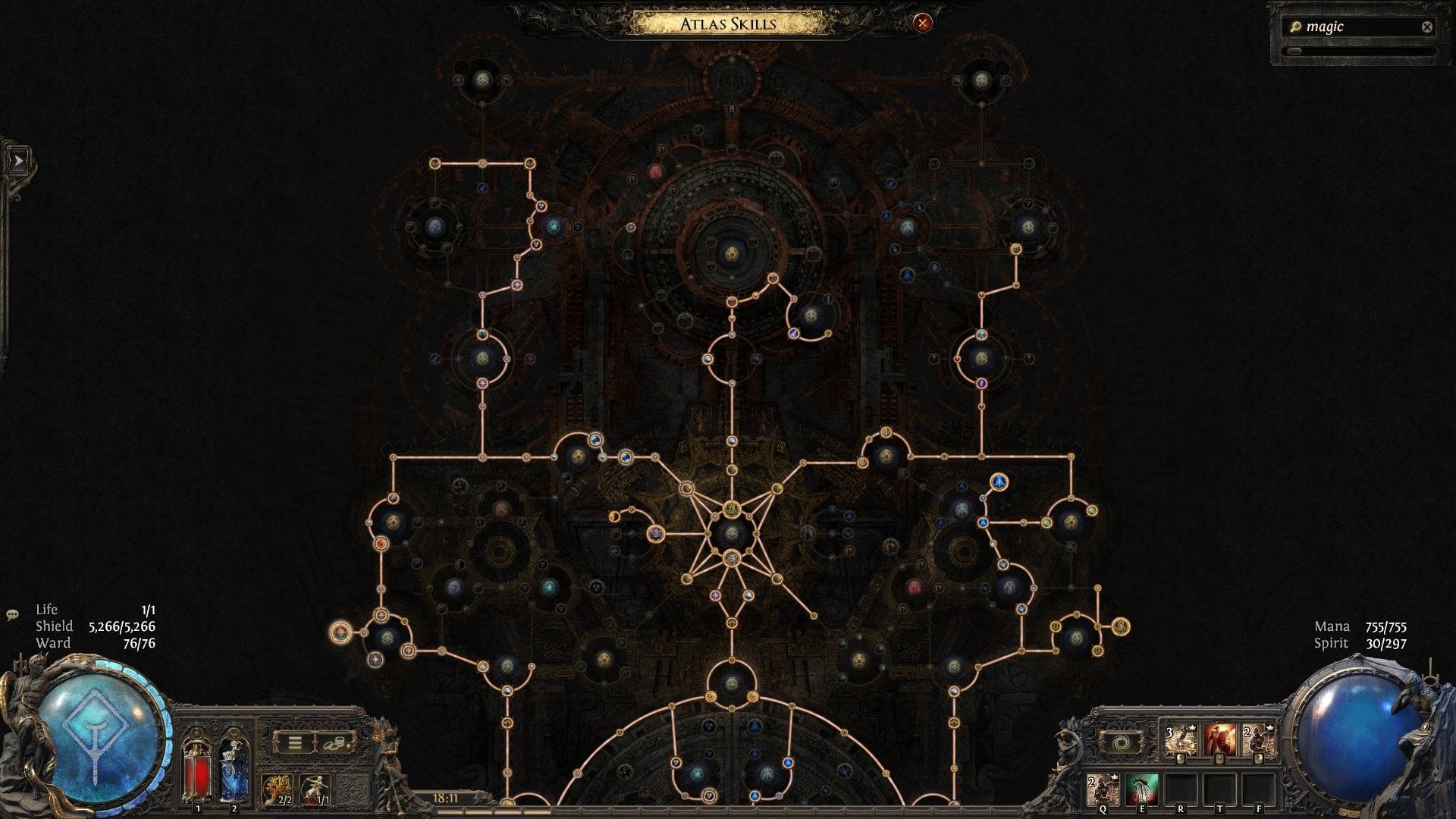
The Atlas passive tree (0.5): 301 points, spend them all
The biggest 0.5 change: the Atlas passive tree now holds 301 main points, and you can allocate every one of them. No more agonizing respecs to swap farms — the tree is wide enough to commit to a strategy and keep utility. Many nodes are now multi-choice (e.g. add Essences, Strongboxes, or Rogue Exiles), so you tailor branches to your farm.
How to spend points, in order of priority:
- Waystone sustain first. Before anything fancy, take the nodes that boost rare monster pack modifiers and map drops — the cluster around Rising Danger (more rare-pack modifiers → more and better Waystones). Your one job in early endgame is to never run out of Waystones before T15. This is non-negotiable.
- Then your money mechanic. Pick one — Ritual is the standout currency farm in 0.5 — and dump points into its branch to raise spawn rate, reward quantity, and quality. (Full breakdown in our PoE2 Ritual farming guide.)
- Then raw quantity/rarity. General increased item rarity, pack size, and map modifier nodes multiply everything you've already set up.
- Utility last. Tower radius, Tablet effect, and quality-of-life nodes round out the build once the core is online.
The mistake new mappers make is sprinkling points across five mechanics. Don't. One farm, fully invested, plus Waystone sustain out-earns a scattered tree every time.
Atlas Masters: pick one, switch freely
New in 0.5, the Atlas Masters add an Ascendancy-style layer to mapping. You align with one Master at a time (you can run up to 3 of their abilities at once), and switching between them is free — so match the Master to what you're farming that session. The three:
| Master | What they bring | Farm it for |
|---|---|---|
| Jado | More unique drops, buffed unique Strongboxes, extra modifiers on corrupted Waystones. | Unique hunting + Waystone value. |
| Hilda | More powerful boss encounters; redirects Azmeri Spirits away from rares. | Boss-rushing and pinnacle farming. |
| Doryani | Extra map revivals (survivability) and amplified Waystone modifier effectiveness. | Pushing high tiers and juiced maps safely. |
For pure currency farming, Doryani (more juice + extra revivals to survive it) or Jado (unique + Waystone value) are the usual picks. Use Hilda when you're farming pinnacle bosses. Because switching is free, there's no wrong long-term choice — just match the session.

PoE2 - Items
Skip the grind — get Items
The fastest mapping loop (step by step)
- Allocate Waystone-sustain nodes first (Rising Danger cluster) so you climb tiers without running dry.
- Push tiers steadily. Run the highest Waystone tier you can survive, upgrading your Waystone drops as you go. Aim to reach red maps (T11–T15) as fast as your defenses allow — that's where the real drops live.
- Set up a Tower. Once you control a Tower, slot Tablets for your chosen mechanic to blanket its radius. Stack duplicates to guarantee the mechanic every map.
- Craft your Waystones and Tablets. Spend currency to add modifiers — more pack size and rarity on Waystones, stronger rolls on Tablets. Scale to your defenses.
- Pick the right Master for the session (Doryani/Jado for currency, Hilda for bosses).
- Clear the map fully, then move outward, completing Towers to reveal regions and find the Fortress for the boss questline.
- Reinvest. Sell your currency/uniques, buy upgrades, push higher tiers, repeat. The Atlas compounds — each loop funds a bigger next loop.
Where the Atlas leads: pinnacle bosses
Mapping isn't the destination — it's the engine that gets you to the pinnacle bosses, where the chase rewards live. Through the Fortress you reach the Arbiter of Ash and the Arbiter of Divinity; through mechanics you reach their own pinnacles (Ritual's King in the Mists, etc.). Each is a gear-and-mechanics check that drops the build-defining loot — Mageblood, chase uniques, mountains of Divines — that the whole Atlas grind is for.
Skip the grind — PoE2 services
Climbing the Atlas, sustaining Waystones, and learning every pinnacle fight takes serious hours. If you'd rather land straight on the rewards, we've got you:
- PoE2 Boosting & Carries — Atlas progression, map farming, pinnacle boss kills by pro players
- PoE2 Currency (all orbs) — divine · chaos · exalted, instant delivery, best rate
- PoE2 Divine Orbs — instant delivery · trusted · best rate
For the Breach-specific tree and the current Breachstone pipeline (Splinters → Wombgift → Genesis Tree), our PoE2 Breach farming guide covers the full loop. Want to go deeper on the best money farms once your Atlas is set up? Read our PoE2 Ritual farming guide, PoE2 currency farming guide, and our PoE2 Abyss farming guide.
FAQ
How many Atlas passive points are there in PoE2 0.5? There are 301 main Atlas passive tree points in 0.5 "Return of the Ancients," and you can allocate all of them. Many nodes are multi-choice, so you can commit to a farming strategy while keeping general map-quantity and rarity bonuses.
What's the best early Atlas tree in PoE2? Start with Waystone sustain — the rare-pack-modifier nodes around Rising Danger — so you never run out of Waystones before reaching red maps (T15). Then invest in one money mechanic (Ritual is the top currency farm in 0.5), then general rarity/quantity nodes.
How do Precursor Towers and Tablets work? Completing a Precursor Tower reveals a large region of the Atlas and lets you slot Tablets, which apply mechanics (Ritual, Breach, Delirium, etc.) to every map in that Tower's radius. Stack duplicate Tablets to guarantee your chosen mechanic every map. The first Tower also reveals a Precursor Fortress.
How do I get Tier 16 Waystones in PoE2? Tier XVI Waystones only come from corrupting a Tier XV Waystone with a Vaal Orb. Climb to red-tier maps first by sustaining and upgrading your Waystone drops through the Atlas tree.
Which Atlas Master should I pick? You can run one Master at a time (up to 3 abilities) and switch for free, so match the session: Doryani (extra revivals + Waystone juice) or Jado (uniques + Waystone value) for currency farming, Hilda (more boss encounters) for pinnacle hunting.
What is the Precursor Fortress in PoE2? It's the central endgame questline location, revealed by your first Tower. Find three keys inside to fight the Arbiter of Ash, then the Arbiter of Divinity — PoE2's ultimate boss — which unlocks Citadels and special modifier maps.
What changed in the Atlas in PoE2 patch 0.5.4? Patch 0.5.4 "Grand Expedition" (launched June 24, 2026) added a dedicated Expedition Atlas Passive Skill Tree with its own Notables and Keystones, the Liquid Verisium currency (dropped by Expedition Runic Monsters, used in Runeforging), and reworked Grand Expedition map modifiers. The core Atlas system — Waystones, Precursor Towers, Tablets, the 301-point passive tree, and Atlas Masters — is unchanged. If you're running any other mechanic, 0.5.4 plays identically to 0.5.0.
How long does it take to finish the PoE2 Atlas? "Finishing" the Atlas is a moving target. Revealing every node and completing your first T16 Waystone typically takes 8–15 hours for an experienced player with a functional build; reaching the Arbiter of Divinity (the game's current pinnacle) and farming it consistently is 20–40+ hours depending on build and currency invested. The more useful milestone for most players is reaching T15 Waystone self-sustain (~2–3 hours of efficient mapping once you're in red maps), at which point your farm compounds: each map funds the next one plus trades for gear upgrades.
Mechanics verified against the Maxroll Atlas of Worlds & Mapping resource and official Path of Exile 2 sources (pathofexile.com, poe2wiki.net). Current for the 0.5 "Return of the Ancients" league (launched May 29, 2026); verified through patch 0.5.4 "Grand Expedition" (June 24, 2026). Atlas details and node values can change between patches — confirm in-game and check poe.ninja for live currency prices before trading.