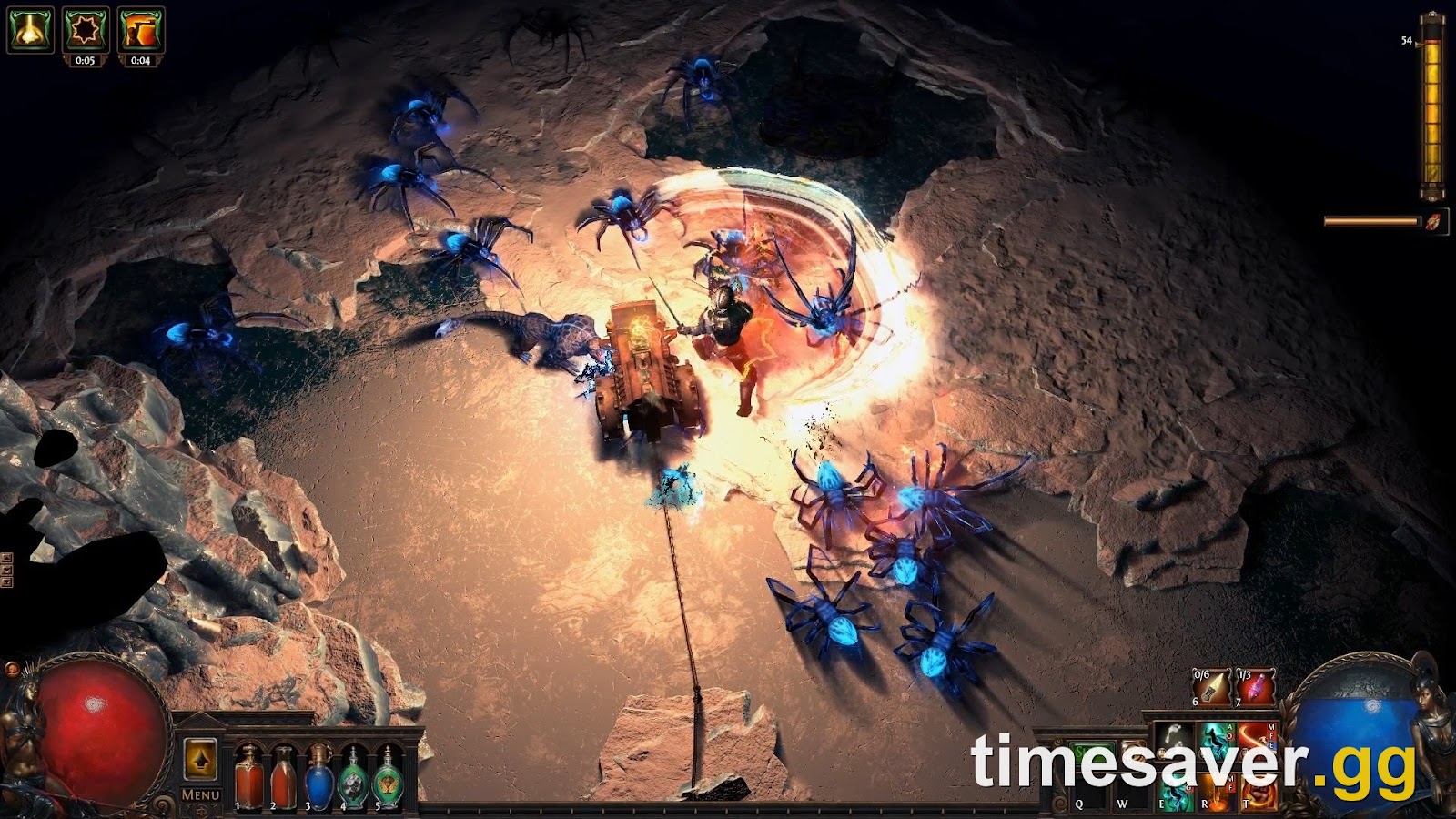
Updated for 3.29.1 "Curse of the Allflame" (last verified 2026-09-02). Delve took no changes in the 3.29 patch cycle, so every mechanic below is current for this league.
Quick answer: Delve is Path of Exile's infinite underground dungeon — you spend Voltaxic Sulphite (farmed from maps) to drive a light-carrying Crawler deeper into the Azurite Mine, collecting Azurite and Fossils as you go. It stays a top currency lane because Fossils power the game's most deterministic crafting (tag-biased reforging), and because Delve was untouched in 3.29 — no nerf, no rework. The fastest way to profit: farm Sulphite in your maps, run the mine for Fossils and Resonators, and either craft with them or sell them in bulk.
Delve is one of the few endgame systems in PoE that has stayed a reliable earner across a decade of leagues, and 3.29 didn't change that. While the community chased Charts and Voyages in Curse of the Allflame, the Azurite Mine kept quietly printing crafting currency. This guide covers the full loop — how the mine works, how to sustain Sulphite so you can keep descending, what to spend Azurite on, how Fossil crafting makes money, and where to find Aul, the Crystal King, the boss that can fund an entire league.
If you want the wider picture first, see our best currency farming strategies in PoE 3.29 — Delve sits comfortably in the "reliable, low-variance" tier alongside Expedition and Harvest.
Short on currency for the build? You can buy PoE Divine Orbs from Timesaver on any league or Standard, delivered in a private trade.
Path of Exile - Divine Orbs
Get up to 1,000 Divine Orbs in 10 minutes
What is Delve in PoE?
Delve is unlocked by Niko the Mad, a master you first meet in Act 4. He grants access to the Azurite Mine — a subterranean region that, unlike normal maps, has no fixed end. You descend node by node, and monster difficulty and reward quality climb the deeper you push.
The core moving parts:
- Voltaxic Sulphite — the fuel. You gather it from caches that spawn in your regular map runs (Niko's mission), then burn it to move the Crawler between nodes in the mine.
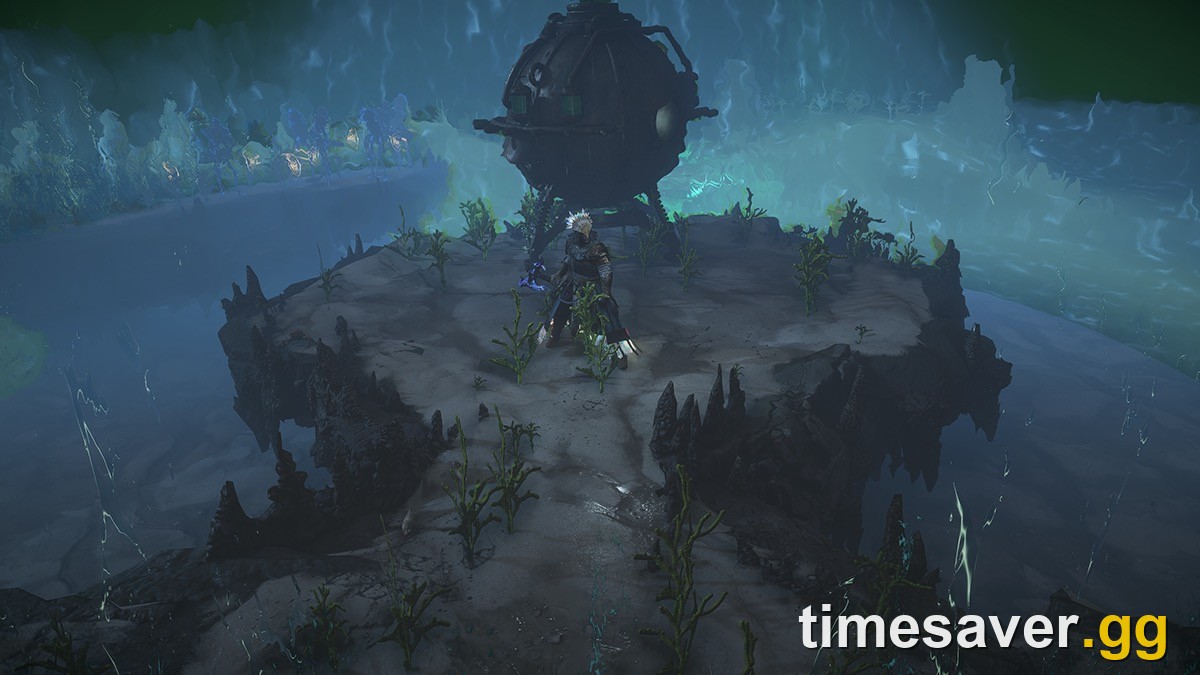
- The Crawler — Niko's machine (players call it the mine cart). It projects a light aura and travels the mine path; you follow inside its light.
- The Darkness — step outside the Crawler's light and you start taking damage. As PoE Vault puts it: "Standing in the Darkness will cause the player to take 2% of their Life and Energy shield per second, per stack (at 0% Darkness Resistance)." Stacks build fast, so straying is lethal without preparation.
- Azurite — the mine's own currency, gathered from veins and chests while delving, and spent at Niko's shop on upgrades and Resonators.
- Flares and Dynamite — Flares light up an area so you can briefly leave the Crawler to grab loot; Dynamite blows open Fractured Walls that hide extra paths, Fossils, and rewards.
Each node in the mine connects to other nodes, and reading the map matters. Per PoE Vault, "Each node in delve can have 1, 3 or 4 paths coming off it" — so a node showing only two visible connections is a strong tell that a third path is hidden behind a Fractured Wall you should dynamite.
Is Delve still worth farming in PoE 3.29?
Yes — and the reason is what 3.29 didn't do to it. The official 3.29.0 and 3.29.1 patch notes contain no balance changes to Delve, Azurite, Sulphite, Fossils, Resonators, or Aul. Grinding Gear Games poured its 3.29 design into the Curse of the Allflame league mechanic (Charts, Voyages, Ducats) and left the Azurite Mine alone.
That makes Delve a rare thing in a fresh league: a stable, unchanged, deterministic-crafting economy. Fossil-crafted items don't crash the way league-specific loot does, because Delve income has been consistent for years. If you want a farm that isn't a moving target, this is it.
One important clarification for 3.29 specifically: the white-socket overhaul that reworked Chromatic Orbs is a global sockets change and has nothing to do with Fossil crafting. No Fossil in the standard set re-rolls socket colours — only the Hollow Fossil touches sockets at all (it adds an Abyssal socket). Don't conflate the two systems.
How the Azurite Mine works: light, dynamite and Fractured Walls

The whole mine is a tension between reward and the Darkness. Everything valuable is spread along the path and tucked into side rooms, but the moment you leave the Crawler's aura, the clock starts.
Your tools for managing that:
| Tool | What it does |
|---|---|
| The Crawler's light | Your safe zone; follow it down the main path |
| Flares | Throw one to create a temporary lit area and dart off-path for loot |
| Dynamite | Destroy Fractured Walls (and stagger/kill packs) to open hidden branches |
| Darkness Resistance | An Azurite-purchased stat that reduces how fast Darkness damages you |
Rewards in the mine come as Azurite veins, currency and item chests, and — most importantly for profit — Fossil nodes and Fractured Walls. The rarer, higher-value Fossils tend to sit behind walls, which is why dynamite discipline (and reading those 2-connection nodes) directly increases your income. Fossil availability also depends on the biome you're delving; different biomes drop different Fossils.
How to get more Voltaxic Sulphite in 3.29
Sulphite is the bottleneck. You can only delve as far as your Sulphite lets you, so sustaining it is the difference between a few quick descents and an all-night mining session. The current, still-valid methods:
- Run maps with Niko active. Each map instance can contain 1–3 Sulphite caches from Niko's mission — the baseline way to keep fuel topped up while you map.
- Sulphite Scarab of Greed. Adds 150% more Voltaxic Sulphite to a map — the single biggest per-map multiplier.
- Atlas passive — Sulphite Infusion. Grants 400 / 700 / 1000 extra Sulphite on completing a white / yellow / red map.
- Atlas passive — Mining Byproducts. Sulphite veins and chests have a 15% chance to grant double Sulphite.
Stack the Scarab with the Atlas passives on a fast red-map layout and you'll bank enough Sulphite in a mapping session to fund deep, uninterrupted Delve runs. This is the same "farm the fuel while you map, then cash it in" rhythm that makes lanes like Expedition so consistent.
What to spend Azurite on
Azurite is spent at Niko's shop in the mine. Priorities early on are the upgrades that keep you alive and moving:
- Darkness Resistance and Light Radius — survivability first; these let you push deeper safely.
- Flare upgrades (radius, maximum) and Dynamite upgrades (maximum, damage) — more off-path looting and faster wall-breaking.
- Sulphite Capacity — hold more fuel per trip so you delve longer between map sessions.
Once your upgrades are handled, Azurite becomes a currency-printing tool. The Delve shop lets you buy Resonators (and other currency), and there's a well-known low-effort play here. As Maxroll's Delve guide states: "Exchange your Azurite for Primitive Chaotic Resonators and sell them in bulk for profit." Resonators are always in demand from crafters, so surplus Azurite converts straight into tradeable value.

Path of Exile - Chaos Orbs
Get up to 20,000 Chaos Orbs in 10 minutes
Fossils and Resonators: the real money maker

This is why Delve is a crafting farm, not just a loot farm. Fossils drive the most deterministic reforging system in PoE. Per Maxroll: "Fossils are a special crafting currency that can be socketed into Resonators to enable targeted tag-based reforging."
Here's how it works: you socket one or more Fossils into a Resonator, then apply it to a Rare item. It re-rolls the item like a Chaos Orb would — but the socketed Fossils bias the result, adding weight to certain modifier tags and blocking others. Both the Fossils and the Resonator are consumed. That "block the junk, push the good mods" targeting is what makes Fossil crafting valuable.
Resonators determine how many Fossils you can combine at once:
| Resonator | Fossil sockets |
|---|---|
| Primitive Chaotic Resonator | 1 |
| Potent Chaotic Resonator | 2 |
| Powerful Chaotic Resonator | 3 |
| Prime Chaotic Resonator | 4 |
More sockets let you stack multiple Fossils for tighter, more powerful outcomes — and Prime Resonators are correspondingly rarer and pricier.
A sample of common, useful Fossils and what they bias (effects verified on poedb):
| Fossil | Effect |
|---|---|
| Pristine | More Life modifiers / no Defence modifiers |
| Dense | More Defence modifiers / no Life modifiers |
| Prismatic | More Elemental modifiers / no Physical or Chaos Ailment modifiers |
| Serrated | More Attack modifiers / fewer Caster modifiers |
| Aberrant | More Chaos modifiers / no Lightning modifiers |
| Faceted | More Gem modifiers |
| Bound | More Minion, Aura or Curse modifiers |
| Sanctified | Numeric modifier values are lucky / high-level modifiers more common |
Combine them for targeted crafts — for example, a Bound + Faceted mix on a minion helmet pushes toward the exact tags a summoner build wants. Fossil crafting sits alongside the classic bench recipes like the Chaos recipe and 6-link/6-socket vendor recipes as a core part of a self-funded crafting workflow.
Because good Fossil crafts often land item bases worth many Divine Orbs, the value of a Delve session can swing on a single lucky reforge. If you'd rather skip the grind and craft immediately, you can buy Divine Orbs and PoE currency with instant delivery instead of mining for the funds.
Aul, the Crystal King: the boss that funds your league
Deep in the mine lives PoE's chase Delve boss, Aul, the Crystal King. He can only appear inside The Crystal King's Throne nodes within the Primeval Ruins biome, and only at significant depth (community reports put his earliest possible spawn around Depth 170, with encounters becoming more common the deeper you go).
Aul's signature drop is the Aul's Uprising amulet, which rolls a random "cheaper / no reservation" modifier for a specific Aura. Because that mod can land on a build-defining Aura, a good Aul's Uprising is worth a fortune — and it's the key ingredient used to craft the powerful Precursor's Emblem unique ring. Finding and killing Aul reliably is a real "one drop funds the league" moment, which is why deep-Delve carries and boss-kill services exist at all.
If pushing to Aul's depth is beyond your character's gear, that's exactly the kind of thing a PoE boosting and carry service handles — deep-Delve runs and Aul kills without the wall of survivability investment.
Best way to farm currency with Delve in 3.29
Putting it together, the efficient 3.29 Delve loop looks like this:
- Map with Sulphite sustain — Sulphite Scarab of Greed + the Sulphite Infusion and Mining Byproducts Atlas passives, on a fast red-map layout.
- Spend your first Azurite on survivability — Darkness Resistance, Light Radius, Sulphite Capacity — so you can delve deeper safely.
- Dynamite the walls — read 2-connection nodes, break Fractured Walls, and prioritise Fossil nodes and biomes with the Fossils you want.
- Convert everything — craft with your Fossils and Resonators, sell the surplus in bulk, and bank Azurite into Primitive Resonators when you're not spending it on upgrades.
- Push for Aul once your character can survive the depth — the Aul's Uprising drop is the jackpot.
It won't spike like a hot league mechanic, but it also won't crash. That reliability — plus untouched-in-3.29 mechanics and a crafting economy that always has buyers — is exactly why Delve remains a staple currency farm this league.
Get straight to crafting and mapping:
>
- PoE Currency — instant delivery — Divine, Chaos and more at the best rate, so you can Fossil-craft now instead of mining for funds.
- PoE Boosting & Carries — deep-Delve runs, Aul kills, leveling and boss carries.
- All Path of Exile services — everything PoE 3.29 in one place.
FAQ
Was Delve changed in PoE 3.29 "Curse of the Allflame"? No. The official 3.29.0 and 3.29.1 patch notes contain no balance or mechanical changes to Delve, Azurite, Voltaxic Sulphite, Fossils, Resonators, or Aul. Every mechanic in this guide is current for the 3.29 league.
How do I get more Voltaxic Sulphite to Delve deeper? Farm it while mapping. Each map with Niko active can drop 1–3 Sulphite caches; add the Sulphite Scarab of Greed (150% more Sulphite per map) and the Atlas passives Sulphite Infusion (400/700/1000 extra on white/yellow/red maps) and Mining Byproducts (15% chance for double Sulphite from veins and chests).
What are Fossils and Resonators used for? Fossils are a crafting currency socketed into Resonators to perform targeted, tag-biased reforging on Rare items — the most deterministic crafting in PoE. Resonators come in four types with 1 to 4 sockets (Primitive, Potent, Powerful, Prime), letting you combine that many Fossils for a single, weighted re-roll.
Do any Delve Fossils change socket colours in 3.29? No. Fossil crafting affects item modifiers, not socket colours. The 3.29 white-socket overhaul is a separate, global system. The only Delve Fossil that touches sockets at all is the Hollow Fossil, which adds an Abyssal socket — it does not re-roll R/G/B colours.
Where do I find Aul, the Crystal King, and why does he matter? Aul spawns only in The Crystal King's Throne nodes inside the Primeval Ruins biome, at significant depth (around Depth 170 and beyond). He drops the Aul's Uprising amulet — a random Aura-reservation modifier that can be worth a huge amount and is used to craft the Precursor's Emblem ring.
Is Delve a good currency farm for beginners in 3.29? Yes, with a caveat: the early loop (map for Sulphite, delve for Azurite and Fossils, sell Resonators in bulk) is low-risk and reliable. Pushing to deep-Delve rewards and Aul requires a tanky, well-geared character — until then, stick to shallower profitable depths or use a carry for the deep content.