Updated for 3.29 "Curse of the Allflame" (last verified 2026-09-03). Divination cards took no core changes across the entire 3.29 patch cycle (3.29.0 → 3.29.3), so every mechanic and farm below is current for this league.
Quick answer: Divination cards are Path of Exile's targeted-drop currency lane — each card drops in one specific area and turns into one specific reward once you collect a full set. Unlike Charts, Legion, or Breach, you're not juicing a map mechanic; you're farming a chosen map for a chosen payout. The classic money farms are The Doctor (Burial Chambers → Headhunter) and The Apothecary (Cage Map → Mageblood). Turn full sets in to Tasuni in Highgate or Lilly Roth in your hideout. Div cards were left essentially untouched in 3.29, which makes this one of the most reliable, low-variance currency lanes in Curse of the Allflame.
While most of the league is chasing the seafloor loot in Charts and Voyages, divination-card farming has quietly stayed one of the most dependable ways to convert map time into a known reward. That predictability is the whole point: you decide what you want — a chase unique, a stack of Divine Orbs, a specific map — pick the card that gives it, and farm the area it drops in. This guide covers exactly how the system works in 3.29, the best cards to target this league, which farms are dead traps you should skip, and how to concentrate card drops with scarabs and the Atlas tree.
If you want the wider picture first, see our best currency farming strategies in PoE 3.29 — div-card farming sits in the "reliable, target-what-you-want" tier alongside Delve and Bestiary.
Short on currency for the build? You can buy PoE Divine Orbs from Timesaver on any league or Standard, delivered in a private trade.

Path of Exile - Divine Orbs
Get up to 1,000 Divine Orbs in 10 minutes
What are divination cards in PoE?
A divination card is, in Maxroll's words, "fragments of a specified reward that can be collected, with each card dropping in a specific map or location." Each card is a stackable, tradeable item, and each one is tied to a fixed reward — some currency, a specific unique item, a map, or a boss item. Collect enough copies to complete a set, and you exchange the set for that reward.
The moving parts:
- The card — drops in its designated area(s). You'll see it hit the ground like any other item, usually with a distinct card frame.
- The set size — baked into each card, and it varies wildly. The Doctor is an 8-card set; The Apothecary is a 5-card set; House of Mirrors is a 9-card set. You need a full set before you can turn it in.
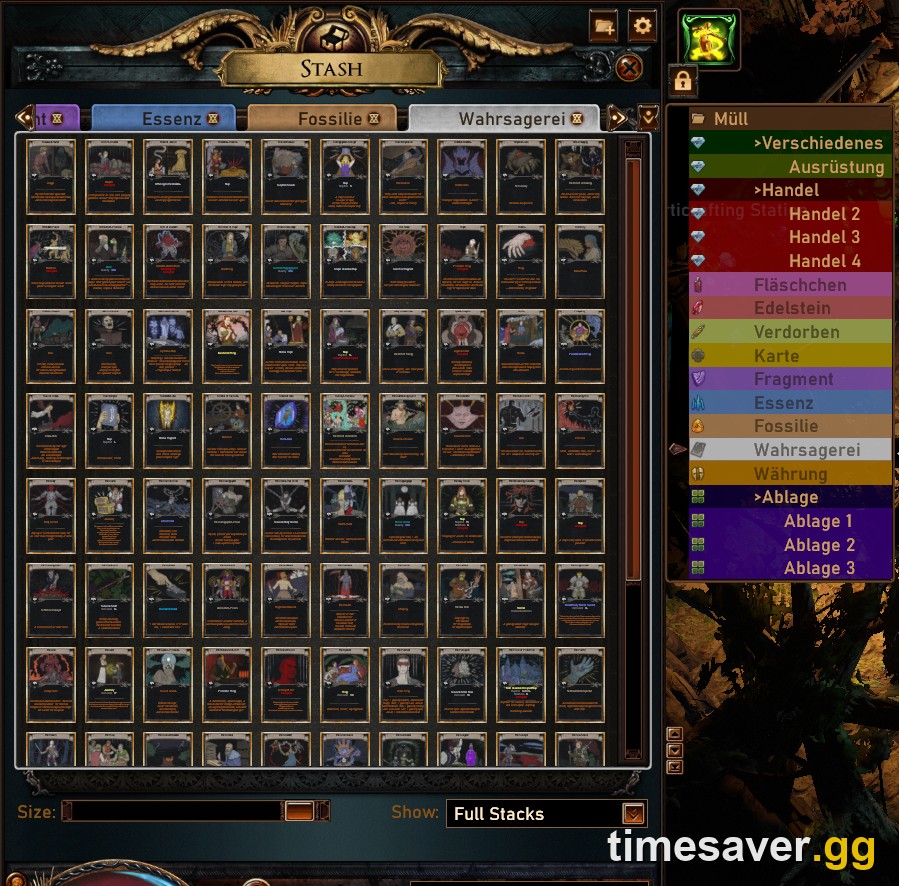
- The turn-in — take the full set to Tasuni in Highgate (Act 4 / Epilogue) or, more conveniently, Lilly Roth in your hideout. As Maxroll states plainly: "You can exchange full sets of cards to Tasuni in Highgate or Lilly Roth in your hideout." You can hold multiple full sets and hand them all in at once — 24 of an 8-set card gives you three rewards.
The appeal versus every other farm is determinism. A Legion or Breach map is a gamble on what drops; a card farm is a slow, steady march toward a guaranteed payout you chose in advance. That's why card farming is the go-to when you're saving for a specific chase item rather than raw currency churn.
How do divination cards drop?
Two things matter: where cards drop and how you increase the rate.
Cards are area-specific. Each card has a designated drop location — a particular map, zone, or boss. If you want The Doctor, you farm Burial Chambers; farming anywhere else will not produce it. This is the single most important mechanic to internalize: you don't farm "divination cards" in general, you farm a card in its area.
Random-card sources exist too. Two items give you a random card instead of a targeted one:
- Stacked Deck — "Stacked Decks are currency items that give you a random Divination Card" (Maxroll). You flip one and get a random card from the general pool.
- Diviner's Strongbox — a strongbox variant that drops random cards.
One catch worth knowing: boss-exclusive cards are excluded from the Stacked Deck pool. As Maxroll notes, "Boss-exclusive Divination Cards like The World Eater are excluded from the Stacked Deck reward pool." So you can't gamble a Stacked Deck into a boss-drop card — those you have to farm at the source.
A note on Item Rarity. You'll see conflicting claims online about whether Increased Item Rarity boosts divination-card drops. The honest answer is that div cards are governed by their own drop weighting plus dedicated modifiers — scarabs and Atlas passives built specifically for cards — rather than the generic Rarity you stack for rare-item and currency drops. Don't build your whole map setup around Rarity expecting more cards; use the dedicated card tools below instead.
Divination scarabs in 3.29
Scarabs are the primary lever for concentrating card drops in a map. In 3.29 there are exactly three Divination Scarabs (verbatim effects from poedb):
- Divination Scarab of The Cloister — "Area contains 8 to 12 additional packs of Doedre's Devoted / Doedre's Devoted have 1% additional chance to drop a Stacked Deck." This is your Stacked-Deck multiplier: more of the pack that can drop random cards.
- Divination Scarab of Plenty — "Area contains 6 to 10 additional Packs of Divination Touched Magic Monsters that have 1000% increased chance to drop Divination Cards." The workhorse: extra monster packs with a massive card-drop chance, which stacks with whatever card the area already drops.
- Divination Scarab of Pilfering — "Divination Cards which drop in Area are stolen by a Final Map Boss / That Final Map Boss becomes more Difficult and deals increased Damage the more Divination Cards they have stolen / That Final Map Boss duplicates all stolen Divination Cards when defeated." A high-risk multiplier: the boss hoards every card that would have dropped, then duplicates the lot when you kill it — great when you can reliably kill a juiced boss.
There is no "Divination Scarab of Curation" or any fourth variant — if you see one referenced, it's wrong. Cloister, Plenty, and Pilfering are the complete set.
Atlas passives for divination-card farming
The Atlas tree has a dedicated card cluster, and 3.29 added a new one on top. Straight from the official 3.29.0 patch notes:
"Added a new Altered Prophecy cluster to the Atlas Passive Tree. The Notable grants your Tier 14+ Maps 4% chance to drop a Scrying Orb on completion, while the small Passives grant your Maps increased chance to drop Divination Cards. In Ruthless, this cluster grants Scarab related bonuses."
That new cluster ties into another 3.29 addition, the Scrying Orb. Per the official notes:
"The Scrying Orb is a new currency item that stores the Map that the currency item was found in. It then allows you to Scry the Divination Cards of the Map area listed on the item to a Map on your Atlas."
In plain terms: a Scrying Orb lets you copy one map's divination-card pool onto a different map on your Atlas. That's a genuine quality-of-life tool for card farmers — you can graft a valuable card's drop pool onto a map layout you actually enjoy running. Combine the Altered Prophecy small passives (increased card drop chance) with the card scarabs above and you have a map that's built to print your chosen card.
The best divination card farms in 3.29
These are the premier targeted farms this league — the card, its set size, its reward, and the exact area it drops in, all confirmed live:
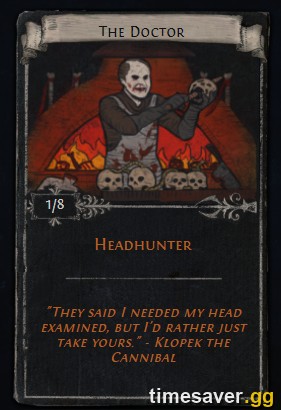
- The Doctor → Headhunter. Set size 8, drops in Burial Chambers Map. Headhunter is the iconic mapping belt, and The Doctor is the way to target-farm it instead of gambling. Favorite Burial Chambers, spec your Atlas into it, and run it with the card scarabs. This is the single most famous card farm in the game — and if you'd rather skip the grind entirely, Headhunter is available directly.
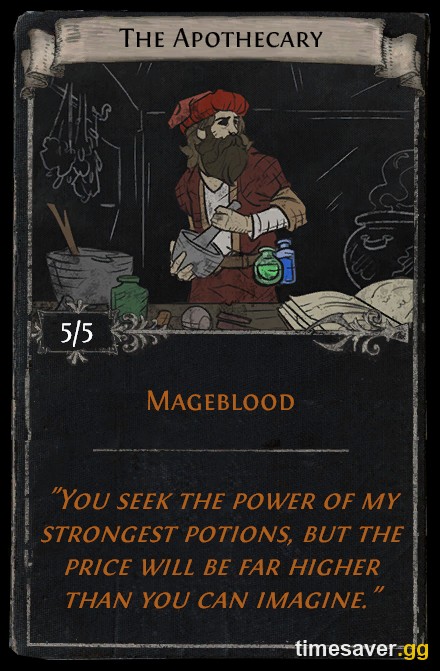
- The Apothecary → Mageblood. Set size 5, drops in Cage Map. Mageblood is arguably the strongest chase belt in PoE, and The Apothecary is its card. Note a 3.29 change here: the old Defiled Cathedral source was removed from this league's Atlas, so Cage Map is now the sole donor for The Apothecary — farm Cage, nothing else.
- House of Mirrors → Mirror of Kalandra. Set size 9 — but there is no natural map that drops this card. House of Mirrors comes from the ultra-rare The Immortal card trade and a handful of global sources, not from farming a specific map. Anyone telling you to "farm map X for House of Mirrors" is wrong; treat the Mirror card as a lottery, not a farm.
A word on stale guides: older pages list The Doctor as dropping in Sepulchre, Putrid Cloister, Waste Pool, or Spider Forest. Those are outdated. The current source is Burial Chambers only — always cross-check a card's drop area against a live source before committing hours to it, because GGG reshuffles card drop locations between leagues.

Path of Exile - Chaos Orbs
Get up to 20,000 Chaos Orbs in 10 minutes
Cards to skip — the dead farms
Some famous cards are no longer worth chasing because they aren't currently drop-enabled. On poedb, a set size listed as 10000 is the marker for a card that has been pulled from natural drops (legacy/removed). Two big names carry that flag right now:
- The Nurse (historically → The Doctor) — not currently farmable.
- Brother's Gift (historically → Divine Orbs from Cemetery) — not currently farmable.
If a guide points you at either as a 3.29 currency strategy, skip it — you'll farm the area forever and the card will never drop. Stick to the confirmed-live farms above.
What changed for divination cards in 3.29?
Almost nothing — and that's exactly why the lane is reliable this league. Here's the complete 3.29-cycle change list for div cards:
- 3.29.0: added 3 new Divination Cards, the Altered Prophecy Atlas cluster, and the Scrying Orb currency (both quoted above).
- 3.29.1: two small touches — GGG "Lowered the gold cost of the Matryoshka divination card on the Currency Exchange" and "Fixed a bug where the Alone in the Darkness Divination Card was no longer obtainable outside of sources of random divination cards, such as Stacked Decks and Diviner's Strongboxes."
- 3.29.2: no divination-card changes.
- 3.29.3: no divination-card changes.
The 3.29 white-socket overhaul — which shook up socket colours and Chromatic Orbs — has nothing to do with divination cards; they're separate systems. So aside from three new cards and two additive tools, the core drop-and-turn-in loop is identical to prior leagues. In a league where farms like Breach got re-priced and mechanics shifted week to week, div cards are a fixed point: pick your card, farm its area, collect your reward.
How divination card farming turns into currency
The payout side depends on which card you target:
- Chase-unique cards (The Doctor → Headhunter, The Apothecary → Mageblood) either equip the item or sell it. These are the biggest single hits and the reason people run card farms at all.
- Currency cards hand you a fixed pile of orbs per set — a steady, predictable income you can bank toward a craft.
- Bulk selling — if you don't want to complete a set yourself, partial stacks of valuable cards sell readily; other players finish the set.
Whatever the card, the endgame is the same: a targeted payout that converts into the trade currency you actually need, most often Divine Orbs. If a farm is taking longer than you'd like, or you want the reward without the map hours, our PoE currency and boosting services cover both the currency and the carries.
One rule for pricing: never trust a static chaos or Divine value from a guide, including this one. Card and item prices float hard through a league. Always check the live rate on poe.ninja before you buy, sell, or commit to a farm — a card that was worth a fortune at league start can crater by mid-league.
FAQ
Where do I turn in divination cards in PoE? Take a full set to Tasuni in Highgate (Act 4 / Epilogue) or Lilly Roth in your hideout. Lilly is the convenient option since she lives in your hideout. You can hand in multiple complete sets at once, but you must have a full set — partial stacks won't exchange.
What's the best divination card to farm in 3.29? For raw value, The Doctor (Burial Chambers → Headhunter, 8-card set) and The Apothecary (Cage Map → Mageblood, 5-card set) are the two premier chase-unique farms. Pick based on which belt you want. For steady income instead of a jackpot, target a currency card with a smaller set size so you complete sets faster.
Does Item Rarity increase divination card drops? Divination cards use their own drop weighting plus dedicated modifiers — the Divination Scarabs (Cloister, Plenty, Pilfering) and the Atlas card passives — rather than the generic Increased Item Rarity you stack for currency and rares. Build your map around those card-specific tools, not around Rarity, if cards are your goal.
What is a Stacked Deck? A Stacked Deck is a currency item that, when used, gives you a random divination card from the general pool. Boss-exclusive cards like The World Eater are excluded from that pool, so you can't gamble your way into a boss-drop card — those must be farmed at the source.
Did league 3.29 change divination cards? Barely. 3.29.0 added three new cards, the Altered Prophecy Atlas cluster, and the Scrying Orb (which copies a map's card pool onto another map). 3.29.1 made one gold-cost tweak and one bugfix; 3.29.2 and 3.29.3 changed nothing about div cards. The core loop is unchanged, which makes card farming a stable currency lane this league.
How many of each card do I need? Every card has its own fixed set size. Examples: The Doctor needs 8, The Apothecary needs 5, House of Mirrors needs 9. The set size is shown on the card itself, so check before you commit — a small-set currency card completes far faster than an 8- or 9-card chase.