Quick answer: The best Atlas passive tree for currency farming in Path of Exile 3.29 "Curse of the Allflame" isn't one fixed tree — it's a method. Take the universal map-sustain and Kirac nodes first, then commit the bulk of your ~138 points into ONE mechanic's cluster (Expedition, Legion, Abyss, Harvest, or the Allflame Charts/Voyages league mechanic) plus its adjacent quantity and pack-size wheel. Skip the "spread across everything" trap. You can refund and re-path freely with Orbs of Unmaking, so treat your first tree as a draft you tune as your build gets stronger. This guide applies to league 3.29 (live since 24 July 2026, latest patch 3.29.3b); the Atlas system was not reworked this league — only tuned.
Most "best Atlas tree" results you'll find are screenshots with no explanation of why the nodes are picked, or they're from a league two patches ago. This guide gives you the reasoning so you can build a currency tree for your build and your budget — and adjust it when the next patch moves the numbers.

Short on currency for the build? You can buy PoE Divine Orbs from Timesaver on any league or Standard, delivered in a private trade.

Path of Exile - Divine Orbs
Get up to 1,000 Divine Orbs in 10 minutes
How does the Atlas passive tree work in PoE?
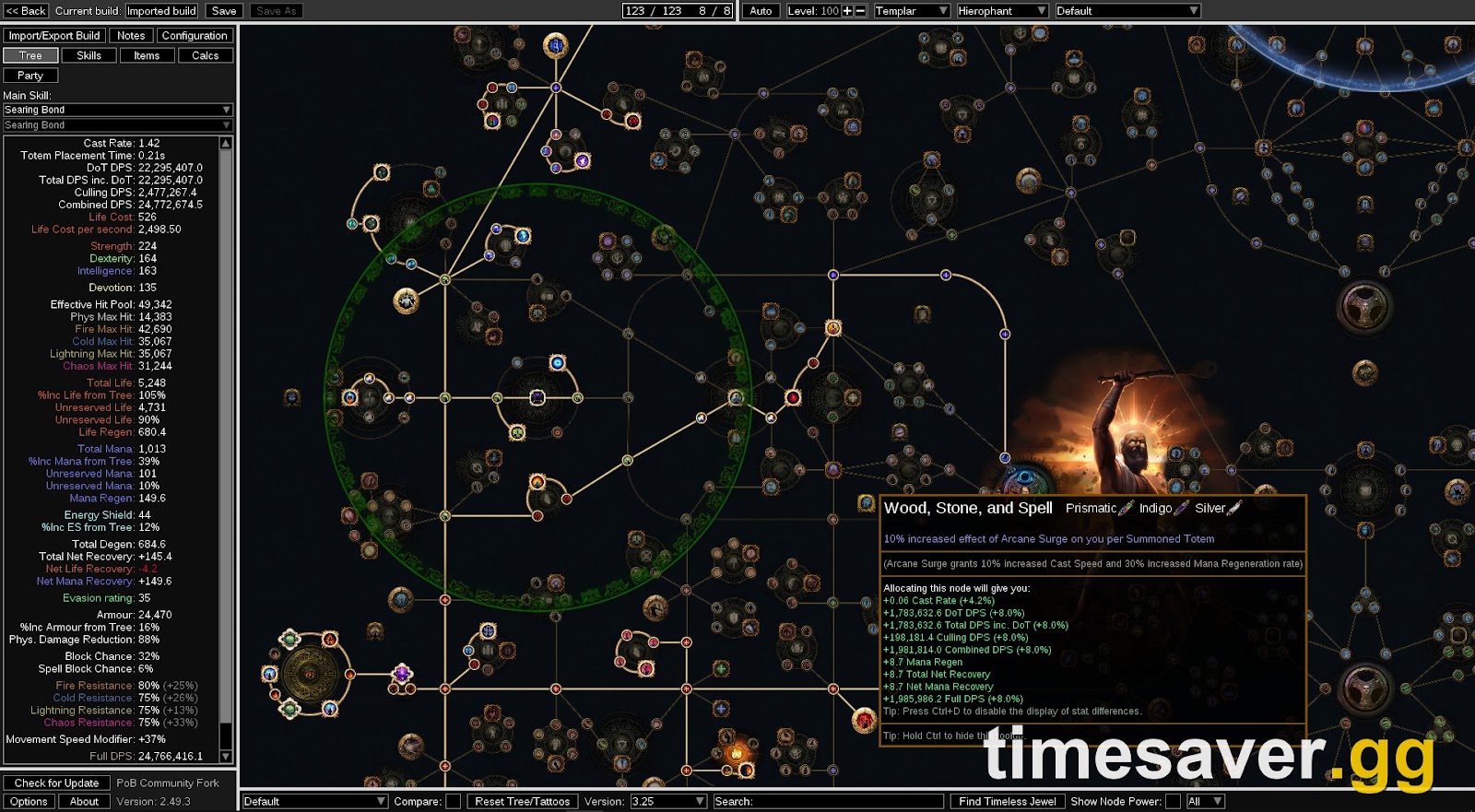
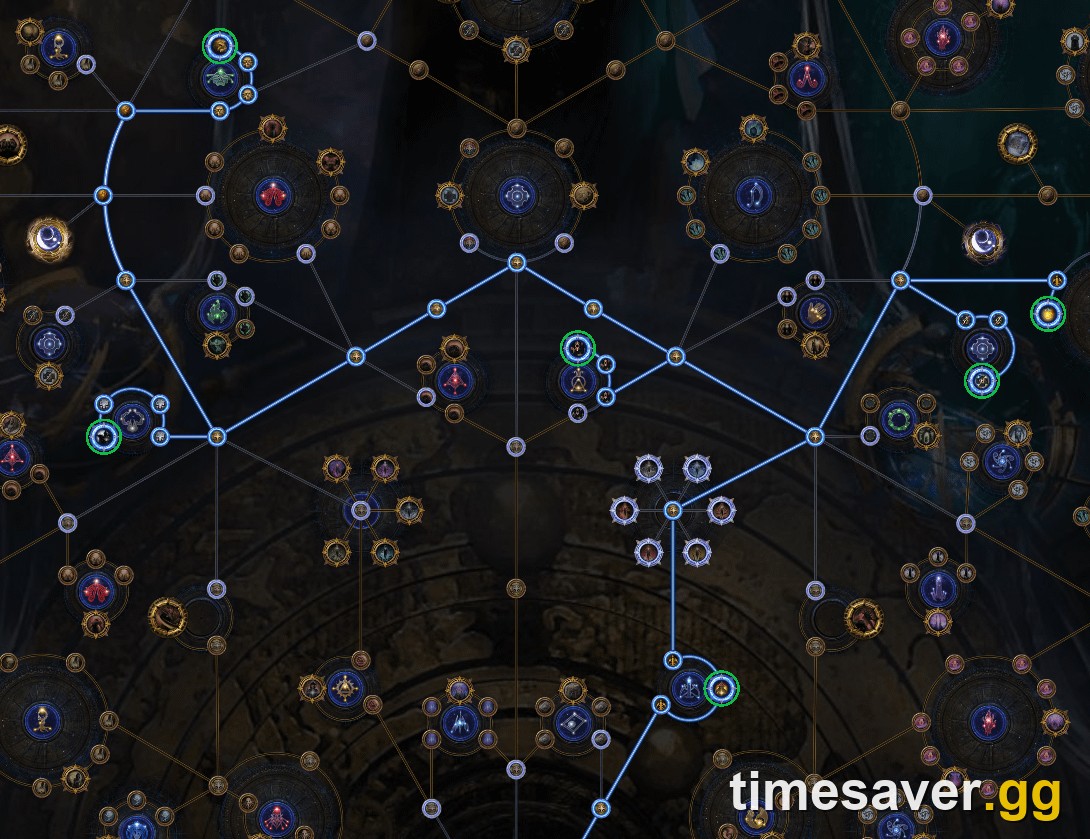
The Atlas of Worlds is Path of Exile's endgame map tree. You unlock it after finishing the ten-act campaign and getting your own Map Device from Commander Kirac during the Epilogue. From there, every point you spend on the Atlas passive tree changes how your maps behave — which league mechanics appear, how dense the monster packs are, how much currency drops.
According to Maxroll, you can earn up to 138 Atlas passive points in total: roughly 100 from completing map bonus objectives, 10 from unique maps, 5 from Nightmare maps, and the rest (around 23) from quests and pinnacle/endgame content. (GGG doesn't publish a single headline number, so treat 138 as the community-maintained ceiling rather than a fixed guarantee.)
The point that matters most for a currency farmer: you can respec the entire tree whenever you want. The refund currency is the Orb of Unmaking — Kirac sells them and they drop while you play. That means your Atlas tree is never a permanent commitment. Build a rough currency tree today, test a mechanic for a few maps, and re-path if it isn't paying.
How do you earn Atlas points faster?
Bonus objectives are the bulk of your points, and the requirement scales with map colour: a white map needs a Magic-rarity clear, a yellow map needs a Rare map, and a red map needs a Corrupted Rare map. Rolling your maps to the right rarity before you run them is the fastest way to bank the completion bonus — and it's the same rarity-rolling discipline that makes a map drop more currency, so you lose nothing.
What should every currency-farming Atlas tree take first?
Before you specialize, there are nodes almost every currency tree wants. These are your foundation:
- Kirac / map-sustain passives. Your first real problem as a map farmer is running out of maps. Kirac's mission inventory sells maps and resets each time you open a mission, and the map-drop investment nodes keep your atlas self-sustaining. Path here early so you're not buying maps off the trade site every ten minutes.
- A nearby "starter wheel" mechanic cluster. PoE-Vault's advice is to grab wheels close to the center of the tree first — Bestiary, Ambush, Harbinger, Heist, or Essence — "since those wheels are close to the start and take little time." They pad your income while you path toward your main mechanic.
- Generic quantity / pack-size notables. More monsters and more item quantity multiply everything else you do. These small wheels are cheap and universal.
Think of the foundation as "keep the maps flowing and the packs dense." Only after that do you commit to a money-maker.
Which mechanic should your currency tree specialize in?
This is the real decision. The Atlas rewards specialization — dumping most of your points into one mechanic's cluster so it appears in nearly every map, fully juiced. Here are the strongest currency lanes in 3.29 and how this league treated each.
Expedition
Still one of the most reliable low-skill-floor currency lanes. You place explosives, blow up Runic Monsters, and collect Artifacts — then Tujen converts those Artifacts straight into raw currency with no crafting or trading step. 3.29 made no balance change to Expedition's currency output, so it prints the same as last league. Great for a cheap build because the income is deterministic rather than drop-luck.
Legion
Legion is a monster-density explosion that generates stacked decks of Divination Cards and splinters fast. 3.29 reworked Legion's rewards: monsters now drop fewer Splinters but in larger stacks (less trade-noise), and the old Unrelenting Timeless Emblems were removed and folded into regular Emblems. The raw currency-and-card density is still excellent — Legion drops straight into normal maps with no league-mechanic gating, so it rewards fast clear-speed builds. A common beginner tree pairs Legion with a density mechanic like Beyond.
Abyss
The biggest upward mover this league. GGG buffed Abyss repeatedly: in 3.29.1 the Abyssal Depths bosses now drop three reward chests and GGG "reduced the variance in number of drops and increased the quality/quantity of rewards from Abyss chests," especially currency and scarabs. 3.29.2 increased the quantity of items dropped by slain elite Abyss monsters on top of that. If you want a mechanic that got measurably better in 3.29, Abyss is it.
Harvest
Harvest is the classic high-investment, high-ceiling lane — reforge crafting plus lifeforce income. One caveat for 3.29: GGG removed the Harvest crafting option to Synthesise an item, so if an old guide tells you to farm Harvest for Synthesis, that path is gone. The currency farm itself is intact.
The Allflame Charts & Voyages league mechanic
3.29's own money loop. Charts give fast, steady currency; Voyages are the high-end, high-reward version. The Deep Altar currency-conversion blessing got a direct buff in 3.29.2 — GGG stated:
"Blessings granted by Offerings to the Deep Altars now grant a 10% chance for certain common currencies to be converted to rarer currencies (from 4%)."
That's more than double the conversion rate, which makes the league mechanic's Atlas nodes genuinely worth a chunk of your tree this league specifically.
One lane to size up carefully: Breach
Breach is still a strong currency-and-splinter farm, but be honest about 3.29: GGG removed the Mirage system entirely, which cut roughly half the ceiling off the Mirage-boosted Breach builds that dominated the previous league, and reduced Breach pack size on top of that. As one community breakdown put it, "Curse of the Allflame did not kill old farms; it re-priced them." Breach is good-not-god this league — don't path your whole tree into it expecting last-patch density.

How do scarabs and the Map Device fit into a currency tree?
Your Atlas tree decides which mechanic shows up; scarabs decide how hard each map is juiced. A scarab is a map fragment you slot into the Map Device before you run a map. You have four Map Device slots, upgradeable to a fifth (and eventually a sixth), which lets you stack multiple scarabs of the same or different categories per map.
Two things trip up returning players:
- Scarab tiers are gone. The old Rusted → Polished → Gilded → Winged ladder was removed in the 3.24 Necropolis league and is still gone in 3.29. Scarabs are now flat, named effects that drop anywhere in the world. Don't go hunting for "Gilded" versions — they don't exist.
- Each scarab has its own stack limit (1 to 4 copies of the same scarab per map). Some, like the Bestiary Scarab, are limited to one; others let you stack several to multiply the effect.
For a currency tree, the scarabs you stack should match your specialized mechanic — Expedition scarabs on an Expedition tree, Legion scarabs on a Legion tree, and so on. The Atlas passives that increase your scarab find are worth taking once you know which mechanic you're committing to.
How do you sustain maps while farming currency?
Nothing kills a currency session faster than running out of maps. Your sustain comes from three places working together:
- Atlas map-drop nodes + Kirac. The sustain wheel on the tree plus Kirac's resetting map shop keep your stock topped up.
- Voidstones. As you unlock the four Voidstones — Decayed, Eldritch, Ceremonial and Originator — each one gives a 25% chance for dropped maps to be one tier higher. With all four socketed, effectively every map you run is Tier 16, which keeps you in red maps (where the currency is) without buying up.
- Rolling for quantity. Higher item quantity on a map rolls more map drops, so the same rarity-rolling that banks your completion bonus also feeds your sustain.
If you're still unlocking the Voidstones, our Voidstones guide walks through exactly which pinnacle boss drops each one.

Path of Exile - Atlas Boost
Get your Atlas and voidstones done
What about the Wandering Path keystone?
Wandering Path is the keystone people most often misunderstand. Its current 3.29 wording, per PoEDB, is:
"Notable Atlas Passive Skills grant nothing / 100% increased effect of Small Atlas Passive Skills"
In plain terms: you give up every Notable on the Atlas in exchange for doubling the value of all the small passives. That's a generalist / specialist-spread keystone — it's strong only if you're deliberately touching the small passives of many mechanics at once, not if you're committing to one cluster. For a focused single-mechanic currency tree, you usually skip it, because you want those big Notables. (Note: a line on the PoEDB page granting 20 Atlas points is the Ruthless variant, not standard league — ignore it for a normal currency build.)
Did 3.29 change the Atlas passive tree?
No — and this is the single most important thing to know if you're following an older guide. 3.29 "Curse of the Allflame" did not rework the Atlas system. It added content (the Allflame Charts/Voyages nodes, the Mercenaries of Trarthus cluster, and the new "Contract Killers" notable in 3.29.1) and it tuned existing clusters (the Abyss buffs, the Breach re-pricing, the small Legion trim). The core structure — map sustain, Voidstones, mechanic specialization — is the same tree veterans already know. So a 3.28 "best Atlas tree" screenshot is mostly still valid; just apply the 3.29 tuning: lean a little harder into Abyss and the Allflame mechanic, ease off Breach.
A practical currency tree, step by step
You won't find a Tier-1 source that lists an exact node-by-node tree, and you shouldn't trust one that claims to be universal — the right nodes depend on your build and budget. Here's the repeatable process instead:
- Foundation (first ~20 points): Kirac/map-sustain wheel + one close-to-center starter mechanic + the generic quantity and pack-size notables.
- Pick ONE main mechanic from the lanes above based on your build. Attack or strong-DoT builds handle Expedition's block-stacking well; screen-clear builds love Legion and Abyss; patient high-investment players scale Harvest.
- Commit the bulk of your points into that mechanic's full cluster — its Notables, its "more mechanic / bigger reward" nodes, and the adjacent quantity wheel.
- Add a cheap secondary only if points are left over (a Divination or Scarab wheel, or the 3.29-buffed Allflame/Deep Altar nodes).
- Buy the matching scarabs and slot them in your Map Device every map.
- Re-path with Orbs of Unmaking the moment a lane stops paying or your build outgrows it.
If you'd rather skip the ramp entirely and jump straight to the chase currency, buying Divine and Chaos Orbs gets you trading immediately, and our boosting and carry services can push you to the Voidstones and red-map sustain that make a currency tree actually print.
Want the currency without the grind? Set up your farm, or skip straight to the orbs:
- PoE Currency — Divine & Chaos Orbs, instant delivery — best rate, buy the currency you'd farm anyway
- PoE Boosting & Carries — leveling, pinnacle bosses, Voidstone unlocks, red-map sustain
- All Path of Exile services
Where to go next
Once your currency tree is paying, specialize deeper. Each of these spokes drops straight into the mechanic clusters above:
- Best currency farming strategies in 3.29 — the full lane-by-lane income comparison
- Atlas passive tree & progression guide — how the tree, Voidstones and points work in full
- Scarab guide — which scarabs juice which mechanic
- Expedition farming guide and Harvest farming guide — two of the best single-mechanic trees
FAQ
What is the best Atlas tree for currency in PoE 3.29? There's no single best tree — the strongest approach is to take the Kirac/map-sustain and quantity nodes everyone needs, then specialize the bulk of your ~138 points into one mechanic (Expedition, Legion, Abyss, Harvest, or the Allflame Charts/Voyages mechanic) plus its adjacent quantity wheel. In 3.29 specifically, Abyss and the Allflame Deep Altar nodes got buffed, while Breach was toned down.
How many Atlas passive points can I get? Up to around 138 total, per Maxroll — roughly 100 from map completion bonuses, 10 from unique maps, 5 from Nightmare maps, and about 23 from quests and pinnacle content. GGG doesn't state a single official number, so treat it as the practical ceiling. You don't need all 138 to farm well: a working specialist tree is effective at around 60–100 points, and the last stretch is mostly polish.
Can I respec my Atlas tree? Yes, freely. You refund Atlas points with Orbs of Unmaking, which Kirac sells and which also drop while you play. Because respeccing is cheap, treat your first currency tree as a draft and re-path it as your build and budget grow.
Should I take the Wandering Path keystone for currency farming? Usually no. Wandering Path removes all Notables in exchange for doubling small passives — it only pays off if you're deliberately spreading across many mechanics' small passives. A focused single-mechanic currency tree wants the big Notables, so most currency farmers skip it.
Did 3.29 change the Atlas or scarabs? The Atlas system was not reworked in 3.29 — GGG added league content (Allflame nodes, Mercenaries of Trarthus, the Contract Killers notable) and tuned existing clusters (Abyss up, Breach down). Scarab tiers (Rusted/Polished/Gilded/Winged) were removed back in 3.24 Necropolis and are still gone — scarabs are now flat, named world-drop effects.
How do I stop running out of maps while farming? Combine three things: the Atlas map-drop/Kirac sustain nodes, the four Voidstones (each gives a 25% chance for dropped maps to be one tier higher, so all four keeps you in Tier 16), and rolling your maps for item quantity so they drop more maps. Prices on everything float through the league — always check the current rate on poe.ninja before you buy or sell.