Quick Answer (TL;DR)
In PoE2 the Orb of Chance does exactly one thing: it takes a Normal (white) item and either turns it into a Unique of that base — or destroys it. There is no Magic or Rare middle step like in PoE1. That makes it the game's pure lottery currency: a white Utility Belt can become a Mageblood, a white Heavy Belt can become a Headhunter, and a white Gold Ring can become Ventor's Gamble. The catch: the base must have a Unique on it, the odds on the big chase items are brutal (community testing puts them near 0.05–0.1%, roughly 1 in 1,000–2,000), and most attempts just brick the base. Use Omen of Chance so a failed roll won't destroy the item, or Omen of the Ancients to guarantee some Unique of that class. For the chase belts, chancing is a gamble — funding the buyout with currency is the reliable play.
The Orb of Chance is the most romantic currency in Path of Exile 2 and one of the most misunderstood. Every league, someone posts a clip of a white belt turning into a Mageblood worth hundreds of Divine, and a thousand exiles go dump their chance orbs into belts. Most of them are doing it wrong — or chancing a base that can never give them what they want.
This guide covers exactly how the Orb of Chance works in 0.5.4 Runes of Aldur (updated August 2026), why it's completely different from PoE1, the best bases and Unique targets to chance, the real odds, and how the two chancing Omens change the math. Every mechanic here is verified against poe2db, the Path of Exile 2 Wiki, and Maxroll.

PoE2 - Divine & Exalted Orbs
Skip the grind — get Divine & Exalted Orbs
What Does the Orb of Chance Do in PoE2?
The in-game tooltip is blunt about it. Quoting the item text verbatim from poe2db:
"Unpredictably either upgrades a Normal item to Unique rarity or destroys it."
That's the whole mechanic. You right-click an Orb of Chance and click a Normal (white) item, and one of two things happens:
- The item becomes a Unique that uses that exact base type, or
- The item is destroyed — gone, consumed, nothing back.
A few hard facts to anchor it:
- Works on Normal items only. Magic, Rare and already-Unique items can't be chanced.
- Drop level 12, stacks to 10 — it's a common, low-value currency that drops anywhere from early maps onward.
- The base must have a Unique attached to it. If no Unique in the game uses that base type, the orb has nothing to turn it into.
That last point is the one most new players miss, so it gets its own section below.
How Is PoE2's Orb of Chance Different From PoE1?
This is the #1 trap for returning Path of Exile 1 players. In PoE1, the Orb of Chance upgrades a white item to a random rarity — it can come out Magic, Rare, or Unique, and the item is never destroyed. People used it as a budget "make this white thing better" orb.
PoE2's Orb of Chance is binary: Unique or destroyed. There is no Magic or Rare consolation result. If it doesn't hit the Unique, the base is gone. That single change turns it from a casual upgrade orb into a high-stakes gamble, and it's why you should never chance a base you'd be sad to lose without an Omen protecting it.
If you want a white item turned into a workable Rare, that's a job for an Orb of Transmutation → Augmentation → Regal → Exalted sequence, not a Chance Orb. (See our PoE2 currency farming guide for the full crafting ladder.)
How Does Chancing for Mageblood or Headhunter Actually Work?
The key rule: an Orb of Chance can only roll into a Unique that uses the exact base type you're chancing — and if that base has several Uniques, you get a random one from the pool, not the specific item you wanted. Your target is set by which white base you pick up, but it isn't a clean single-target gamble.
That matters a lot for the two famous chase belts, because neither base hosts only its jackpot unique. Per poe2db:
| Normal base | Uniques in the pool | The jackpot |
|---|---|---|
| Utility Belt | Cat O' Nine Tails · Ingenuity · Mageblood | Mageblood — strongest belt in the game |
| Heavy Belt | Waistgate · Headhunter · Zerphi's Genesis | Headhunter — the rare-buff chase belt |
So chancing a white Utility Belt can land Mageblood — but a successful upgrade might instead give Cat O' Nine Tails or Ingenuity. Chance a white Heavy Belt and you might get Waistgate or Zerphi's Genesis instead of Headhunter. That's the part most "chance a belt for Mageblood" clips gloss over: even when the orb upgrades the item rather than destroying it, the jackpot is only one outcome in the base's pool, weighted by rarity — and the chase uniques are the rarest in that pool, stacking a second layer of bad luck on top of the already-tiny upgrade chance.

Two takeaways:
- Prefer bases whose whole pool is valuable, so a non-jackpot hit still pays. The Gold Ring is the classic friendly base — it can roll Ventor's Gamble, Andvarius, or Perandus Seal, all worth something, so a miss on the best one is still a "consolation prize" (Maxroll's phrasing).
- For Mageblood/Headhunter you fight two lotteries at once — the destroy-or-upgrade coin flip and the which-unique roll. Treat it as pure gambling, never a farming plan.
What Are the Best Unique Items to Chance? (0.5.4 — August 2026)
Here are the bases worth feeding Chance Orbs into this league, based on Maxroll's 0.5 chancing list:
| Base | Jackpot unique (pool) | Rough value | Why chance it |
|---|---|---|---|
| Utility Belt | Mageblood (vs Cat O' Nine Tails / Ingenuity) | Hundreds of Divine | Biggest payoff in the game — but a 3-unique pool |
| Heavy Belt | Headhunter (vs Waistgate / Zerphi's Genesis) | Hundreds of Divine | The other chase belt — also a 3-unique pool |
| Gold Ring | Ventor's Gamble / Andvarius / Perandus Seal | Variable | Friendliest base — every pool hit has value |
| Ornate Belt | Ryslatha's Coil | Medium–high | Value swings with build meta |
| Solar Amulet | Fireflower | Low–very high | Most valuable after a good Vaal corruption |
For the two chase belts, the payoff is enormous. As of 0.5.4 (August 2026), Mageblood has been trading in the 550–700 Divine Orb range and the Headhunter at 200–280 Divine — but both move daily, so always check poe.ninja for the live rate before you value a hit. For context, community bulk-trade data shows Chance Orbs averaging roughly 8–12 orbs per Divine Orb on the Currency Exchange in 0.5.4 — meaning a stack of 500 Chance Orbs costs about 50–65 Divine, far less than either belt is worth.
What Are the Odds of Chancing a Unique?
Low. Brutally low for the chase items. GGG doesn't publish exact chance weightings, but community testing converges on roughly 0.05% to 0.1% per orb for top-tier targets like Mageblood and Headhunter — about 1 in 1,000 to 1 in 2,000, and many estimates run lower. Maxroll flags these as a "risky longshot mega-gamble" with "lottery-like odds," and that's the right mental model.
Two things follow from that:
- You'll destroy a lot of white bases. Without an Omen, every miss eats the base. Stock up on cheap Normal bases before you start.
- Expected value is usually negative on the chase belts. If you chanced a thousand Utility Belts at ~0.05%, you'd expect roughly one Mageblood — and a thousand white belts plus a thousand Chance Orbs is a real cost. Chance for the dream, not for profit.
PoE2 - Items
Skip the grind — get Items
Should You Use Omen of Chance or Omen of the Ancients?
This is where 0.5 gives you control over the gamble. Both are Ritual-farmed Omens that sit in your inventory and modify your next Orb of Chance.
Omen of Chance — verbatim from poe2db: "While this item is active in your inventory your next Orb of Chance will not destroy the Item." (Drop level 75.) Translation: your failed roll no longer bricks the base. The white item survives, so you can chance it again. This is the safety net that makes chancing expensive-to-source bases sane — you only lose the orb, not the belt.
Omen of the Ancients — verbatim from the PoE2 Wiki: "While this item is active in your inventory your next Orb of Chance will upgrade the Item to a random Unique of the same Item Class." This guarantees a Unique (no destroy) — but note the wording: it's a random Unique of the same Item Class, not your specific base. On a Utility Belt that means a random belt Unique, not a guaranteed Mageblood. It trades targeting for a guarantee.
The practical split:
- Want to keep hammering a specific base for a specific Unique (Mageblood/Headhunter)? Omen of Chance protects the base — but each Omen only covers a single orb, so true "re-roll forever" safety means one Omen per attempt (and they're a rare, drop-level-75 Ritual Omen, so this gets expensive fast).
- Just want a Unique out of a class and don't care which? Omen of the Ancients — guaranteed Unique, random within the item class.
You farm both from Ritual — see our PoE2 Omens guide for how to print them.
How to Farm Orb of Chance Fast
Chance Orbs themselves are cheap and common, so "farming" them is really just farming currency density and converting:
- Run juiced Tier 15+ maps with Item Rarity and currency-focused Atlas passives — Chance Orbs drop alongside everything else from drop level 12 upward.
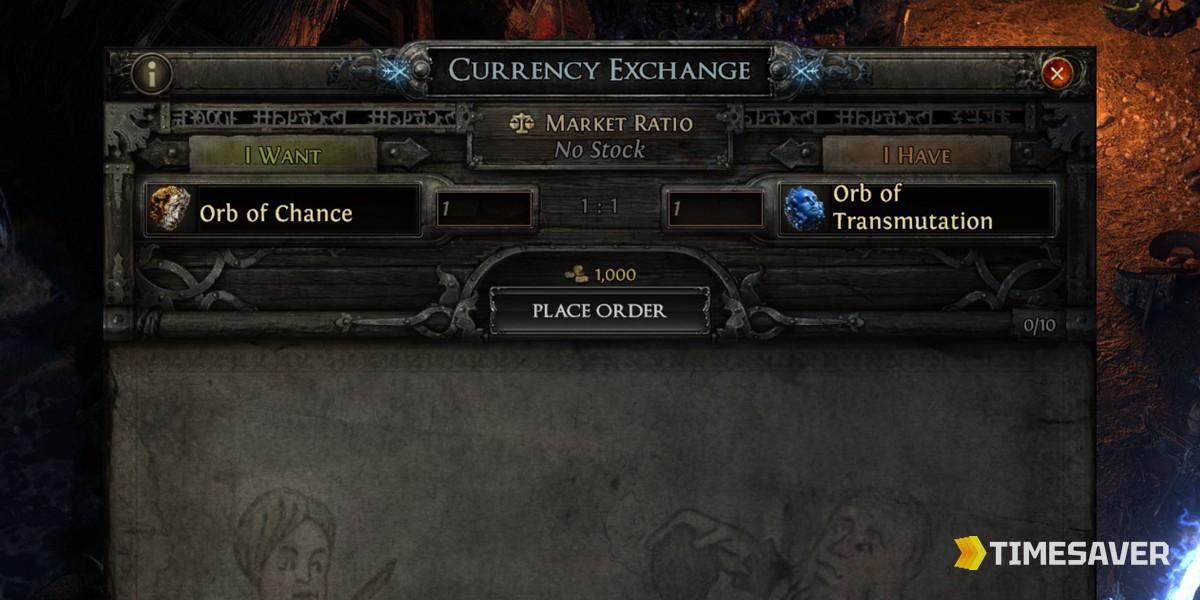
- Buy them in bulk on the Currency Exchange. They sit near the bottom of the value chart (poe2db lists a ~1,000-gold reference price), so a small pile of Exalted or Divine converts into hundreds of Chance Orbs instantly — far faster than waiting on drops.
- Stockpile white bases in parallel. Pick up Normal Utility Belts, Heavy Belts and Gold Rings as you map, or buy white bases cheap. You need a deep stack of bases to feed a serious chancing session.
If your real goal is the belt and not the gamble, the honest math is simple: the currency you'd burn chancing a thousand belts is often most of the way to just buying the Mageblood or Headhunter outright — with a guaranteed result and zero destroyed bases.
Skip the Lottery: Fund the Belt Instead
Chancing is fun, but it's a coin-flip with a thousand-sided coin. If you want the chase item without donating a stash tab of belts to the RNG gods, the reliable path is to stack the currency and buy the finished Unique — or buy a clean pile of Chance Orbs and bases to gamble on your own terms.
timesaver.gg — skip the grind, get the orbs:
- PoE2 Currency (all orbs) — Divine · Chaos · Exalted · Chance · instant delivery, best rate
- PoE2 Divine Orbs — fund the Mageblood / Headhunter buyout outright
- PoE2 Items & Uniques — grab the chase belt directly, no gamble
- PoE2 Leveling & Boss Carries — pro players, skip the grind
For the targeted-belt route via Ritual instead of chancing, see our Mageblood & Headhunter farming guide.
Orb of Chance — Key Numbers at a Glance (0.5.4)
Here are the concrete figures to anchor your chancing session in August 2026:
- Chance Orb exchange rate: roughly 8–12 per Divine Orb on the PoE2 Currency Exchange (bulk; 0.5.4 economy).
- Chase-belt odds: community testing estimates roughly 1 in 1,000–2,000 orbs for a Unique hit on Utility Belt / Heavy Belt, with Mageblood or Headhunter being one of 3 possible Uniques in each pool — so the real per-orb odds on the specific jackpot are closer to 1 in 3,000–6,000.
- Omen of Chance drop level: 75. Farmed from Ritual Altars — see the full Omens guide for fastest sourcing methods.
- With-Omen expected cost: at ~10 Chance Orbs per Divine and 1 Omen per roll (Omens are rarer than Orbs — factor in their value), a 1-in-1,500 overall Unique hit still means an expected ~150 Divine in orbs alone before any Mageblood appears. The belt buyout is usually cheaper.
Attributed perspective — Maxroll's Path of Exile 2 team on chancing meta: "Chancing belts is a lottery-like mega-gamble. Unless you already have hundreds of Chance Orbs stockpiled, the math will almost always favor simply buying the Unique outright." — Maxroll's 0.5 Chancing Guide
Frequently Asked Questions
Does the Orb of Chance work on Magic or Rare items in PoE2? No. It only works on Normal (white) items. Magic, Rare and Unique items can't be chanced — you'd need a fresh white base.
Why does my Orb of Chance say the item "cannot be upgraded" or do nothing? The base you're chancing has no Unique tied to that base type, so the orb has nothing to turn it into. Check that a Unique actually uses that exact base (e.g. Utility Belt for Mageblood) before spending orbs.
What's the best item to chance in PoE2? For raw payoff, white Utility Belts (jackpot: Mageblood) and white Heavy Belts (jackpot: Headhunter) — but both bases hold three Uniques, so a successful upgrade can land a cheaper one (Cat O' Nine Tails/Ingenuity, or Waistgate/Zerphi's Genesis) instead. Gold Rings are the friendlier pick because every Unique in their pool (Ventor's Gamble, Andvarius, Perandus Seal) has value, so a miss on the best one still pays.
What are the odds of chancing Mageblood or Headhunter? GGG doesn't publish exact numbers, but community testing estimates roughly 0.05–0.1% per orb (about 1 in 1,000–2,000) for top-tier targets. Expect to destroy a lot of bases. Treat it as a lottery, not a farming method.
How do I stop the Orb of Chance from destroying my item? Hold an Omen of Chance in your inventory — verbatim, "your next Orb of Chance will not destroy the Item." Your failed roll leaves the white base intact so you can chance it again.
Can you chance the same base multiple times with Omen of Chance? Yes — and that's exactly the use case. Each Omen of Chance protects a single roll: failed chance doesn't destroy the base, leaving it in Normal rarity so you can keep spending orbs. You need one Omen per attempt to maintain that protection indefinitely, so a long session burns both Chance Orbs and Omens. They're drop-level-75 Ritual Omens, so factor their value into your cost math.
What happens if the base only has one Unique in PoE2? If the Normal base has exactly one Unique tied to it, a successful Orb of Chance roll guarantees you get that specific Unique — there's no pool to randomize across. The odds of the roll succeeding are the same (still very low), but every upgrade is the item you want. This is why some single-Unique bases can be a cleaner chancing target than Utility Belt or Heavy Belt, which both have three Uniques sharing the pool.
Is chancing or buying the belt better? If you want the item reliably, buying is better — the expected currency cost of chancing a chase belt usually exceeds its market price, with no destroyed bases and a guaranteed result. Chance for the thrill; buy for the build.