TL;DR — In Path of Exile 3.29 "Curse of the Allflame," Delirium is still one of the best density-scaling mechanics for stacking currency, scarabs, and divination cards in a single map. Touch the Mirror of Delirium, run into the fog, and clear monsters fast enough to hit reward thresholds before the fog thins out. Save Simulacrum Splinters — 300 of them combine into a Simulacrum, a 30-wave arena that is one of the game's densest reward piñatas. Delirium and Simulacrum are unchanged in 3.29 (the only related tweak is the retired Timeless Delirium Orb), so the proven layering strategies still work. Below: how the mechanic pays out, which Delirium Orbs to slam, how to build for it, and how to run Simulacrum without dying on wave 27.
Delirium is the endgame mechanic players love to ignore — right up until they watch someone strip a Delirium-layered map for a screen full of currency and cards. It rewards two things Path of Exile is built around: clear speed and monster density. If your build can push deep into the fog and keep killing, Delirium turns a normal map into one of the fastest currency-per-hour strategies in the game.
This guide covers the full loop for the 3.29 Curse of the Allflame league: reading the reward bars, layering Delirium Orbs, pairing scarabs, building a character that can actually survive the fog, and turning your Simulacrum Splinters into 30 waves of loot.

Short on currency for the build? You can buy PoE Divine Orbs from Timesaver on any league or Standard, delivered in a private trade.

Path of Exile - Divine Orbs
Get up to 1,000 Divine Orbs in 10 minutes
What is Delirium and how does the fog actually pay out?
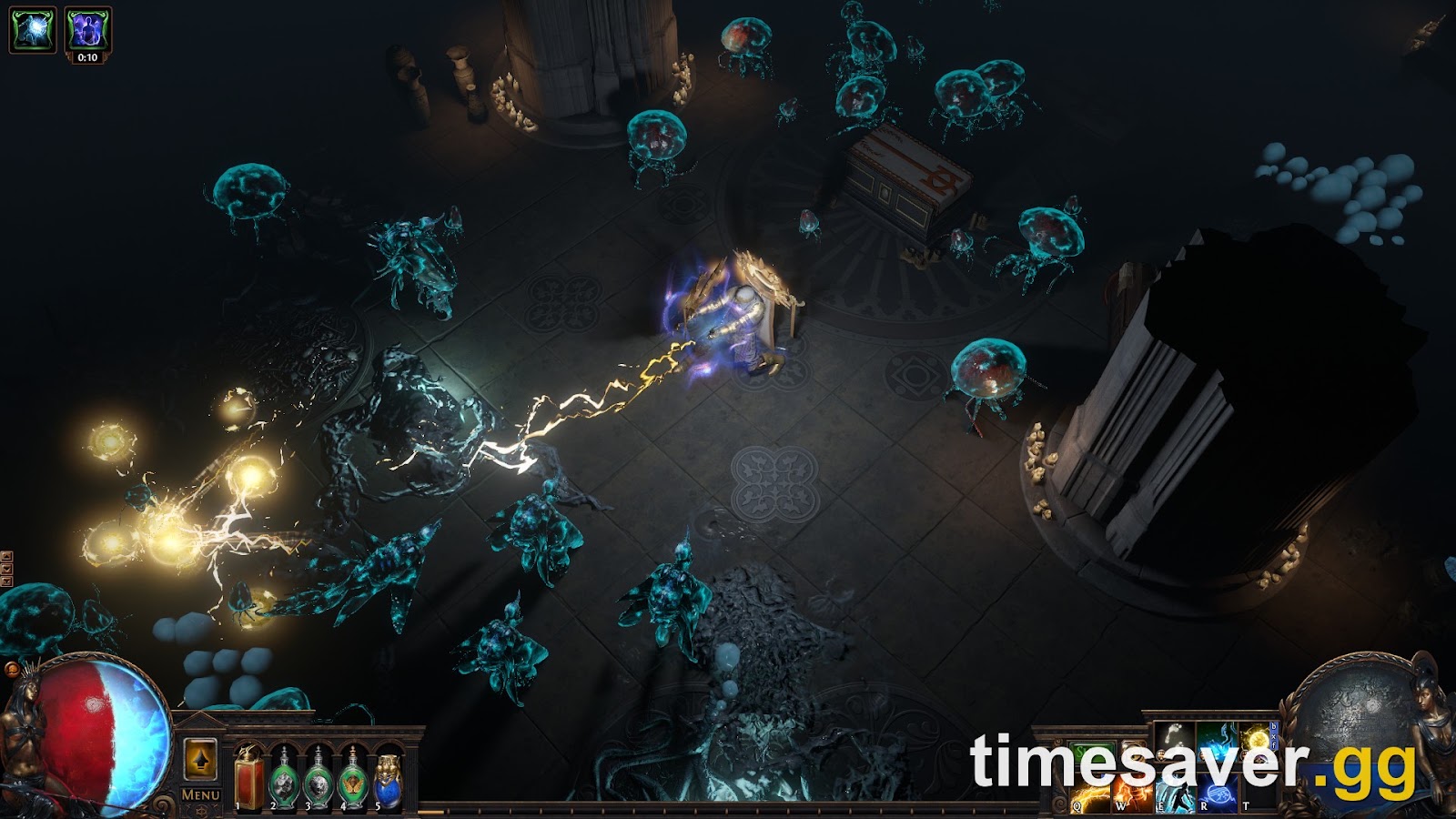
Every map can spawn a Mirror of Delirium near the entrance. Touch it and the map fills with a spreading gray fog. As the official 3.10 reveal put it: "Upon touching the mirror, your reality will turn to mist and your nightmares will manifest." The further you travel into that fog, the higher the "delirium %" climbs — and both monster difficulty and reward density scale up together.
Rewards are the whole point. As you kill monsters inside the fog, you fill reward bars (shown above your experience bar). Maxroll's Delirium guide describes the core loop plainly: "As you follow the fog… you will gain a continually increasing item quantity bonus; monsters will also become harder the deeper you go." Each time you cross a reward threshold, a new reward tile unlocks and the loot for that category drops. Common categories you'll see:
- Currency — raw orbs, the bread-and-butter payout
- Fragments & Scarabs — feeds your other map strategies
- Divination Cards — pairs beautifully with a card-farming setup
- Unique Items — the jackpot tiles at high delirium
- Simulacrum Splinters — your ticket to the Simulacrum (more below)
The catch: the fog is a race. It keeps expanding away from you, so you have to kill fast enough to keep unlocking reward tiles before you run out of fog to chase. A slow, tanky build that clears one pack at a time will bank a fraction of what a fast AoE build banks on the same map. This is why Delirium is a build-defining mechanic, not a side activity.
Hard numbers to anchor on: the Simulacrum is a 30-wave encounter (Grinding Gear added the final 10 waves, per poedb: "Added 10 additional waves to the Simulacrum, it now has a total of 30 waves"). It takes exactly 300 Simulacrum Splinters to build one Simulacrum — poedb states it verbatim: "Simulacrum is a map fragment obtained by combining 300 Simulacrum Splinters." And you can apply up to 5 layers of Delirium to a single map with orbs.
Which Delirium Orbs should you use to layer a map?
You don't have to wait for a natural Mirror spawn. Delirium Orbs are consumable currency that apply a persistent Delirium fog to a map when you use it — and you can stack them. poedb's description is exact: the orb "Modifies a Map item adding layers of Delirium… Can apply up to 5 to a single Map item." Layering multiple orbs raises the baseline delirium % and, critically, lets you bias the reward category toward what you want to farm.
Each named orb pushes rewards toward a specific bucket. Tier-1-confirmed examples worth knowing:
- Fine Delirium Orb → biases Currency
- Diviner's Delirium Orb → biases Divination Cards
- Skittering Delirium Orb → biases Scarabs
- Cartographer's Delirium Orb → biases Maps
- Singular Delirium Orb → biases Unique Items
- Blacksmith's / Armoursmith's / Whispering / Abyssal → weapon, armour, and other specialized buckets
The winning move is stacking orbs of the same category so all five layers point at one reward type. Five Diviner's Orbs on a map running a divination-card strategy compounds hard — the delirium reward tiles and your card-farming setup both pull in the same direction. If you're chasing raw orbs to fund crafting, five Fine Delirium Orbs on a high-quantity map is a clean, repeatable currency engine.
One 3.29 note so you don't get caught out: Delirium and Simulacrum themselves were not changed in Curse of the Allflame. The only adjacent tweak in the 3.29.0 patch notes is that "the Timeless Delirium Orb is no longer obtainable" — that's a Legion-reward orb being retired, not a change to the Delirium league mechanic. Every layering strategy in this guide still works exactly as it did last league.

Building a character that can farm Delirium
Delirium punishes two weaknesses instantly: not enough damage (you can't cross reward thresholds fast enough) and not enough defense (the deep-fog monsters delete you). A Delirium farmer needs both, plus movement speed to physically keep pace with the fog.
Priorities, in order:
- Clear speed & AoE. You are killing dense packs against a timer. A build that one-shots screens (a strong mapping skill, good area-of-effect, and high attack/cast speed) will out-earn a single-target monster by a wide margin.
- Layered defenses. Deep-fog monsters hit hard and apply degens. Capped elemental resistances, a large life or energy-shield pool, and at least one recovery/mitigation layer (fortify, a guard skill, high regen, or leech) keep you alive past the point where rewards get good.
- Passive-tree investment. This is where jewels matter. Well-chosen jewels in your tree sockets (the interior ones) tune damage and defense to your build. Cluster Jewels are a separate system — they socket only in the outer rim of the passive tree and add entirely new passive options, as the 3.10 notes describe: "Added Cluster Jewels, a new type of jewel which can be socketed in the outer rim of the Passive Skill Tree." Don't confuse a normal jewel in a large interior socket (like the Split Personality jewel shown above) with a Cluster Jewel — they do different jobs.
- Movement speed. Boots, a movement skill, and quicksilver uptime all matter more here than in most content, because the fog literally runs away from you.
If your current character can already blast Tier-16 maps comfortably but stalls in Delirium, the fix is almost always more speed and AoE, not more single-target damage.
How does the Simulacrum work, and is it worth running?
Save every Simulacrum Splinter that drops from your Delirium maps. Once you hit 300, they combine into a Simulacrum — a self-contained arena encounter that is one of the densest reward sources in the game. Grinding Gear's own note when it launched: "Added the Simulacrum, an endgame encounter accessible by collecting Simulacrum Splinters from Delirium encounters."
Inside, you survive 30 escalating waves of Delirium monsters. Two bosses interrupt the run:
- Omniphobia, Fear Manifest — appears around wave 10 (guaranteed by wave 15)
- Kosis, The Revelation — appears around wave 15 (guaranteed by wave 20)
Rewards scale hard toward the back half. Waves 1–15 are a warm-up; the real payout is surviving 20 through 30, where the loot density spikes. Practical Simulacrum tips:
- Bring a boss-viable build. The Simulacrum is a survival check, not a mapping check — sustained single-target and AoE both matter here, unlike open-map Delirium where clear speed dominates.
- Watch your degens. Late waves layer on damage-over-time effects; recovery uptime is what fails first.
- Don't be a hero at low investment. If your build stalls at wave 22, farm a few more Splinters, over-level, and come back — a failed Simulacrum still drops the waves you completed, but a full clear is worth far more.
If you want to fund a lot of Simulacrum runs fast, stacking Delirium on your maps (with Splinter-friendly layering) is the most direct pipeline to 300 Splinters.

Path of Exile - Chaos Orbs
Get up to 20,000 Chaos Orbs in 10 minutes
How does Delirium fit with your other 3.29 farming strategies?
Delirium isn't a standalone strategy — it's a multiplier you bolt onto an atlas you're already running. It stacks cleanly with other density mechanics because more monsters in the map means more monsters inside the fog. Natural pairings for 3.29:
- Layer Delirium over a Legion or Breach map — both dump huge monster counts into the fog at once.
- Run it alongside Abyss for a second on-death-effect-free density layer.
- Pair Diviner's Delirium Orbs with a dedicated divination card farm so both systems pull the same cards.
- Funnel your Delirium currency drops into the Deep Altar / currency conversion loop to compound your profit.
The economy moves fast in a fresh league, so verify the current value of any orb or fragment on poe.ninja before you commit — Delirium Orb prices in particular swing with league-wide farming trends.
Frequently asked questions
Is Delirium worth farming in 3.29? Yes. Delirium is unchanged in Curse of the Allflame, and it remains one of the best density-scaling mechanics for currency, scarabs, and divination cards. Any build with strong clear speed profits from layering it onto maps.
How many Simulacrum Splinters do you need? Exactly 300 Simulacrum Splinters combine into one Simulacrum fragment. Splinters drop from Delirium encounters and Delirium-layered maps.
How many waves is the Simulacrum? The Simulacrum is a 30-wave survival encounter. Omniphobia appears around wave 10 and Kosis around wave 15, with the biggest rewards concentrated in the final waves.
What do Delirium Orbs do? Delirium Orbs apply a persistent Delirium fog to a map, and you can stack up to five on a single map. Named orbs (Fine, Diviner's, Skittering, Cartographer's, Singular, and others) bias the reward tiles toward a specific category like currency, cards, scarabs, maps, or uniques.
Are Cluster Jewels part of Delirium? Cluster Jewels were introduced in the same league as Delirium but are a separate system. They socket only in the outer rim of the passive tree to add new passive skills, unlike normal jewels that slot into interior tree sockets.
Did 3.29 change Delirium or the Simulacrum? No. The Delirium league mechanic and Simulacrum are unchanged in 3.29. The only related adjustment is that the Timeless Delirium Orb (a Legion-reward orb) is no longer obtainable.
Skip the grind
Delirium is a farming engine — but 300 Splinters, a Delirium-ready build, and a stack of orbs all take time to assemble. If you'd rather run the fog than farm the setup, we can shortcut the currency and carry side:
- Buy PoE currency — fund your Delirium Orbs, scarabs, and crafting in one go
- PoE boosting & carry services — Simulacrum wave-30 clears and endgame carries by veteran players
- Divine Orbs — the crafting currency that turns Delirium drops into a real build
- All Path of Exile services — leveling, currency, and endgame help in one place
Prices and league economy shift daily — always confirm the current rate on poe.ninja before you trade.