Quick answer: In Path of Exile 3.29 "Curse of the Allflame," the Forbidden Sanctum is a self-contained, run-based currency lane: you spend four floors of eight rooms managing a Resolve bar (start value 300) instead of your normal life, hoarding Aureus coins to buy Relics and Boons, and finishing on Lycia, Herald of the Scourge, who has a 100% chance to drop a Unique Relic and can drop the Sanctum-only chase uniques like Original Sin. It survived 3.29 completely intact except two tweaks: flask charges now refill between rooms, and Volatile Vaal Orbs were added to the reward pool. That "untouched" status is exactly why it's a stable, undervalued farm right now.
The whole Sanctum economy runs on one skill: not getting hit. Everything below is built around protecting Resolve and converting completed runs into Divines. This guide is current for 3.29, verified against the official 3.29.0 patch notes, Maxroll, and poedb.
Short on currency for the build? You can buy PoE Divine Orbs from Timesaver on any league or Standard, delivered in a private trade.

Path of Exile - Divine Orbs
Get up to 1,000 Divine Orbs in 10 minutes
What is the Forbidden Sanctum in Path of Exile?
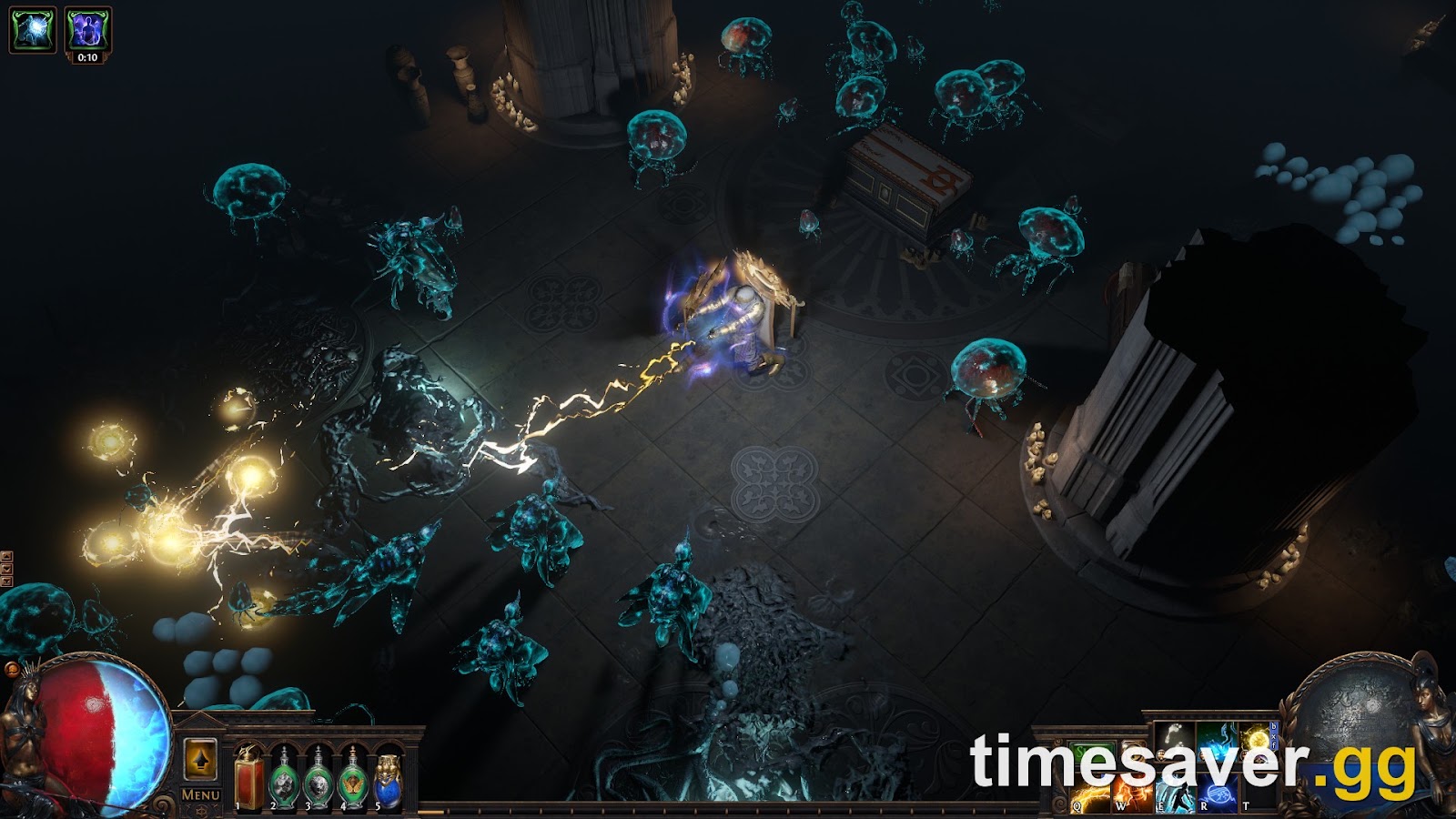
The Forbidden Sanctum is an ancient Templar enclave beneath the Fellshrine Ruins, added to the core game back in 3.20 and unchanged in structure since. You access a run through the Forbidden Sanctum map fragment (a Forbidden Tome represents the entire first floor and can be played room-to-room), and the NPC Divinia first introduces it in the Oriath Docks in Act 10. The Sanctum has a maximum area level of 83.
Inside, the normal rules of the game are suspended. Your life, energy shield and flasks stop mattering the way they usually do. Instead you have Resolve, a single bar that gets chipped every time an enemy hits you. As Maxroll puts it:
"At a baseline you start every Sanctum run with 300 Resolve and this is reduced every time you are hit during. If this value reaches 0 the run ends and the Sanctum is lost."
That last clause is the whole game. Failure isn't a death screen you shrug off. You lose the entire run, every unspent Aureus coin, and any progress toward the boss. That risk is precisely why a market exists for Sanctum carries.
If you like self-contained farms where a single mistake ends the attempt, Sanctum sits next to mechanics like the Ritual altar and Delve's Azurite Mine, but Sanctum is the most punishing of the three because there's no "just walk away" once Resolve is gone.
How does a Sanctum run actually work?
A full run is 4 floors of 8 rooms each, with a boss encounter capping each floor. As you move room to room, you accumulate two kinds of modifiers:
- Boons — positive effects you pick up or buy (examples: All-Seeing Eye, Crystal Shard).
- Afflictions — negative effects the Sanctum forces on you (examples: Cutpurse, Deadly Snare).
Between rooms you choose your path, deciding whether to take a fight, a merchant, a fountain, or a reward. The in-run currency is Aureus coins, which drop from bosses, guards and chests and auto-loot as you walk near them. You spend Aureus at merchants and fountains during the run (on Relics, Boons, and Resolve restoration) and you lose all of it the moment the run ends, win or lose. Bank nothing; spend it before Lycia.
One critical detail unique to Path of Exile (do not confuse this with Path of Exile 2's Trial of the Sekhemas): PoE1 Sanctum uses Aureus coins only. There is no "Sacred Water" here; that's a different game.
The two Sanctum changes in 3.29
This is the info-gain that makes Sanctum worth revisiting now. The mechanic is otherwise identical to previous leagues, but the official 3.29.0 patch notes made exactly two Sanctum adjustments:
"When in The Forbidden Sanctum, Flask Charges are now restored when you interact with the Sanctum Map between each room. This does not apply to The Writhing Jar Unique Flask."
"Volatile Vaal Orbs can now be obtained as Sanctum Rewards."
The flask-charge change is a quiet but real quality-of-life buff: builds that lean on flask uptime no longer arrive at a boss room bone-dry. Nothing else about Sanctum changed across 3.29.0, 3.29.0b, 3.29.1, 3.29.2 or 3.29.3. That stability is the opportunity: the mechanic is well-understood, the guides are current, and the reward structure hasn't been nerfed.
How do you stop losing Resolve?
Resolve management is the entire skill ceiling of Sanctum. Four levers matter:
- Don't get hit. Resolve drops per hit, not per second, so movement and positioning beat raw tankiness in many rooms.
- Your defensive layers now protect Resolve. This is the biggest mechanical detail people miss: Armour provides Resolve Mitigation from enemy hits, Evasion grants a chance to avoid Resolve loss entirely, and Energy Shield gives you a Resolve Aegis that behaves like ES does for life. A defensively-built character genuinely bleeds less Resolve.
- Stack Inspiration through Relics and Boons. Inspiration offsets the Resolve you sacrifice to Pacts, so an Inspiration-focused Relic setup lets you take more aggressive rewards safely.
- Buy Resolve back at fountains when Aureus allows, and take defensive Boons early on floors 3 and 4 where monster difficulty ramps hardest.
A quick word on Pacts, since they trip up new runners. Pacts are optional deals the Sanctum offers between rooms: you accept an Affliction or spend Resolve now in exchange for a reward such as Aureus, a Boon, or a better item. On a squishy build, a Pact that drains 30 Resolve for a handful of coins is a trap that snowballs into a failed floor 4. The way you make Pacts safe is Inspiration: when you have a stockpile of Inspiration built up, the Resolve cost of a Pact is paid out of Inspiration first, so you can take the reward without touching your actual Resolve bar. That is the entire economic engine of a good Sanctum run: bank Inspiration early, spend it on Pacts and rewards later.
Rare monsters can appear inside the Sanctum, and a room isn't complete until all rares are dead, so a room that looks clear can still be draining your Resolve from an off-screen rare. Monsters are immune while no player is within 100 units, which means you can't safely leash-pull the whole room; you have to commit.
Relics: the real reason to farm Sanctum
Relics are the meta reward. They're equippable items you lock into your Relic inventory at the start of floor one, and, importantly, they cannot be changed for the rest of the run, so your Relic loadout is a pre-run decision. They're tradeable, so a strong Relic set is itself a currency sink you can buy into or sell out of.

Relics come in Magic and Unique rarities. Magic Relics roll helpful prefixes; Unique Relics alter the run's rules and only drop from bosses. The strongest general-purpose Relics grant repeatable Inspiration gain, because Inspiration is what lets you keep taking Resolve-negative rewards without ending the run early.
For newer players, the trap is treating Relics as loot to sell rather than tools to equip. Early on, equipping a solid Inspiration Relic set makes the difference between finishing floor 4 and dying on floor 3 with nothing to show for it.
A reliable starter loadout looks like this: prioritise Relics that grant Inspiration on entering a room or Inspiration when you kill the room's rare monster, because that gives you a steady Inspiration income to spend on Pacts. Round the set out with a Relic that grants increased Aureus found so you have more to spend at merchants, and one defensive Relic (for example, one that reduces Resolve lost from the first hit each room) for the harder floor 3 and 4 fights. Save the exotic Unique Relics that change the run's rules for when you know the mechanic well; some of them raise reward quality at the cost of far more Resolve pressure, which is only worth it on a genuinely tanky character. Because your loadout is locked at the start, decide before you enter whether this run is a safe farm or a high-risk push, and equip accordingly.
Lycia, Herald of the Scourge: the payoff
Each floor ends in a boss, and floor 4 ends on Lycia, Herald of the Scourge. Completing a run requires killing Lycia in both her first and second form (poedb also labels a later phase "Lycia, Unholy Heretic," the same fight, not a separate boss).
Her value is guaranteed: Maxroll confirms Lycia "has a 100% chance to drop a Unique Relic after being defeated." On top of that guaranteed Relic, she and the run's reward rooms are the source of the Sanctum-exclusive chase uniques.

Path of Exile - Chaos Orbs
Get up to 20,000 Chaos Orbs in 10 minutes
What makes Sanctum profitable in 3.29?
The money comes from three stacked sources:
- The guaranteed Unique Relic from every completed run — a baseline floor of value that other farms don't hand you for free.
- Divine Orb density. Per Maxroll: "Making a large amount of currency from Sanctum heavily relies on you executing successful runs, Divine Orbs appear much more frequently in areas level 81+." Run high-tier Sanctums (the max area level is 83) and Divines show up materially more often.
- The chase uniques. The Sanctum-only unique pool in 3.29 includes Original Sin (the marquee build-enabling drop and the big-money target), The Balance of Terror, Eternal Damnation, Sandstorm Visage, and The Winds of Fate. A single Original Sin can be worth more than a week of ordinary mapping.
Prices swing hard through a league, so check the live rate on poe.ninja before you buy or sell any of these. Don't trust a number from a stale guide. If you want a stable currency lane to convert your Sanctum profits into, Divine Orbs are the trade backbone that Sanctum farmers cash out to.
Is Sanctum better than other 3.29 farms?
It depends on your build, and here's the practical decision tree:
- Tanky, defensively-layered build? Sanctum is excellent: your Armour/Evasion/ES actively protects Resolve, and you can push floor 4 reliably for the guaranteed Relic plus chase-unique chances.
- Glass-cannon mapper? Sanctum will punish you. You'll lose Resolve fast and fail runs. You're better off on a density farm like Delirium, where dying costs one map, not an entire run.
- Short on time? This is where buying a completed run makes sense. Because failure wipes everything, players routinely pay tanky specialists to clear the Sanctum or kill Lycia for them.
One structural note: unlike most PoE mechanics, Sanctum has no scarab and no dedicated Atlas passive cluster. You can't juice it through the Atlas tree the way you juice Breach or Legion. Verified against the full poedb scarab list, there is no Sanctum Scarab. Access comes from the map fragment itself, which keeps supply (and therefore the market for carries) tighter than scarab-farmable mechanics.
If you'd rather skip the Resolve grind entirely and go straight to the rewards, our PoE boosting and carry services cover Sanctum runs and Lycia kills.
FAQ
Is Sanctum worth farming in 3.29? Yes, if you can survive it. It's untouched core content this league (only a flask-charge QoL tweak and a Volatile Vaal Orb reward addition), the guides are current, and level 81+ runs give strong Divine density plus a guaranteed Unique Relic from Lycia. It's marginal for squishy, under-geared builds because a single failed run loses everything.
How do Relics work in Sanctum? You equip Relics in your Relic inventory before the run begins, and they're locked in for the entire run, so you can't swap them mid-Sanctum. They buff you only inside the Sanctum, come in Magic and Unique rarities, and are tradeable. Inspiration-granting Relics are the strongest general pick because Inspiration offsets Resolve costs.
Can you die in the Forbidden Sanctum? Your normal life still matters, but the run-ending condition is Resolve reaching 0. When Resolve hits zero the run ends and the Sanctum is lost, along with all unspent Aureus coins. That's why Resolve management, not raw DPS, is the skill that matters here.
What is the big-money drop from Sanctum? Original Sin is the flagship chase unique and the highest-value target. Every completed run also guarantees a Unique Relic from Lycia, and the other Sanctum-exclusive uniques (The Balance of Terror, Eternal Damnation, Sandstorm Visage, The Winds of Fate) add to the pool. Always verify current prices on poe.ninja.
Does Sanctum have a scarab or Atlas tree nodes? No. Unlike Breach, Legion, or Betrayal, the Forbidden Sanctum has no scarab and no dedicated Atlas passive cluster. You access runs through the Sanctum map fragment, which keeps supply tighter than Atlas-juiced mechanics.
What changed for Sanctum in 3.29? Exactly two things per the official 3.29.0 notes: flask charges are now restored when you interact with the Sanctum Map between rooms (except the Writhing Jar), and Volatile Vaal Orbs were added as a possible Sanctum reward. Everything else is unchanged across every 3.29 patch.
Bottom line
The Forbidden Sanctum in 3.29 is a high-skill, high-ceiling currency lane hiding in plain sight: unchanged mechanics, a guaranteed Unique Relic per clear, strong Divine density at level 81+, and a set of chase uniques headlined by Original Sin. The catch is Resolve: get hit too much and you lose the whole run. Build defensively, equip Inspiration Relics, spend your Aureus before Lycia, and it becomes one of the most reliable self-contained farms in the game. Or skip the risk and buy the clear.
Start faster in Path of Exile:
- PoE boosting & carry services — Sanctum runs and Lycia kills, done for you
- PoE currency — stock up before your Sanctum push
- Divine Orbs — the trade backbone for cashing out chase uniques