Quick Answer (TL;DR)
A Sanctified item in Path of Exile 2 is a Rare that has been modified with the Omen of Sanctification: while that Omen is active in your inventory, your next Divine Orb used on a Rare multiplies every modifier by a random 0.78x to 1.22x (in 0.01 steps), rounds the result up, and permanently locks the item. The huge upside: because Sanctify multiplies the current value instead of rerolling within the mod's range, a perfectly-rolled affix can be pushed above its normal maximum — up to +22%. The catch: it's a gamble (you can also lose up to 22%), and once an item is Sanctified it behaves like a Corrupted or Mirrored item — no further crafting is possible. You buy the Omen with Tribute on the Ritual Favours page (a high-level Ritual Omen, drop level 79–80), set it active, then Divine your finished Rare. Each attempt costs one Divine Orb (floating ~100–130 Exalted right now — check poe.ninja for the live rate) plus the Omen, so this is an endgame, best-item-only tool.
Updated August 2026 — verified for PoE2 patch 0.5.5 (Event League). Omen of Sanctification mechanics, Ritual Tribute costs, and Divine Orb price range confirmed current.
If you've ever Divined a god-tier Rare and watched a mod roll down, Sanctify is the answer — it's the only mechanic that can take an already-max item and roll it higher. But it's also the mechanic quietly bricking expensive trade-bought items for players who didn't read the tooltip. Here's exactly how it works, when it's worth a Divine, and how to avoid losing a chase item to it.

PoE2 - Divine & Exalted Orbs
Skip the grind — get Divine & Exalted Orbs
What Is a Sanctified Item in PoE2?
Sanctified is an item property — a permanent state, just like Corrupted or Mirrored. When an item becomes Sanctified, every one of its explicit modifiers gets a magnitude multiplier applied, and the item is then sealed: most crafting and modification methods can no longer touch it.
The PoE2 Wiki is explicit on the lockout:
"Most methods of item crafting and modification cannot be used on Sanctified items."
That single line is why Sanctified shows up in panicked Reddit threads. Players buy a strong Rare off the trade site, try to keep improving it — instil an anointment, slam an Exalted Orb, add a Desecrated mod — and nothing works, because the item is Sanctified. Unlike a Corrupted item (which the trade site flags with an obvious red highlight), the Sanctified line is just one more row of text on the tooltip, so it's easy to miss before you spend "days of savings," as one buyer put it.
Important: Sanctified does not mean bricked. If the rolls came out well, a Sanctified item is simply a finished, locked-in item — fully usable, fully tradeable. It's only a problem if you wanted to keep crafting it. Treat the Sanctified line the same way you treat Corrupted: it means "this item is done, what you see is what you get."
What Does the Omen of Sanctification Do?
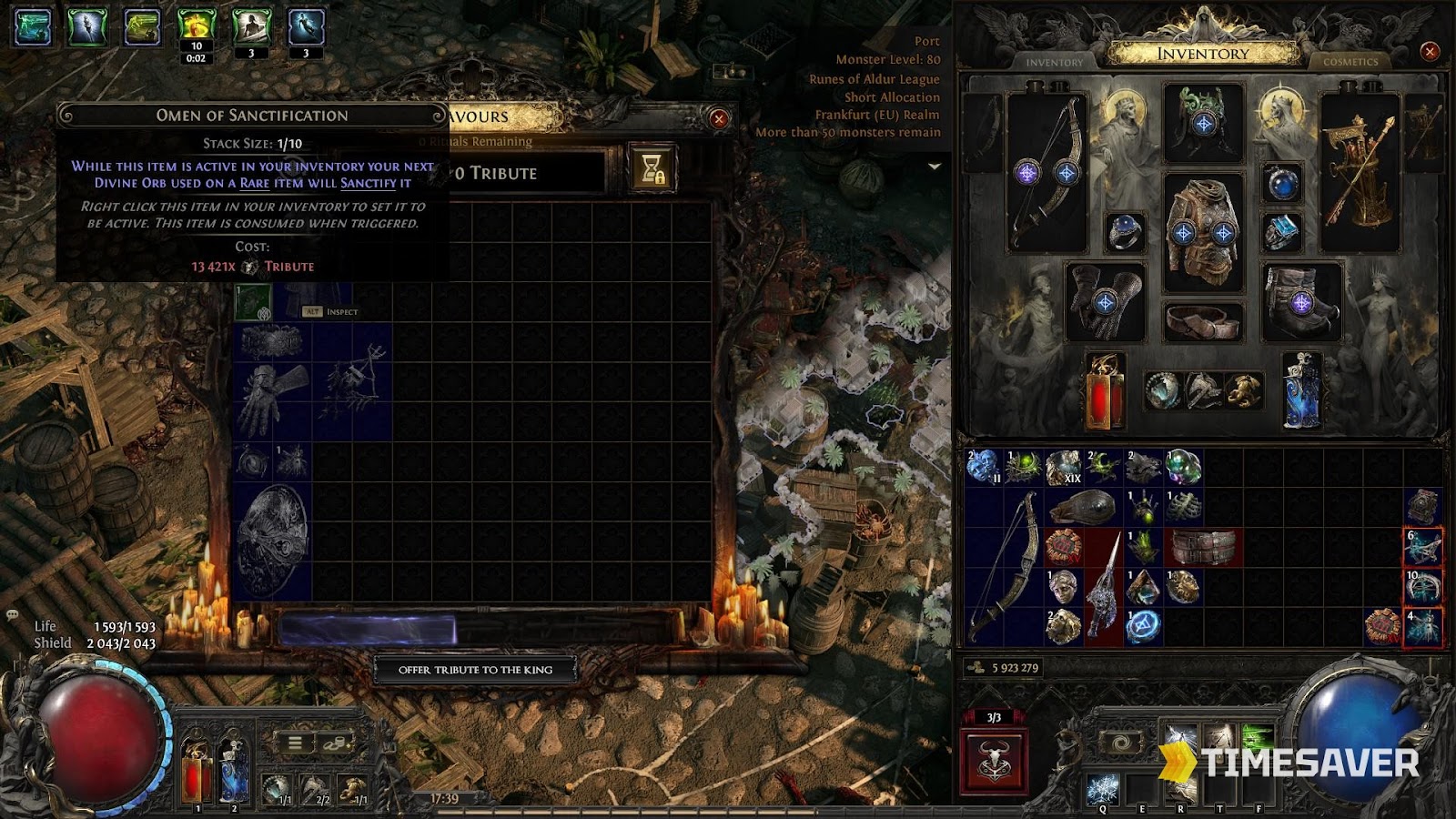
The Omen of Sanctification is a Ritual-exclusive Omen that changes how your next Divine Orb behaves. Its in-game text reads verbatim:
"While this item is active in your inventory your next Divine Orb used on a Rare item will Sanctify it. Right click this item in your inventory to set it to be active. This item is consumed when triggered."
So the workflow is two items, not one: the Omen redirects a Divine Orb. Normally a Divine Orb "randomises the numeric values of modifiers on an item" — it rerolls each mod somewhere within its existing range. With the Omen of Sanctification active, that same Divine Orb instead does something completely different:
- It takes each modifier's current value (no rerolling).
- It multiplies that value by a random 0.78x to 1.22x, rolled independently per mod, in increments of 0.01.
- It rounds the result up.
- The item becomes Sanctified and can no longer be modified.
The official 0.5.1 patch note describes the magnitude behaviour directly:
"Sanctifying an item now multiplies the modifier values by 0.78x to 1.22x and rounds up the results, similar to unique item corruption."
The wiki frames Sanctification as "a more predictable variant of corruption" — and that's the key mental model. A Vaal Orb can do almost anything (reroll, add sockets, brick the item entirely). Sanctify can only do one thing: nudge every existing mod up or down within a tight ±22% band, then lock it. No new mods, no removed mods, no destroyed item.
Why Sanctify Can Beat a Max Roll (the Whole Point)
Here's the nuance that makes Sanctify a genuine chase tool rather than a gimmick. A normal Divine Orb rerolls a mod within its defined range — if "+90 to maximum Life" can roll 80–90, Divining a 90 can only ever give you 80–90 again. You can never exceed 90.
Sanctify ignores the range. It multiplies the current number, so a maxed 90 Life roll can become up to 90 × 1.22 = 110 (rounded up) — a value the affix could never reach normally. For mirror-tier crafters chasing the single best copy of an item in the league, this is the only mechanic in the game that breaks the ceiling.
| Tool | What it does to a maxed mod | Can exceed max roll? | Risk | Item locked after? |
|---|---|---|---|---|
| Divine Orb (normal) | Rerolls within the mod's range | No | Mod can roll lower | No — keep crafting |
| Divine Orb + Omen of Sanctification | Multiplies current value ×0.78–1.22, rounds up | Yes (up to +22%) | Mod can drop up to −22% | Yes — permanently |
| Vaal Orb (Corrupt) | Unpredictable: reroll / add socket / brick | Sometimes | Can destroy/wreck the item | Yes — permanently |
The trade-off is symmetrical: the same orb that can push a mod 22% over cap can also drop it 22% under. And because it hits every mod at once, a six-mod item is six independent coin-flips — getting all of them to land high is rare. That's why Sanctify belongs only on items where you'd be happy to lock in a slightly worse roll and thrilled to land a better-than-possible one.
Sanctify vs Corrupt (Vaal): Which Should You Use?
These two are mutually exclusive — you cannot Sanctify a Corrupted item, and you cannot Corrupt a Sanctified one. The Omen of Sanctification simply won't fire on a corrupted base. So the decision is made once, and it's permanent.
- Use Sanctify when the item is already finished and excellent, and your only remaining upgrade is bigger numbers on the mods you already have. You want a predictable, contained gamble.
- Use Vaal/Corruption when you're chasing a structural change — an extra socket, a corrupted implicit, a lucky reroll on a cheap base — and you can stomach the item being destroyed or wrecked.
Rule of thumb: Sanctify is for your best item (low-variance polish), corruption is for your gambling item (high-variance lottery). Never Sanctify something you'd cry over losing 22% on, and never Vaal something you can't afford to brick.
Where to Get the Omen of Sanctification
The Omen of Sanctification is Ritual-only. It is a drop-restricted Omen with a drop level of 79–80 (sources vary: poe2wiki lists 79, poe2db 80), and it appears as a purchasable reward on the Ritual Favours page — the same Tribute shop where you buy chase belts and other Omens.
To farm it reliably:
- Run Tier 15+ Waystones with Ritual juiced on your Atlas tree and via Ritual Precursor Tablets in Towers — see the Ritual types guide for the full setup.
- Clear and activate each Ritual altar to bank Tribute (kill the revived monster waves).
- Spend Tribute on the Omen of Sanctification when it appears in the Favours, or Defer it (15% of its Tribute cost) to make it reappear 10% cheaper next time while you stack reroll-cost-reduction passives.
Because it's gated behind level-79+ content and Ritual specifically, the Omen carries a real price tag on the market — treat each one as a meaningful investment, not a casual slam. If you'd rather skip the Ritual grind entirely, you can buy the Tribute fuel and chase currency directly and just purchase Omens off the trade market.

PoE2 - Items
Skip the grind — get Items
How to Sanctify an Item Safely (Step by Step)
- Finish the item first. Sanctify is the last step. Roll, Exalt, instil, and craft everything you want before you Sanctify — once it's done, you're locked out forever.
- Make sure it's a Rare and not Corrupted. The Omen only works on uncorrupted Rare items. If it's already Corrupted, you can't Sanctify it.
- Right-click the Omen of Sanctification in your inventory to set it active. You'll see it flagged as the active Omen.
- Use a Divine Orb on the Rare item. The Omen is consumed, every mod gets the 0.78x–1.22x multiplier, the values round up, and the item becomes Sanctified.
- Accept the result. There's no undo. If a key mod landed low, the item is still locked — so only Sanctify items where the floor (every mod at 0.78x) is still good enough to keep or sell.
The single biggest mistake — and the most common one on the trade market — is buying a Sanctified item without realising it, then trying to upgrade it. Before you spend big on any high-end Rare, hover the tooltip and check for the Sanctified line, exactly as you'd check for Corrupted. If it's Sanctified, the price you see is for a finished item that can never be touched again.
Sanctify Outcome Distribution: What the Math Actually Looks Like
The Omen of Sanctification applies a multiplier drawn uniformly from 0.78x to 1.22x in 0.01 steps — that's 45 possible values, each equally likely (2.22% chance each). Here's how the outcomes actually distribute:
| Outcome category | Multiplier range | Steps | Probability |
|---|---|---|---|
| Net loss (any value drops) | 0.78x – 0.99x | 22 steps | ~48.9% |
| Neutral (rounds back to current) | ~1.00x | 1 step | ~2.2% |
| Net gain (any value rises) | 1.01x – 1.22x | 22 steps | ~48.9% |
| Gain above normal max | ~1.06x – 1.22x (item-dependent) | ~17 steps | ~37.8% |
The key insight: nearly half the time (48.9%) at least one modifier gets a multiplier below 1.00x. The outcome is per modifier, not once for the whole item — a 5-affix Rare has five independent rolls, each with its own multiplier. That means:
- You can have 3 mods increase and 2 decrease in the same Sanctify. Mixed outcomes are the most common result.
- To roll a single specific mod to 1.22x, your expected attempts are ~45 Sanctifies — each costing one Divine Orb and one Omen of Sanctification.
- If you're Sanctifying an item where every current value is already at max (T1 rolled perfectly), a single Sanctify with a ≥1.01x result on all mods gives you a super-max item — impossible to achieve any other way.
The consensus in the PoE2 crafting community (r/pathofexile2, PoE2 Discord theory-craft channels) is consistent: Sanctify is the most powerful crafting tool in the game for finished items, but the math is humbling — treat it like a lottery ticket on an already-perfect item, not a deterministic upgrade. Its value comes from the upside being above the normal maximum, not from being a reliable improvement.
Practical guidance: only Sanctify an item where you're happy keeping it even if the outcome is a 0.78x roll on your top affix. If any downside roll would force you to sell or replace the item, you're not ready to Sanctify yet. The best targets are items where you use every affix at high value and any ±22% shift still keeps the item functional.
Is It Worth a Divine Orb? The Math

Every Sanctify attempt burns one Divine Orb (currently ~100–130 Exalted; always verify on poe.ninja, the values move with the league) plus one Omen of Sanctification. That's a serious sum, so the mechanic only makes economic sense in two situations:
- Mirror-tier polish: You have a near-perfect Rare whose only remaining upgrade is pushing mods over their natural cap. The potential +22% per mod can add real value to an item already worth dozens of Divines — and the downside floor is still a great item.
- Selling a "+" item: Sanctified items with above-max rolls are a distinct, premium trade category. If you have the Divine and Omen stock to attempt several, a single lucky multi-mod result can sell for far more than the inputs.
For a normal mapping character, Sanctify is not worth it — your gear isn't close to the ceiling, and a regular Divine (or just buying an upgrade) is more efficient. This is a whale-tier finishing move, not a leveling tool. If you want the Divines to fund those attempts without grinding maps for days, you can top up your currency and go straight to the gamble.
Skip the grind, fund the gamble:
- PoE2 Divine Orbs — instant delivery · trusted · best rate (the orb every Sanctify attempt consumes)
- PoE2 Currency (all orbs) — divine · chaos · exalted · more
- PoE2 Exalted Orbs — fast & secure, for finishing the item before you Sanctify
- PoE2 Boss Carries & Services — skip the grind, pro players
FAQ
What does Sanctified mean in PoE2? Sanctified is a permanent item property, like Corrupted or Mirrored. It's applied by using a Divine Orb on a Rare while the Omen of Sanctification is active. Every modifier gets multiplied by 0.78x–1.22x and rounded up, and the item can no longer be modified by crafting.
Can I still craft, instil, or Exalt a Sanctified item? No. Sanctified items are locked from further modification — Exalted Orbs, instilling (anointing), Desecrated currency, and other crafting all fail on them, the same way they fail on Corrupted or Mirrored items. Do all your crafting before you Sanctify.
Is my Sanctified item bricked? Not necessarily. "Sanctified" only means "locked" — if the rolls are good, it's a finished, usable, tradeable item. It's only a problem if you intended to keep improving it. If you bought it by mistake and the mods are strong, just use it or resell it.
How is Sanctify different from a normal Divine Orb? A normal Divine Orb rerolls each mod within its existing range, so it can never exceed the mod's maximum. Sanctify multiplies the current value by up to 1.22x and rounds up, so it can push a mod above its normal max — but it also locks the item and can roll values down by up to 22%.
Sanctify or Vaal — which should I use? They're mutually exclusive (you can't Sanctify a corrupted item or corrupt a Sanctified one). Use Sanctify on a finished, top-tier item for a predictable ±22% gamble on bigger numbers. Use a Vaal Orb when you want a structural change (extra socket, corrupted implicit) and can accept the item being destroyed.
Where do I get the Omen of Sanctification? It's a Ritual Omen (drop level 79–80) bought with Tribute on the Ritual Favours page. Juice Ritual on T15+ maps to see it more often (see our PoE2 Ritual farming guide for the fastest Tribute generation) or buy one on the trade market. If your budget is tight, check our 0.5.4 currency farming tier list — Ritual is one of the fastest Divine-per-hour strategies that also generates Omens as a side product.
What should I look for when buying a Sanctified item on the trade market? Treat a Sanctified item as a finished product — you cannot modify it further, so evaluate it purely on current rolls vs. your build's thresholds, not on potential. Check whether the affix values are higher than the normal mod maximum (that's the super-max upside of Sanctify) or lower (rolled below the T1 floor — these items are worth less than an unsanctified equivalent with better base rolls). The PoE2 trade site shows Sanctified as a filter; always verify the item is actually stronger than a standard T1 alternative at the same price before buying.
Can I Sanctify the same item twice? No. Sanctified is a permanent, one-way state — once applied, the item cannot receive a second Omen of Sanctification or any further crafting modification. You get exactly one roll. This is also why you should finish all crafting (Exalted slams, Desecrated mods, instilling) before you Sanctify, not after.
Does Sanctify work on unique items? No — the Omen of Sanctification targets Rare items only. The 0.78x–1.22x multiply-and-round-up behaviour on uniques comes from corruption instead, which is why the wiki calls Sanctification "a more predictable variant of corruption."