Quick answer: The Mirror of Kalandra is the single most valuable currency item in Path of Exile 2. It does one thing — creates a perfect, permanent duplicate of a non-unique item — and it is so rare that the vast majority of players will never see one drop. There is no way to farm it directly and no "Mirror Shard" system in PoE2; it only ever appears as an extraordinarily rare global drop. In the current Runes of Aldur (0.5) league it trades for a four-figure number of Divine Orbs, making it the de-facto "jackpot" of the entire economy. Below: exactly what it does, how (and whether) you can get one, what makes an item worth mirroring, and what it's actually worth right now.
Updated for PoE2 0.5.4 (August 2026): Mirror values and economy figures reflect the current Runes of Aldur league; poe.ninja live rates always supersede any number here. The 0.5.5 event league (expected August–September 2026) will reset the event economy — spend or convert Mirror-tier currency before it drops.
The Mirror of Kalandra is the most mythologized item in the entire Path of Exile franchise, and PoE2's Early Access economy is no different. Most exiles know the name long before they understand the mechanic — and a lot of the "knowledge" floating around the trade chat and Reddit is wrong (people genuinely think a "1 mirror" price tag means an item sold for a mirror). This guide cuts through it with verified facts from the official item data and the live economy.

PoE2 - Divine & Exalted Orbs
Skip the grind — get Divine & Exalted Orbs
What Does the Mirror of Kalandra Do in PoE2?
The Mirror's function is simple, and it has not changed in 0.5.4. The in-game item text reads, verbatim:
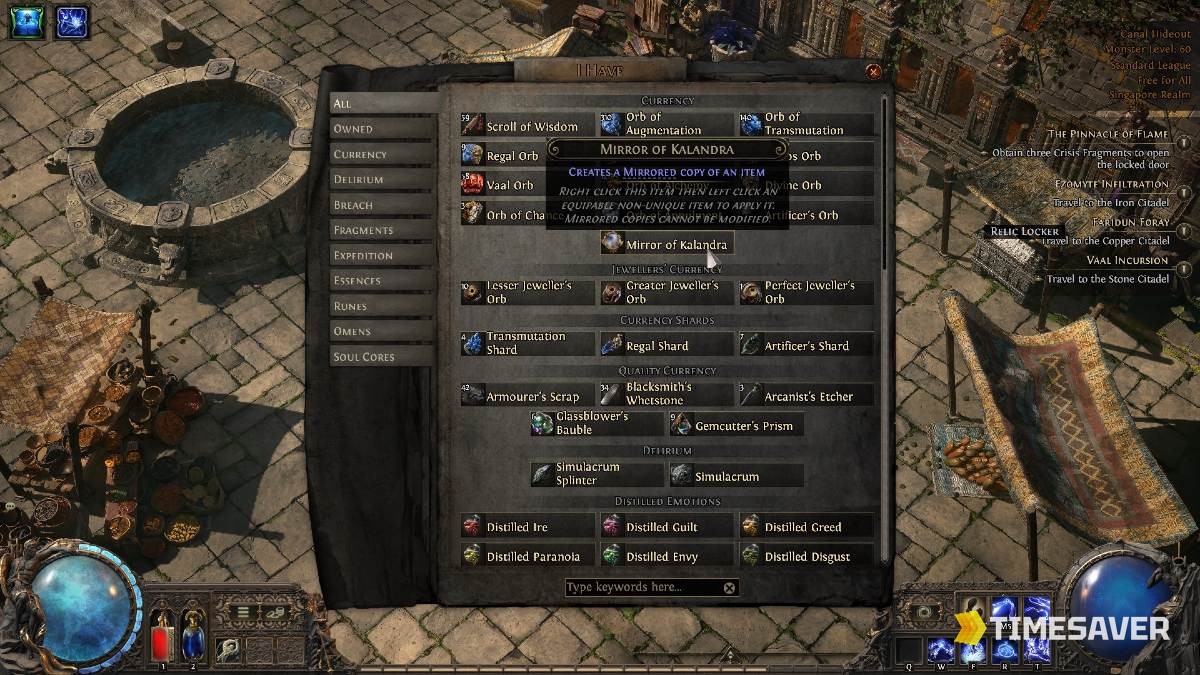
"Creates a Mirrored copy of an item. Right click this item then left click an equipable non-unique item to apply it. Mirrored copies cannot be modified."
— Mirror of Kalandra, in-game description (poe2db)
In plain terms: you right-click the Mirror, then left-click a rare item, and you get an identical copy — every modifier, every tier, every rolled value, preserved exactly. The original is untouched, so you keep both.
Three rules define how it behaves:
- The copy is permanently locked. A Mirrored item carries a "Mirrored" tag and cannot be modified — no Divine Orb reroll, no Exalted slam, no crafting, no corruption. What you mirror is what you keep, forever.
- It only works on equippable non-unique items. That means rare gear (and magic/normal bases). You cannot mirror a unique item, and you cannot mirror currency.
- It stacks up to 10. Like other PoE2 currency, the Mirror is a stackable item — though owning even one is a fantasy for most players.
This is why the Mirror sits at the very top of the food chain: it lets a single, perfectly-crafted "god-tier" item be duplicated, which is the foundation of the entire high-end gear market.
How Do You Get a Mirror of Kalandra in PoE2?
Here is the honest answer most guides bury: you almost certainly won't.
The official wiki data is blunt about the source — the Mirror of Kalandra "can be found randomly throughout the world" (poe2db). It has a drop level of 35, and beyond that it is a pure, global rare drop with no dedicated farm, no boss that guarantees it, and no recipe that builds toward it.
A few hard truths to set expectations:
- There is no farmable source. Despite what you'll read on some sites, no specific boss "drops the Mirror." It is not a Zarokh reward, not a Trial of the Sekhemas drop, not a pinnacle guarantee. Those fights drop their own loot (relics, uniques, fragments) — the Mirror is not part of any of them. Treat any "kill X to farm Mirrors" claim as false.
- It is one of the rarest items in the game. Community estimates put the natural drop rate somewhere around one per tens of millions of monster kills — effectively a lottery ticket, not a goal. Veteran players go entire leagues, or entire accounts, without ever seeing one.
- There is no "Mirror Shard" in PoE2. In the original Path of Exile, you could combine 20 Mirror Shards into a full Mirror. As of 0.5, PoE2's item data lists no Mirror Shard — the "20 shards = 1 mirror" idea is carried over from PoE1 and does not apply here. It's all-or-nothing: the full orb, or nothing.
Can you improve your odds at all?
Marginally. The only lever PoE2 gives you is Increased Rarity of Items Found — stacking Item Rarity on your gear and on your Waystones boosts the rarity of all drops, the Mirror included. But the base rate is so astronomically low that even a heavily magic-find-stacked character is not "farming Mirrors" in any practical sense — you're just farming currency efficiently and hoping. If your actual goal is a Mirror (or the gear a Mirror enables), the realistic route is the PoE2 trade economy, not the drop table.
What Is a Mirror of Kalandra Worth in Runes of Aldur (0.5.4)?
The Mirror is the most expensive single item in the PoE2 economy, period. Its value is denominated in Divine Orbs (the standard high-end trade currency), and in the Runes of Aldur league it trades in the four-figure Divine range — community price trackers on poe.ninja have reported it in the 1,200–2,000 Divine Orb range across 0.5.4, settling from higher peaks as the economy matures. See the dedicated Mirror of Kalandra price guide for current data and historical trend.
Two things to understand about that number:
- It moves constantly. Mirror value swings with league age, the supply of mirror-worthy items, and overall currency inflation. Always check poe.ninja's live Mirror page for the current rate — any fixed number you read (including this one) is a snapshot, not a quote.
- A "1 mirror" listing is almost always a joke. This trips up new players constantly. When you price-check an item on trade and see it "listed for 1 Mirror," that does not mean the item is worth a Mirror — anyone can list anything at any price, and a wildly over-priced listing is usually a troll, a placeholder, or someone who has no intention of selling. As the community puts it: an item listed for a Mirror "won't be sold even for one wisdom scroll." Judge value by the cluster of realistic listings, not the single outlier at the top.
For scale, here's where the Mirror sits relative to the currency you actually use day-to-day:
| Currency | What it does | Rough role / value |
|---|---|---|
| Chaos Orb | Removes one mod and adds a new one (targeted reforge) | Mid-tier crafting staple |
| Exalted Orb | Adds a random modifier to a rare item | Baseline trade & crafting currency |
| Divine Orb | Rerolls the numeric values of an item's existing mods | High-end trade currency; the "Divine" benchmark |
| Mirror of Kalandra | Duplicates a non-unique item (permanent copy) | The jackpot — thousands of Divine |
(Exact orb behaviors per the official mechanics; live prices per poe.ninja. Note PoE2's Chaos Orb behaves differently from PoE1's — it's a targeted reforge, not a full reroll.)
What Makes an Item Worth Mirroring?
A Mirror is only as valuable as what you point it at. Because the copy is locked forever, you only ever mirror a "perfect" item — one where re-rolling or improving it further would be a downgrade. In practice that means:
- A non-unique rare (uniques can't be mirrored) on a top-tier base.
- Multiple high-tier modifiers that all matter for the build — ideally near-max rolls (which is why owners often Divine the item to perfection before mirroring; you can't touch it afterward).
- A base that's in demand across many builds, so copies actually sell.
This is the engine behind the "mirror service" economy. A player who owns both a Mirror and a flawless item can sell copies of that item to others — the buyer typically supplies the Mirror (or its value) plus a fee, and walks away with an identical piece of god-tier gear. It's how the absolute top end of the market gets geared without every player needing to win the drop lottery themselves. Whether you're chasing the Mirror itself or the endgame gear and boss carries it represents, the path runs through trade, not luck.
Mirror of Kalandra vs the "Grand Mirror" — Don't Confuse Them
One quick disambiguation, because 0.5 muddied the water: the Mirror of Kalandra (the currency) is not the same as the Grand Mirror structure that can appear in Delirium. The Delirium "Grand Mirror" is a map mechanic — killing a Map Boss inside the Delirium fog can manifest one, spreading the fog to adjacent maps and seeding Simulacrum. It is a Delirium encounter object, not a tradeable currency, and it has nothing to do with duplicating items. If someone in your map says "grand mirror," they mean the Delirium structure — not a free Mirror of Kalandra.
PoE2 - Items
Skip the grind — get Items
Mirror of Kalandra — Hard Numbers (0.5.4)
To calibrate expectations before we get to the practical advice:
- Drop rate estimate: Community tracking across thousands of logged sessions puts the Mirror's natural drop rate at roughly one per 50,000–100,000 monsters killed — on par with PoE1's historically documented Mirror rate. A player mapping at 2,000 kills/hour would expect to wait 25–50 hours per league character statistically, and that's before accounting for the fact that at higher rarity the rate improves only marginally.
- Mirror service fee: When buying access to a Mirror service (paying someone to copy their god-tier rare), the typical fee in Runes of Aldur is 20–50 Divine Orbs on top of the Mirror itself, depending on the item being copied and how many copies have already been sold. High-demand items (best-in-slot amulets, weapons) command higher fees.
- Stacks of 10: The Mirror stacks up to 10 in a single inventory slot — the same as most PoE2 currency. Owning even a 2-stack would be extraordinary; a full 10-stack would be a top-0.001% scenario league-wide.
- Market denominator: To put Mirror value in context — efficient Divine Orb farming at endgame yields roughly 20–40 Divine per hour in a juiced setup. A 1,500 Divine Mirror represents 37–75 hours of peak farming output. Most players opt for currency shortcuts rather than grinding that out.
Community consensus (per r/PathOfExile2): "If you see a Mirror drop, screenshot it immediately — you'll probably be telling this story for years." The rarity is not an exaggeration.
The Faster Route to Mirror-Tier Power
The reality of the Mirror is that it's a status symbol and a market mechanic, not a realistic personal goal — the drop rate makes sure of that. What players actually want when they chase a Mirror is the outcome: best-in-slot gear, a finished build, and the currency to fund it without grinding for a thousand hours.
That's the practical play. Stack your currency through efficient mapping (the Divine Orb farming guide has the highest-yield setups), and when you want to skip the grind, buy the Divine Orbs and currency you need to gear up directly — instant delivery, best rates, no RNG. And if a literal Mirror of Kalandra is the dream, that's available too.
Skip the grind — gear up the fast way:
- PoE2 Divine Orbs — instant delivery · trusted · best rate
- PoE2 Mirror of Kalandra — the jackpot currency, delivered
- PoE2 Currency (all orbs) — divine · chaos · exalted · more
- PoE2 Leveling & Boss Carries — skip the grind · pro players
FAQ
How do you get a Mirror of Kalandra in PoE2? It only drops randomly from monsters anywhere in the world (drop level 35), and it's one of the rarest items in the game. There is no boss that farms it, no recipe, and no Mirror Shard to build one from — it's a pure, extraordinarily rare global drop, so most players will never see one naturally.
What does the Mirror of Kalandra actually do? It creates a permanent, identical copy of a non-unique equippable item — every mod and roll preserved. Right-click the Mirror, left-click the rare item, and you get a duplicate. The catch: the Mirrored copy is locked forever and cannot be modified by any currency.
Can you mirror unique items or corrupted items? No. The Mirror works only on equippable non-unique items — i.e. rares (and magic/normal bases). Unique items cannot be mirrored.
Does Zarokh or the Trial of the Sekhemas drop the Mirror? No. Those fights drop relics, uniques and their own rewards — the Mirror of Kalandra is not tied to any specific boss or trial. Any guide claiming a "best boss to farm Mirrors" is wrong; there is no such source.
How much is a Mirror worth right now? It's the most valuable currency in PoE2 — in the Runes of Aldur league it trades in the four-figure Divine Orb range, though the exact number moves daily. Check poe.ninja for the live price, and ignore troll "1 Mirror" listings on trade — a listing price is not a sale price.
Can you use a Mirror of Kalandra on a crafted or altered rare item? Yes. The Mirror works on any non-unique equippable item regardless of how it was crafted — Exalted slams, Divine rerolls, Hinekora's Locks, Fracturing Orb, Rune sockets, everything. The only exclusions are Unique items and items that are already Mirrored. This is why mirror-worthy rares are typically perfected (Divine Orb'd to max rolls) before being mirrored — you can't touch the copy afterward.
What is a "Mirror service" and how does it work in PoE2? A Mirror service is a player-run transaction where someone who owns both a Mirror and a perfect rare item sells copies to other players. The buyer supplies the Mirror (or its Divine-equivalent value) plus a service fee — typically 20–50 Divine in Runes of Aldur — and receives an identical locked copy of the item. It's the only realistic way most players will ever obtain mirror-tier gear, since the actual Mirror drop is so rare. Services are listed on the official PoE2 trade site under the "services" category.
Are Mirror Shards in PoE2? No. The shard system (20 shards = 1 Mirror) exists in the original Path of Exile, but PoE2's 0.5 item data has no Mirror Shard. In PoE2 it's the full orb or nothing.