Quick answer: how do skill trees work in The Blood of Dawnwalker?
The Blood of Dawnwalker has three skill trees — Swordmastery, Witchcraft and Vampirism — and they all draw from one shared pool of experience and skill points. What separates them is when you can use them and what it costs to unlock a perk:
- Swordmastery is your melee tree and works day and night. It only needs skill points, so it is the safest place to invest early.
- Witchcraft is your daytime Hex (blood-magic) tree. It works only in the day, and its perks also require Manuals — books you find or buy — on top of skill points.
- Vampirism is your night-only tree. Its perks are gated behind your Corruption level, which you raise by drinking blood, and its ultimate powers need Corruption 15.
You buy perks with points earned on level-up (and topped up at road shrines), and some tiers also cost a time slot from the game's 30-day narrative-sandbox budget. The single most important thing to know before you spend anything: there is no respec. Once a skill point is spent it is locked in, so plan a hybrid of Swordmastery plus one form tree rather than clicking reactively.
This guide was written on September 6, 2026, three days after The Blood of Dawnwalker launched on PS5, Xbox Series X/S and PC. Every mechanic below is attributed to developer Rebel Wolves or to named outlets playing the finished game — nothing here is guesswork.
The Blood of Dawnwalker is the debut RPG from Rebel Wolves, a Warsaw studio founded by veterans of The Witcher 3 and Cyberpunk 2077 (including Witcher 3 game director Konrad Tomaszkiewicz), published by Bandai Namco Entertainment. It launched to strong reviews — as verified live on August 31, 2026 it sits around 84 on OpenCritic ("Mighty") with 89% of critics recommending it, and roughly 83 on Metacritic. The progression system is one of the parts critics singled out as dense: GameSpot's own perks guide opens by admitting the skill trees take "a bit of explaining," and the reason is that the same character plays by two different rule-sets across the day/night cycle. Here is how all three trees actually work, which perks to grab first, and the traps to avoid.
What are the three skill trees in The Blood of Dawnwalker?
Coen is a Dawnwalker — human by day, vampire by night — and the skill system mirrors that split. There are three trees, and they share one XP pool, but each has its own availability window and its own unlock currency:
- Swordmastery — melee aptitude and physical prowess. As GameSpot puts it, "your abilities here can be used both in human form during the day and vampire form at night." This is the only tree that is always live, which is what makes it the backbone of every build.
- Witchcraft — the daytime Hex tree, Coen's blood-magic spellcasting. It is daytime only. Per Method's tree breakdown, "Witchcraft runs off runes carved into Coen's skin, and those carvings heal over at night once he turns, sealing your hexes until sunrise." So the moment night falls, your Hexes go dark until dawn.
- Vampirism — the night-only tree that powers his vampire form and claw attacks. Fextralife's wiki notes that as a vampire, Coen's claw damage and abilities scale "by unlocking relevant Perks and Abilities" in this tree.
The clean way to think about it: Swordmastery is your spine, Witchcraft is your daytime kit, Vampirism is your nighttime kit. You are effectively building two loadouts that share a skeleton.
How do you unlock perks in The Blood of Dawnwalker?
Every tree spends skill points, which you earn as you level up, and you can also buy perk points at road shrines scattered across Vale Sangora, as GamesRadar notes. But each tree layers its own extra requirement on top, and the on-screen icons tell you which:
- Swordmastery perks cost skill points (and, at higher tiers, an experience-point spend marked by a sun/moon symbol plus a time slot shown as an hourglass). It has no gating resource beyond that, which is exactly why it is the friendliest early investment.
- Witchcraft perks need Manuals — represented by an open-book icon — that you find in the world or buy, in addition to your points. You cannot brute-force the Hex tree with levels alone; you need the books. The Witchcraft tree itself only opens up after the prologue, once you complete the quest Smoke and Ashes (game8).
- Vampirism perks are gated by your Corruption level — a teeth icon — which you raise by drinking blood directly from enemies or from vials of Vrakhiri blood found in the world. To unlock the tree's Ultimate perks you need Corruption 15 (GamesRadar). To increase how many vampiric abilities you can slot, you invest in the Vrakhiri Might perk (GamesReviews).
Two currencies recur across all three trees and catch new players out: the hourglass (time slot) and the shared skill-point pool. Spending a time slot to unlock a perk advances the clock in the narrative sandbox — the same 30-day budget you spend on major quests — so upgrades are never entirely "free." That single fact is why planning matters so much here, and it feeds directly into the respec problem below.

Can you respec in The Blood of Dawnwalker?
No. There is no respec, no reset, no talent-point refund. Game8's dedicated check is blunt: "Respec is currently unavailable in the game, meaning you cannot reset or redistribute your spent Skill Points once they have been assigned." Beginner guide space4games says the same in one line: "There is no respec option in Blood of Dawnwalker."
There is a design reason baked in, and it is worth understanding rather than just memorising. As Game Rant explains, "there's no way to respec because spending time segments permanently advances time" — because some upgrades cost a time slot from your 30-day budget, letting you refund them would mean refunding time, which the game will not do. Progression here is deliberately one-directional.
The practical takeaway: before you commit a point, be sure. Screenshot your tree before a big skill-shrine session, decide on a spine-plus-one-form plan early, and pour your first points into Swordmastery, since it pays off in both day and night fights and never risks being stranded in a phase you are not currently in.
⚠️ Ignore any "guide" claiming you can respec at "Blood Altars" using "Crimson Tears." Those mechanics do not exist in the game — they appear only on auto-generated SEO pages, and following them will waste your time. The reliable sources (Game8, Game Rant, space4games) all confirm respec is simply not in the game.
What are the best skills to unlock first in The Blood of Dawnwalker?
Because you cannot respec, your early points should go toward perks that pay off constantly rather than niche situational ones. Based on named outlet guides playing the launch build, here is where the value is:
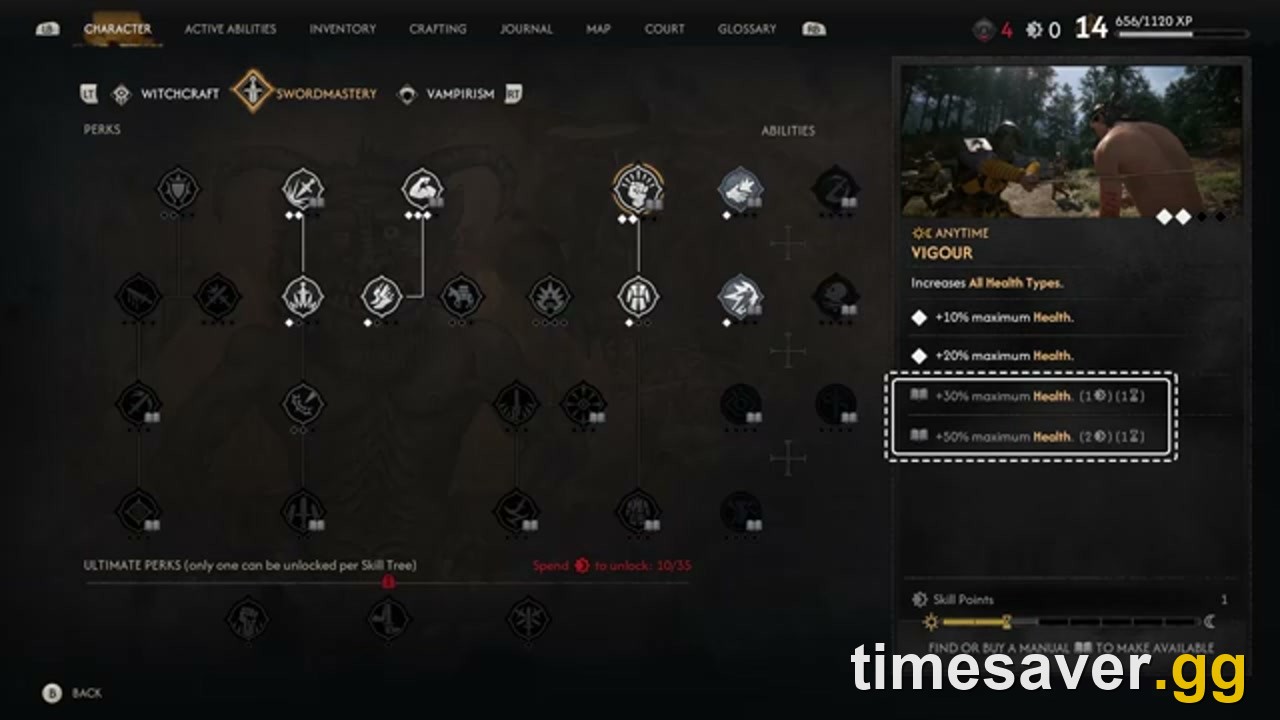
- Lead with Swordmastery. It is the only tree that works in both forms, so every point compounds across the whole game. Perks that raise your core survivability and stamina economy — your health pools and stamina — are the highest-value first buys, because stamina is effectively your combat resource: you spend it on every swing, dodge and held block. The featured tree panel above shows one such node, Vigour, described in-game as increasing "all health types" and flagged "anytime," meaning it is live day and night.
- Open Witchcraft as soon as the prologue ends, then buy the Hexes you will actually cast in daytime encounters. Manuals gate this tree, so grab Manuals whenever you find or can afford them — they are the bottleneck, not your point total.
- Grow Corruption early for Vampirism. Since night-tree perks are Corruption-gated, get in the habit of drinking blood from downed enemies so your Corruption climbs toward the 15 threshold that unlocks Ultimate powers. Invest in Vrakhiri Might to widen your vampiric ability slots so your night loadout is not cramped.
The overarching rule from every guide that has played the finished game: build a hybrid. A pure daytime mage is helpless at night when Witchcraft seals; a pure vampire is weak in daylight. Swordmastery bridges both, so a spine of melee perks plus a focused pick of Hexes and vampire powers is the safest path when mistakes cannot be undone.

How do the Ultimate perks work?
Each tree has a set of top-tier Ultimate perks, and they come with a hard restriction. Per Fextralife's perks wiki, "There are 3 Ultimate Perks per category, or a total of 9. However, you can only learn 1 of these types, and learning 1 will disable other Ultimates on your Skill Tree."
Read that carefully: the lock is per tree. Choosing an Ultimate locks out the other two in that same tree, so you can hold up to three Ultimates, one per tree (PowerPyx, Game8). Swordmastery and Witchcraft Ultimates need 35 points spent on that tree's perks, and the Ultimate itself costs 4 more. See our best Ultimate perks guide for all nine ranked. On the Vampirism side, reaching an Ultimate at all requires Corruption 15 first. Combined with the no-respec rule, your Ultimate choice is one of the most permanent decisions in the game, so it is the last thing you should rush and the first thing you should read the full description of before confirming.
How does Corruption tie into the Vampirism tree?
Corruption is the resource that powers your night build. You raise it by drinking blood — from enemies you drain in combat or from vials of Vrakhiri blood found around Vale Sangora, and certain boss fights give you a chance to drink Vrakhiri blood directly (space4games). The higher your Corruption, the deeper you can go into Vampirism: unlocking additional vampiric ability slots via Vrakhiri Might, and eventually a Vampirism Ultimate at Corruption 15.
There is a natural rhythm to it. Because Vampirism only functions at night and Witchcraft only in the day, your two form-trees are on opposite shifts, and Swordmastery is the constant underneath both. Feeding Corruption during night fights keeps your vampire progression moving without costing you anything in the daytime — one of the few "free" gains in a system where most upgrades cost points, sometimes Manuals, and sometimes a slice of your finite time budget.
FAQ
How many skill trees does The Blood of Dawnwalker have? Three: Swordmastery (works day and night), Witchcraft (daytime Hexes only), and Vampirism (night only). They share one experience-point and skill-point pool but each has its own unlock rules.
Can you respec or reset skills in The Blood of Dawnwalker? No. Respec is unavailable — you cannot reset or redistribute spent skill points (Game8). Part of the reason is that some upgrades cost a time slot that permanently advances the clock, so refunding them would mean refunding time (Game Rant). Plan carefully before spending.
Why can't I use my Hexes at night? Witchcraft magic runs off runes carved into Coen's skin, and those runes heal over once he turns into a vampire at night, sealing your Hexes until sunrise (Method). Your night kit comes from the Vampirism tree instead.
How do you unlock the Vampirism tree's Ultimate perks? You need to raise your Corruption to 15 by drinking blood from enemies and vials of Vrakhiri blood (GamesRadar). You can learn one Ultimate per tree, so picking a Vampirism Ultimate only locks the other two Vampirism Ultimates (PowerPyx, Game8).
What should I put my first skill points into? Swordmastery, because it is the only tree usable in both human and vampire form, so every point works around the clock. Prioritise health and stamina perks early, since stamina fuels every attack, dodge and block.
Do skill upgrades cost anything besides skill points? Yes. Higher-tier perks can also cost experience (sun/moon icon) and a time slot (hourglass icon). Witchcraft perks additionally need Manuals (book icon), and Vampirism perks need a Corruption level (teeth icon).
The bottom line
The Blood of Dawnwalker's progression is really two loadouts sharing one backbone: Swordmastery underpins everything and works in both forms, Witchcraft is your daytime Hex kit that seals at night, and Vampirism is your Corruption-gated night kit. Perks cost shared skill points plus tree-specific currencies — Manuals for Witchcraft, Corruption for Vampirism — and higher tiers also spend from your finite time budget. With no respec in the game, the winning move is to commit to Swordmastery first, open Witchcraft after the prologue, feed Corruption during night fights, and read every Ultimate description before you lock in the one you are allowed to keep.
For more on the moment-to-moment fighting these skills feed into, see our Blood of Dawnwalker combat guide, our breakdown of the difficulty settings and which mode to pick, and our beginner's tips before you start.