Grades are the only progression system in Dead by Daylight that hands you a seven-figure Bloodpoint payout for simply playing, and almost every explanation of them stops at "play more games". That is not an answer. The reward ladder is published, the pip thresholds are fixed, and the gap between Ash IV and Iridescent I is a specific, countable number of trials.
Everything below is current for Patch 10.2.0, the build Behaviour Interactive shipped on 6 October 2026, and was checked against Behaviour's own Player Support documentation on 11 October 2026.
Quick answer: what are DBD Grades and when do they reset?
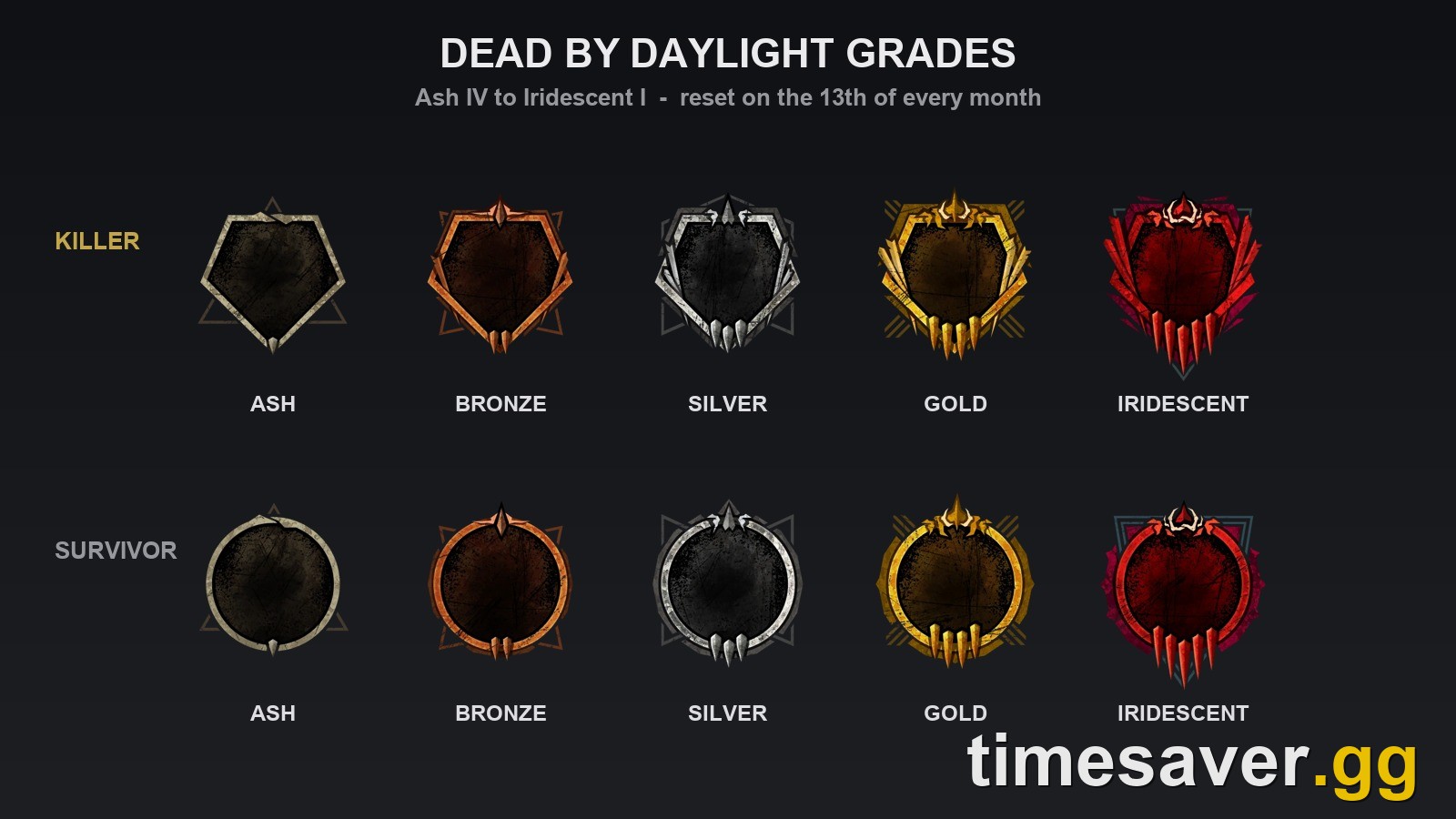
- Grades replaced the old Rank system. They run from Ash IV at the bottom to Iridescent I at the top — twenty steps in total, five tiers of four.
- Grades reset on the 13th of every month. The next reset is Tuesday 13 October 2026.
- Everyone drops back to Ash IV regardless of where they finished. Your hidden matchmaking rating is untouched.
- Your reward is paid in Bloodpoints, scaled to the Grade you reached: 10,000 at Ash IV, up to 1,000,000 at Iridescent I.
- Killer and Survivor have separate Grades and separate payouts, so a player who maxes both collects 2,000,000 Bloodpoints in a single reset.
- Climbing all the way from Ash IV to Iridescent I costs 85 pips, which is 43 flawless trials per role at the two-pip maximum.
When is the next DBD grade reset?
The next Grade reset falls on Tuesday 13 October 2026. After that it is 13 November, 13 December, and so on — Behaviour has kept the date fixed for years.
Behaviour's support article on Ranks, Grades, Skill Rating and Skill-Based Matchmaking states the rule in one sentence, and it is worth reading literally:
"When the Grade Reset happens on the 13th of each month, all players will be reset to Ash IV for both Killer and Survivor, regardless of their previous Grade, but their SBMM rating will be unchanged."
Two things in that sentence catch people out. The first is "regardless of their previous Grade" — there is no partial carry-over and no head start for finishing at Iridescent. The second is "their SBMM rating will be unchanged", which is the single most useful fact about Grades and the one most players get backwards.
On the time of day, we will be straight with you: Behaviour's own article gives the date and nothing else. The community-maintained wiki records that the reset was standardised to 11AM Eastern on 13 March 2024, and that has matched observed behaviour since. For 13 October 2026 that is 15:00 UTC, because the United States is still on Eastern Daylight Time; once clocks change in November the same 11AM Eastern becomes 16:00 UTC. Treat the exact minute as community-sourced rather than official, and do not schedule a last-minute climb around it.
How many Bloodpoints does each Grade pay?
This is the whole reason the system matters. Behaviour published the reward chart, and the numbers have not moved since the 13 February 2022 rework that replaced flat per-tier payouts with a per-Grade ladder.
| Grade | Iridescent | Gold | Silver | Bronze | Ash |
|---|---|---|---|---|---|
| I | 1,000,000 | 550,000 | 340,000 | 175,000 | 50,000 |
| II | 900,000 | 500,000 | 310,000 | 150,000 | 35,000 |
| III | 800,000 | 450,000 | 280,000 | 125,000 | 20,000 |
| IV | 700,000 | 400,000 | 250,000 | 100,000 | 10,000 |
Every figure above is per role, and is paid once, at reset.

Read the curve, not the rows. The jump from Gold I to Iridescent IV is 150,000 Bloodpoints for one Grade. The jump from Iridescent IV to Iridescent I is another 300,000. Meanwhile the entire Ash tier — four Grades, roughly a dozen trials — is worth 115,000 combined, less than a single step inside Iridescent.
That shape has a practical consequence. If you are sitting at Gold III on the 11th with two evenings of play left, pushing to Gold I is worth 100,000 Bloodpoints. Pushing from Iridescent III to Iridescent I is worth 200,000 for the same number of pips. The ladder pays you most for the climb you have already nearly finished.
Behaviour's article adds the other half of the maths in plain language: "Both Killer and Survivor have their own rewards, so you can earn double the points by ranking up both sides." Two Iridescent I Grades is 2,000,000 Bloodpoints, which is comfortably more than most players earn from a full week of trials. For context on what that is worth against the ceiling, see our breakdown of the DBD Bloodpoint cap and the per-match limit.
How many pips does Iridescent I actually take?
Grades move on pips. Each Grade needs a fixed number of pips to clear, and the requirement steps up as you climb:
| Grade range | Pips to advance |
|---|---|
| Ash IV and Ash III | 3 each |
| Ash II and Ash I | 4 each |
| Bronze IV through Bronze I | 4 each |
| Silver IV through Silver I | 5 each |
| Gold IV through Gold I | 5 each |
| Iridescent IV through Iridescent II | 5 each |
| Iridescent I | terminal, no further progression |
Add it up and the full climb is 85 pips per role. A trial awards at most 2 pips, so the theoretical floor is 43 trials per role, 86 across both — and that is 43 trials in which you hit the top emblem bracket every single time, with no safety pips, no bad lobbies and no disconnects.
Realistically, counting on roughly 1.5 pips per trial across a mixed session, Iridescent I is closer to 57 trials per role. At an average trial length of around ten minutes including queue, that is nine to ten hours per role for the 1,000,000 payout, or about twenty hours for both. Those hour figures are our own calculation from the published pip requirements; Behaviour does not publish an average trial length or an expected pips-per-hour rate.
Pips come from emblems, not from your Grade
Here is the misconception worth correcting, because it is repeated constantly: your Grade does not decide how well you have to play. Your emblems do, and the bar they are measured against moves with your Grade.
At the end of every trial you are awarded four emblems, each at one of five qualities. They convert to points like this: none scores 0, Bronze 1, Silver 2, Gold 3, Iridescent 4. Four emblems, so 16 points is the maximum.
Survivors are scored on Lightbringer (generator progress), Unbroken (surviving without being hooked), Benevolent (healing and rescues) and Evader (chases and stealth).

Killers are scored on Gatekeeper (how long generators and gates stay intact), Devout (sacrifices and kills), Malicious (hits and hook states) and Chaser (chase efficiency).

A few of the scoring rules are genuinely non-obvious and change how you should play a trial you want to pip in:
- Evader starts you at 100 points and awards 1 point per second spent inside the Killer's Terror Radius while not being chased, plus 50 per pallet stun. Hiding in a locker all game scores you nothing.
- Gatekeeper awards 1 point per unrepaired generator per minute, for the first nine minutes only, and a flat 10 bonus if both exit gates are still closed at the end. A Killer who slugs for a long endgame earns nothing extra from Gatekeeper after minute nine.
- Chaser penalises camping directly: minus 7.5 points per second within 8 metres of a hooked Survivor, and minus 3 per second within 16 metres, applied after the first ten seconds.
- Devout scores 2 points per sacrifice, kill or disconnect — but a Survivor who bleeds out on the floor is worth zero.
- Unbroken is scored in reverse against a fixed scale, and the top bracket requires escaping. Simply surviving nine minutes is the second bracket, not the first.
Why Killers need more emblem points than Survivors
This is the part nobody publishes, and it is a measurable asymmetry. The emblem-point threshold for earning pips is not the same for both roles once you pass Bronze. Behaviour has never published these brackets or the pip requirements above; both tables come from the community wiki's documentation of in-game behaviour, and they match what the tally screen does.
| Grade range | Role | 0 pips | +1 pip | +2 pips |
|---|---|---|---|---|
| Ash IV to Ash I | Both | 0 to 8 | 9 to 13 | 14 to 16 |
| Bronze IV to Bronze I | Both | 0 to 9 | 10 to 13 | 14 to 16 |
| Silver IV to Silver I | Killer | 0 to 10 | 11 to 14 | 15 to 16 |
| Silver IV to Silver I | Survivor | 0 to 9 | 10 to 13 | 14 to 16 |
| Gold IV to Gold I | Killer | 0 to 11 | 12 to 14 | 15 to 16 |
| Gold IV to Gold I | Survivor | 0 to 10 | 11 to 13 | 14 to 16 |
| Iridescent IV to Iridescent II | Killer | 0 to 12 | 13 to 15 | 16 only |
| Iridescent IV to Iridescent II | Survivor | 0 to 11 | 12 to 14 | 15 to 16 |
From Silver upward, a Killer needs one more emblem point than a Survivor for the same pip result. At the top of the ladder it stops being a rounding error: a Killer in Iridescent IV through II can only double-pip on a perfect 16, meaning all four emblems at Iridescent quality. A Survivor at the same Grade can double-pip on 15, which still allows one emblem to come in at Gold.
In practice the last three Grades of a Killer climb demand a flawless trial every time — full gate control, four hooks each, no camping penalty, efficient chases — while the Survivor equivalent tolerates one weak category. If you are grinding both sides before the 13th, do the Killer climb first, while you still have evenings to absorb the near-misses.
Can you lose a Grade or de-pip?
No. Two separate protections apply.
The first is the Safety Pip. If your emblem total lands in the bottom bracket for your Grade, you do not lose a pip — you simply stay where you are. The tally screen shows the pip meter holding rather than dropping.
The second is structural: de-pipping was removed entirely in Patch 7.7.0, per the community wiki's patch history — Behaviour's own live documentation does not carry that line, so we are flagging the sourcing. Before that change, a bad enough trial could cost you a pip. Today it cannot. Once a Grade is obtained it is yours until the monthly reset, which is why a disconnect, a crash or a genuinely miserable lobby costs you time but never progress.
If you saw your Grade appear to move backwards after being dropped from a trial, what you were almost certainly looking at was the monthly reset, not a de-pip. The reset is the only thing in the game that lowers a Grade.
Do Grade reset Bloodpoints ignore the Bloodpoint cap?
This one needs an honest answer rather than a confident one, because the community answer and the documentation do not line up.
The Bloodpoint cap is 5,000,000, raised from 2,000,000 in Patch 8.2.0. Behaviour's documentation names the exemptions explicitly: "Bloodpoints awarded by other sources (e.g. Log-in Rewards, promotional Codes, Email Codes, etc.) are exempt from the Cap and do not count towards it, allowing for an overflow past the Cap."
Grade reset rewards are not named in that list. The widely repeated community answer is that they overflow the cap like login rewards do, and that may well be correct — the wording ends in "etc." and Behaviour has never published a complete enumeration. But we are not going to assert it as fact on the strength of a forum reply.
The safe play costs you nothing: spend down below 3,000,000 before the 13th. If you are sitting near the ceiling and 2,000,000 lands from a double Iridescent climb, you lose nothing by having spent it first, and you potentially lose a seven-figure payout by not having. Dump the surplus into Bloodwebs on characters you are levelling, or into prestige runs, before reset morning.
Does your Grade affect matchmaking?
No, and this is the most common misreading of the whole system. Matchmaking runs on SBMM, a hidden skill rating completely separate from your Grade, and Behaviour's documentation is unambiguous that the reset leaves that rating untouched.
Two consequences follow. An Iridescent I badge does not mean a player is good — it means they played a lot this month. And the reset does not give you easier lobbies. Patch 10.2.0 shipped fixes to the matchmaking widget and to end-of-trial outcomes, but changed nothing about how the rating itself moves; we broke down exactly what Abandon, Surrender and End Trial do to your MMR separately.
How to climb fast before the 13th
- Pick the role you are better at, and finish it. The ladder is back-loaded. Reaching Iridescent I on one side pays 1,000,000; reaching Gold I on both pays 1,100,000 for roughly the same effort, but only if both climbs actually land. A half-finished second climb at Silver III is worth 280,000.
- Play Killer first. The Iridescent-tier threshold is one point stricter, so give it the days with the most patience in them.
- As Survivor, spread your play. Four emblems means four categories. A game spent entirely on generators scores Lightbringer and nothing else, which is a 7-point trial and no pip. One unhook, one heal and one genuine chase will out-pip a flawless gen rush.
- As Killer, stop camping. The Chaser penalty for proximity to a hooked Survivor is severe enough to drag an otherwise strong trial out of double-pip range.
- Do not bank Bloodpoints into reset day. See the cap section above.
- Check for active codes first. Promotional Bloodpoint codes are explicitly cap-exempt, so they stack cleanly on top of a reset payout — our running list of working DBD codes is updated as Behaviour releases them.
Frequently asked questions
What time does the DBD grade reset happen? On the 13th of the month. Behaviour publishes the date but not the time. Community tracking puts it at 11AM Eastern, which is 15:00 UTC for the 13 October 2026 reset while the United States is on daylight time, and 16:00 UTC once clocks change in November.
Do I keep my Grade if I do not play that month? No. The reset applies to every account regardless of activity, and it applies to both roles independently.
Do Grades affect who I am matched with? No. Matchmaking uses a hidden SBMM rating that the reset does not touch. Grade is a monthly activity measure, not a skill measure.
Can I de-pip in Dead by Daylight? No. De-pipping was removed in Patch 7.7.0, and the Safety Pip protects you from losses before that bracket. Your Grade only ever goes down at the monthly reset.
How many pips to Iridescent I? 85 per role, counting 3 pips each for Ash IV and III, 4 each for Ash II through Bronze I, and 5 each for every Grade from Silver IV to Iridescent II.
Do Killer and Survivor Grades reset separately? They reset at the same moment but are tracked and rewarded separately, so you receive two payouts — up to 1,000,000 Bloodpoints each.
Is Iridescent I worth grinding? If you are already in Iridescent, yes — the last three Grades are worth 300,000 Bloodpoints for 15 pips, the best rate in the game. If you are in Ash on the 11th, no. The whole Ash tier is worth 115,000 combined, and your time converts better into Iridescent Shards through Player Level XP.
Want the rest of the Dead by Daylight economy mapped the same way? We have run the arithmetic on every currency, cap and reward track in the game:
- DBD Bloodpoints: the real cap, the per-match limit and how to farm fast
- DBD Iridescent Shards: how many per level and what they really cost
- DBD Auric Cells: pack prices and the real cost per cell
- DBD codes: every working code this month
- DBD Abandon, Surrender and End Trial: every condition and MMR result
Reward values, pip requirements and emblem thresholds verified against Behaviour Interactive Player Support documentation and the community wiki on 11 October 2026, Patch 10.2.0. Trial-count and hour estimates are our own calculation from the published pip requirements; Behaviour does not publish an average pips-per-hour figure.