Quick answer
Onimusha: Way of the Sword has two linked progression systems: souls you absorb in combat, and stones you find in the world. Souls come in colors — yellow restores health, red is your upgrade currency, blue charges your Oni Armament, and purple feeds your Oni Awakening. You spend red souls to buy and make small upgrades to skills, but the big skill unlocks cost stones instead: Power Stones for the Basic Skills tree and Oni Stones for the Oni (Special) Skills tree. There are roughly 54 of each stone in a playthrough — enough to fully build one tree, but not enough to max everything the Oni Gauntlet can hold in a single run, so full completion rolls into New Game+. (As of the September 4, 2026 launch build; figures below are from hands-on player and outlet coverage and may shift with patches.)
If you were staring at a "soul counter changing color" or wondering why you're short a stone with the skill tree nearly done — that's normal, and this guide explains exactly why and what to do about it.
Onimusha: Way of the Sword is the first all-new mainline Onimusha in over 20 years — a Capcom character-action game (director Satoru Nihei has said repeatedly it is not a Soulslike, even though the parry-heavy combat invites the comparison). Its progression is deliberately front-loaded with jargon: souls, orbs, Power Stones, Oni Stones, Whetstones, skill trees and equipment enhancement all live in different menus. Here's the whole economy in one place.
What are souls in Onimusha: Way of the Sword?
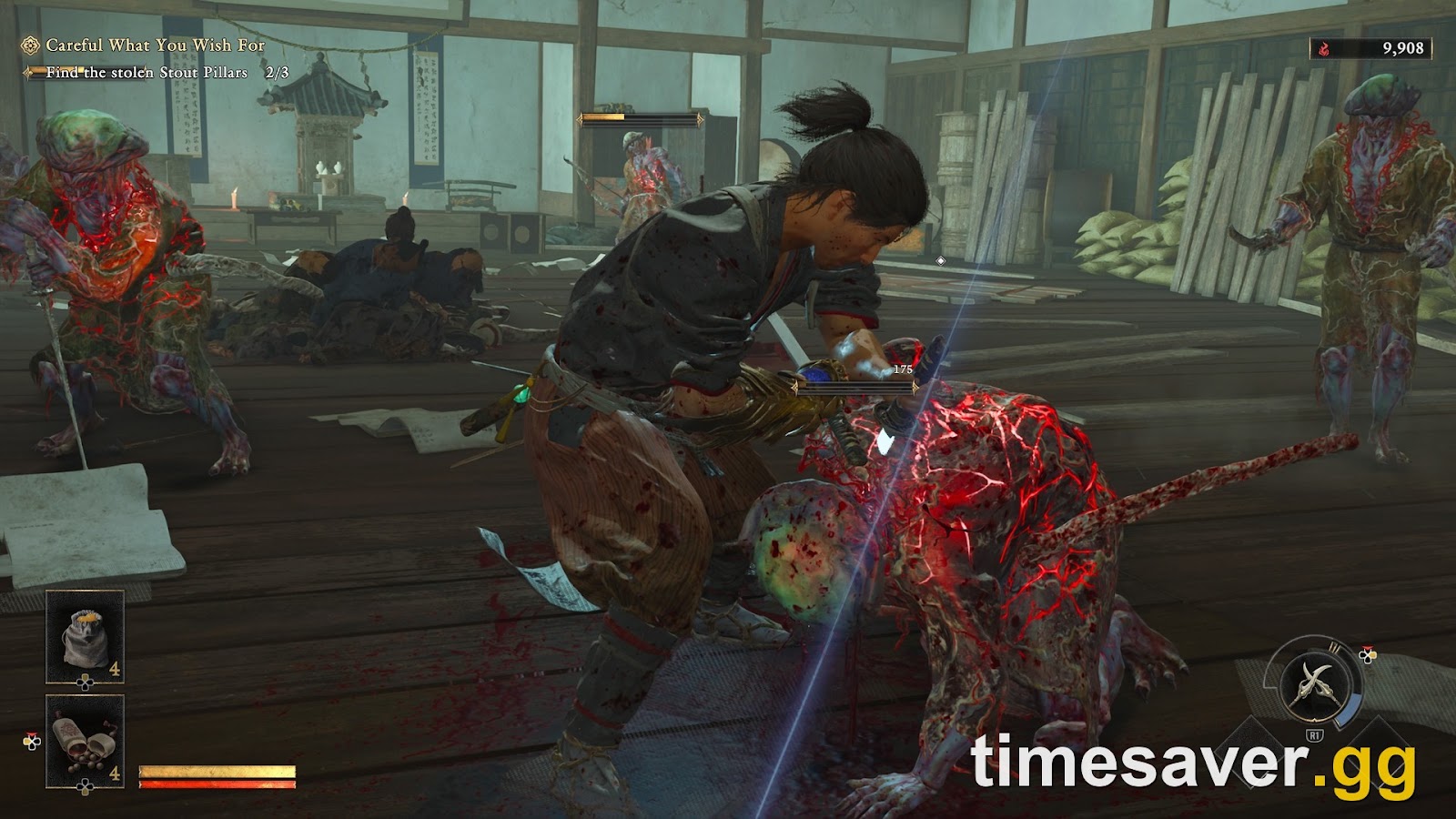
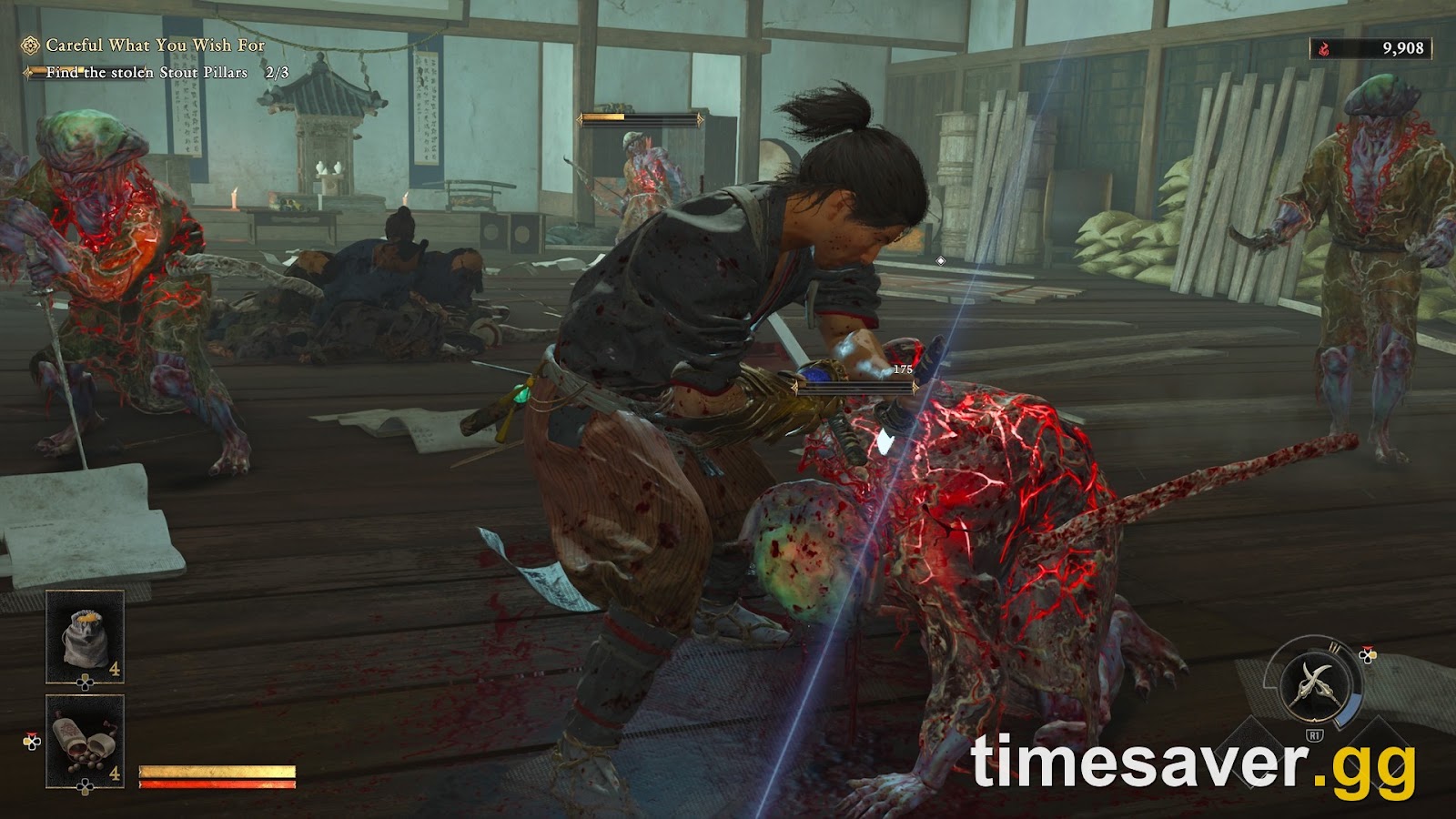
Souls are the resource Genma drop when they die. Musashi's Oni Gauntlet — "a mystical artifact that grants its bearer the power to slay Genma," in Capcom's words — absorbs those souls and converts them into a power source. You absorb by holding the absorb button after a kill; several skills speed this up or let you keep moving while you do it.
Absorbing is not optional flavor. In Way of the Sword, standing back and playing safe starves you: souls left on the ground get sucked up by other enemies, and yellow (healing) souls in particular vanish fast in a busy fight. The intended loop is aggressive — kill, absorb, convert, repeat — which is why the color of each soul matters.
Onimusha soul colors explained
Here's what each soul color does. This is the single most-asked question on the r/Onimusha boards in launch week, and the reason is that the game shows you the orbs before it fully explains them.
| Soul color | What it does | How you use it |
|---|---|---|
| Yellow | Restores Musashi's health | Absorb when you're hurt; drops from enemies and from certain Oni Armament hits (twin-blade combos are a reliable source) |
| Red | Your main upgrade currency (red orbs) | Spend at the upgrade screen to buy skills and pay for their smaller enhancement levels |
| Blue | Charges the Oni Armament special-weapon gauge | Two-handed attacks at the end of combos tend to release blue; fill the gauge to unleash an armament burst |
| Purple | Feeds Oni Awakening (your transformed power state) | Generated by soul choices after a Break Issen; builds your Awakening gauge quickly |
A few practical notes players have surfaced:
- The counter itself can change color as you hold souls. Community testing suggests it's a "you're near your carry cap" indicator — there's a skill that raises how many souls you can hold, and colors appear to warn you as you approach the current limit. Treat it as a nudge to absorb, not a bug.
- Yellow is "use it or lose it" when you're healthy. If your health is high you can briefly let yellow souls sit, but if an enemy grabs them or your gauge is full, they convert or disappear — don't hoard them.
- After a Break Issen (the finishing counter), the game can offer a soul choice; picking the purple option showers yellow, blue and purple drops and builds Awakening faster than almost anything else.
Framing note: only "Issen," "parry," "deflect," "soul absorption" and "Oni Armament" are Capcom-named terms. The finer soul-cap and Awakening behavior is drawn from launch-week hands-on coverage and player testing (as of September 2026) — expect small numeric tweaks in patches.
Red souls vs stones: why your skill tree won't finish on souls alone
Here's the part that confuses people. You'd assume red souls upgrade everything. They don't.
- Buying a skill and its minor upgrades (a little more damage, a slightly wider window) mostly costs red souls.
- Unlocking the major skills — the ones that actually change how Musashi plays — costs stones, not souls. Rock Paper Shotgun's launch guide puts it plainly: "you'll still need Power Stones for significant upgrades," while smaller boosts "tend to cost souls."
So souls are the fast, renewable resource; stones are the scarce, milestone resource. That split is why you can be swimming in red orbs and still unable to open the next node.
Power Stones vs Oni Stones — the two skill trees
Way of the Sword has two skill trees, each fed by its own stone:
- Basic Skills tree → Power Stones. These are Musashi's core sword skills and combat fundamentals. Community reference guides list around 53–54 Power Stones available across a playthrough — enough to fully complete this tree in one run.
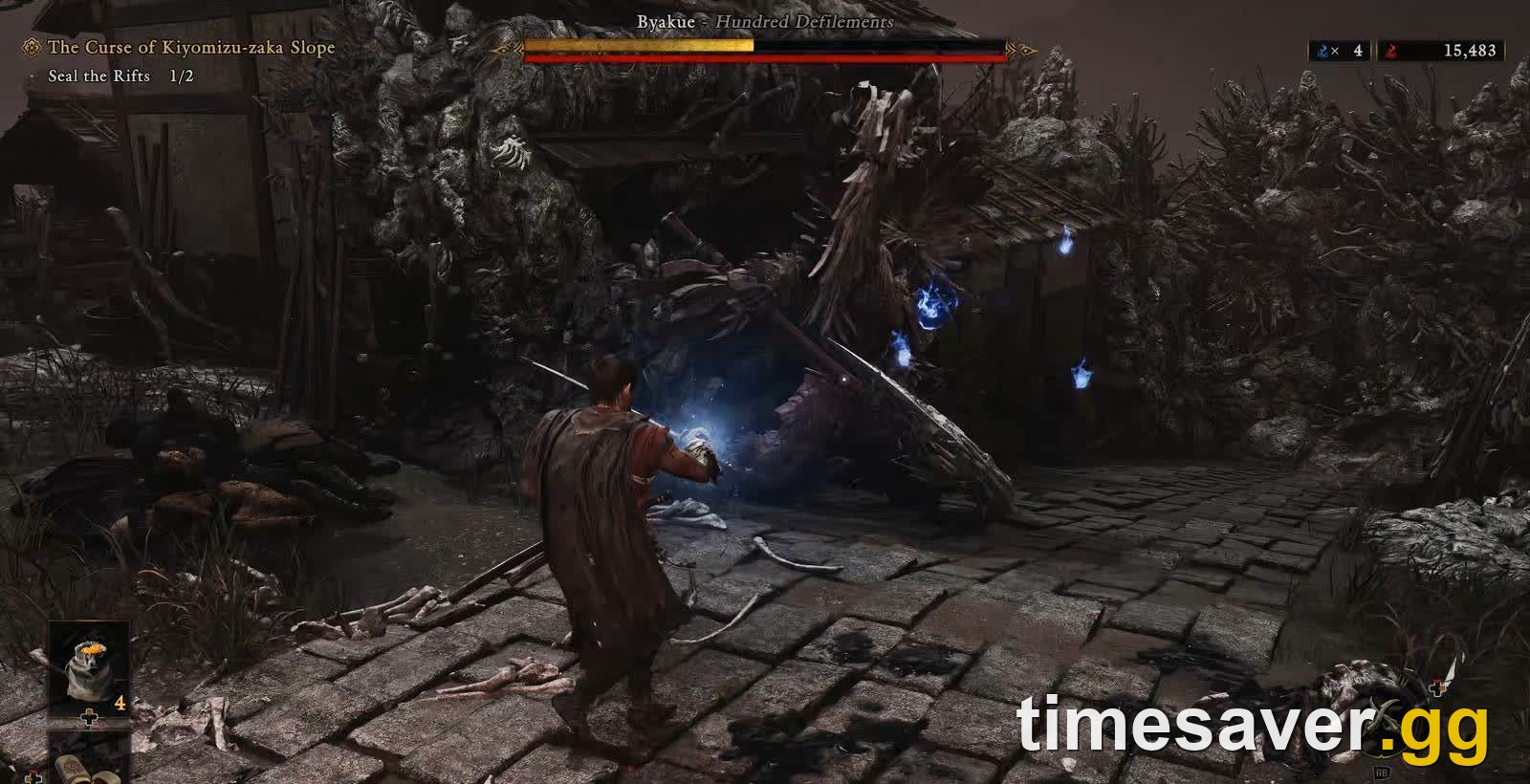
- Oni (Special) Skills tree → Oni Stones. These enhance the gauntlet's toolkit: Oni Vision, Oni Strength, Oni Agility, Oni Awakening and the Oni Armaments themselves (per Maxroll's skills reference). There are roughly 54 Oni Stones in a run too — but that total is short of everything the Gauntlet side can hold, so you can't 100% both sides in a single playthrough.
Where the stones come from
- Power Stones come from two places: defeating story bosses (Formidable Foes in the main campaign — beating them in Takamura's training trials gives nothing), and looting black-and-gold chests scattered through the levels outside the East Kyoto hub. Rock Paper Shotgun notes the game "never tells you where or how to find them," and that a few hours in you'll have enough for "four-ish skills."
- Oni Stones are largely exploration rewards — chests and side-content, including chests in the East Kyoto hub that tend to hold Oni Stones rather than Power Stones.
A genuinely useful tip: upgrade Oni Vision early (it's an Oni-Stone skill) so it highlights collectibles and treasure. That makes the rest of your stone hunt far less painful.
Can you fully upgrade all skills in one playthrough?
Not everything — and that's by design. Here's the accurate breakdown from launch-week completion guides and player reports:
- The Basic Skills tree can be fully maxed in one run with the ~53 Power Stones available.
- The Oni Skills / Gauntlet side cannot — even a perfect sweep of ~54 Oni Stones falls short of maxing the whole Gauntlet.
- Stones carry over into New Game+, and — usefully — players report you keep earning stones in NG+ even after a tree is full, so completion is a matter of a second run, not a lost cause. One community completion guide pegs a full both-trees clear at roughly 53 Power Stones + 54 Oni Stones plus a large pile of red souls across both runs.
If you're chasing the completion trophies: the tree-completion trophy reportedly pops the moment one tree is finished, and you finish the other in NG+. So don't panic-grind — plan for two playthroughs.
Respec is free — experiment freely
One of the best quality-of-life facts about the system: you can refund Power Stones and souls at no cost. If you dumped resources into a skill you don't like, reclaim everything in one action and re-spend. That removes the usual "am I building wrong?" anxiety — try aggressive builds, and reset if they don't click.
Don't confuse skill upgrades with equipment enhancement
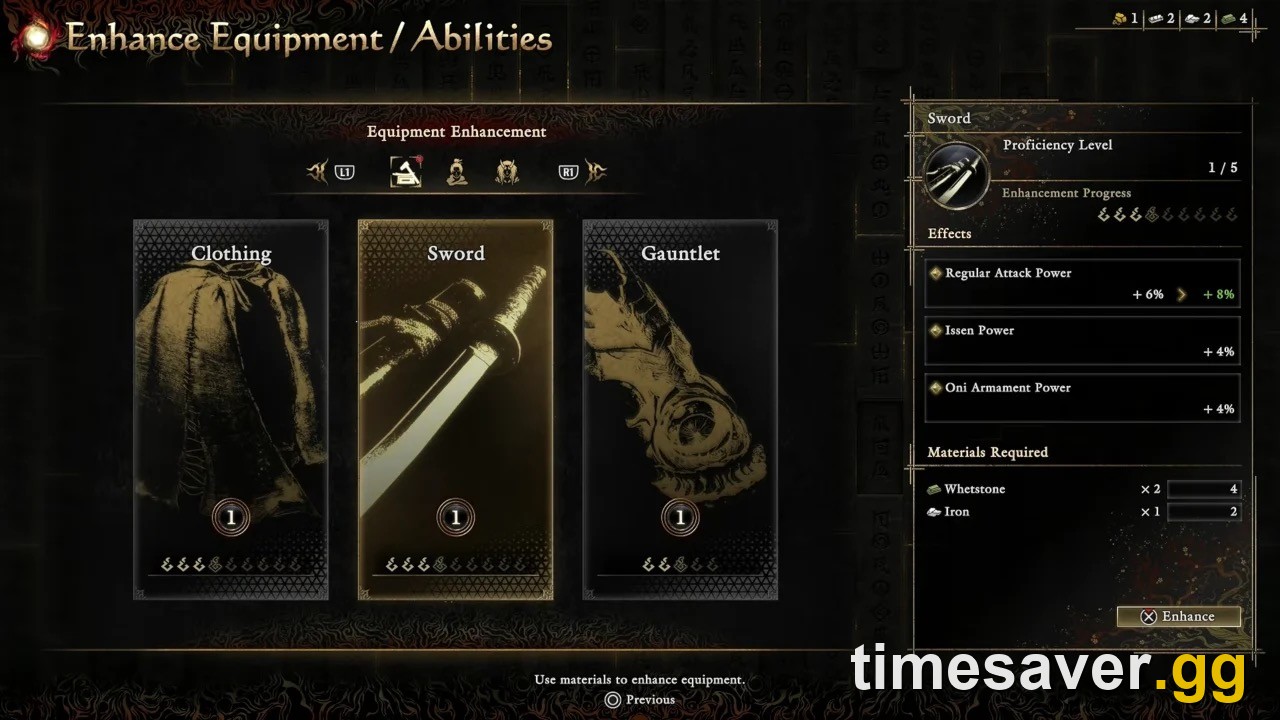
There's a third upgrade menu that trips people up: Enhance Equipment. This is separate from both skill trees.
- Equipment enhancement raises your Sword, Clothing and Gauntlet proficiency (e.g. Sword Level 1/5), bumping stats like Regular Attack Power, Issen Power and Oni Armament Power.
- It's paid with crafting materials — Whetstones and Iron — not souls or stones. You gather these separately as loot.
So the full progression picture is: souls (fast, from kills) → skills; Power/Oni Stones (scarce, from bosses and chests) → the big skill nodes; Whetstones/Iron (materials) → gear proficiency. Three currencies, three menus. Keep them straight and the "why can't I upgrade this?" confusion disappears.
Soul & upgrade priorities: what to build first
If you want a simple early-game plan that most launch-week players converge on:
- Oni Vision (Oni Stone) — treasure/collectible highlighting pays for itself in more stones.
- A soul-absorption speed / move-while-absorbing skill — keeps you aggressive and topped up on health via yellow souls.
- An Oni Armament you enjoy, then its charge-speed upgrade. The heavy hammer-type armament is a community favorite for boss stagger; on the top Carnage difficulty its stagger chunk is smaller (players report ~30% instead of ~half a stagger bar) but still one of the strongest tools available, because every stamina-draining move is scaled down equally on Carnage.
- Bank major sword nodes for Power Stones from bosses — since minor upgrades are soul-priced, save your scarce Power Stones for the skills that change your kit.
FAQ
What do the soul colors mean in Onimusha: Way of the Sword? Yellow souls restore Musashi's health, red souls are your upgrade currency (red orbs) for buying and enhancing skills, blue souls charge the Oni Armament special-weapon gauge, and purple souls feed the Oni Awakening gauge. You absorb them with the Oni Gauntlet after a kill.
Why is my soul counter changing color? Community testing during launch week suggests the counter color is a carry-cap warning — it shifts as you approach the maximum number of souls you can currently hold. There's a skill that raises that cap. In short, it's telling you to absorb rather than keep collecting.
What's the difference between Power Stones and Oni Stones? Power Stones upgrade the Basic Skills tree and come from story bosses and black-and-gold chests. Oni Stones upgrade the Oni (Special) Skills tree — Oni Vision, Oni Strength, Oni Agility, Oni Awakening and the Oni Armaments — and come mostly from exploration and chests. They are not interchangeable.
Can you fully upgrade every skill in one playthrough? You can max the Basic Skills tree in a single run (~53 Power Stones available), but the Oni/Gauntlet side needs more Oni Stones than one playthrough provides. Stones carry into New Game+ and you keep earning them, so full completion happens over two runs.
Do I lose resources if I upgrade the wrong skill? No. You can refund Power Stones and souls at no cost and re-spend them, so it's safe to experiment with builds.
How do I upgrade my sword and gauntlet stats? That's the separate Enhance Equipment menu, which uses crafting materials — Whetstones and Iron — rather than souls or stones. It raises equipment proficiency levels and stats like Attack Power and Issen Power.
More Onimusha guides
For the rest of your Way of the Sword playthrough, these companion guides go deeper on the systems this one touches:
Keep leveling up your Onimusha knowledge:
- Onimusha: Way of the Sword Combat Explained — Issen, Parries & Soul Absorption
- Onimusha: Way of the Sword Difficulty Settings — How to Change Difficulty & Unlock Carnage
- How Long Is Onimusha: Way of the Sword? Playtime, Chapter List & Carnage Difficulty
_Facts current as of September 9, 2026, from the launched game (September 4, 2026). Mechanic details are drawn from Capcom's official descriptions plus launch-week hands-on coverage and player testing; exact numbers may change with patches._