If you want a currency engine in Path of Exile 2 that doesn't depend on RNG drops or a perfect build, Expedition is the answer in the Runes of Aldur league. Patch 0.5.0 "Return of the Ancients" (live since May 29, 2026) turned the old blow-stuff-up minigame into one of the most reliable, scalable farms in the game — you place explosives, blow open a buried excavation, and walk away with artifacts you spend like a second currency on gear, gambles, and trade fodder.
The catch: Expedition has more moving parts than any other mechanic in the game. Four different vendors. Four artifact currencies plus Exotic Coinage. A chain-explosive puzzle where greed gets you killed. And a whole second layer — Logbooks, the Grand Expedition, and the pinnacle boss Olroth — that most players never touch because nobody explained it. This guide does. You'll get the full loop end to end, exactly who to spend each artifact with, how to detonate for maximum loot without one-shotting yourself, how Logbooks and Olroth work, the best Atlas tree priorities, and whether it's actually worth your time versus other 0.5 farms. Every mechanic here is checked against the official Path of Exile 2 wiki and current patch info — not a stale tracker.

PoE2 - Divine & Exalted Orbs
Skip the grind — get Divine & Exalted Orbs
PoE2 Expedition in 30 seconds (the quick answer)
- What it is: an Atlas map mechanic. You get a buried excavation site with Monster Markers, Chests, and Remnants, plus a limited set of explosives to chain together and detonate.
- The reward: detonating unearths Runic Monsters that drop artifacts — a parallel currency you spend with four Expedition vendors.
- The four vendors: Dannig (artifact exchange + Logbooks), Rog (crafts armour & shields), Tujen (haggle for currency & accessories), Gwennen (gamble for weapons/uniques).
- The deep layer: Logbooks open standalone Expedition areas; high-level Logbooks can spawn the pinnacle boss Olroth for Expedition Atlas points and chase uniques.
- The payoff: artifacts → currency, gear, and gambles → sell for Divine and Exalted Orbs. That's the commercial loop, and it's the most consistent in 0.5.
- The #1 beginner mistake: wasting explosives on monsters instead of chaining Remnants into the blast to multiply your artifact haul.
What is Expedition in PoE2?
Expedition is one of the endgame mechanics you can weight onto your Atlas passive tree so it appears more often in your maps. When it spawns, you'll meet one of four NPCs standing in front of a burial site littered with Monster Markers, Chests, and Remnants. You're handed a small number of explosives and a placement tool: you lay a chain of charges across the markers you want, then detonate the whole line at once.
The detonation unearths and immediately aggros Runic Monsters — tougher rare monsters that drop Expedition artifacts and gear. Bigger chains hit more markers, which means more monsters and more loot, but also more danger landing on you at once. That risk-reward placement is the Expedition skill ceiling. As one of the most common complaints on r/PathOfExile2 puts it, half the screen disappears under monsters the second you push for a greedy chain — so position matters.
The reason Expedition is special for currency farming: the loot isn't just orbs you hope drop. It's artifacts, a currency you reliably accumulate every encounter and then choose how to convert. That turns a random map into a predictable income stream — exactly what you want when you're farming currency efficiently.
Who are the four Expedition vendors?
Each Expedition faction has a vendor who accepts a specific artifact. Spend the right artifact with the right NPC:
| Vendor | Faction | Artifact | What they do |
|---|---|---|---|
| Dannig | Knights of the Sun | Sun Artifact | Exchanges artifacts and decodes Logbooks — your gateway to the deep farm |
| Rog | Order of the Chalice | Order Artifact | Crafts armour & shields, modifying a base item step by step |
| Tujen | Black Scythe Mercenaries | Black Scythe Artifact | Haggle for currency, rings, amulets and belts at a discount |
| Gwennen | Druids of the Broken Circle | Broken Circle Artifact | Gamble on unidentified weapons — the unique jackpot vendor |
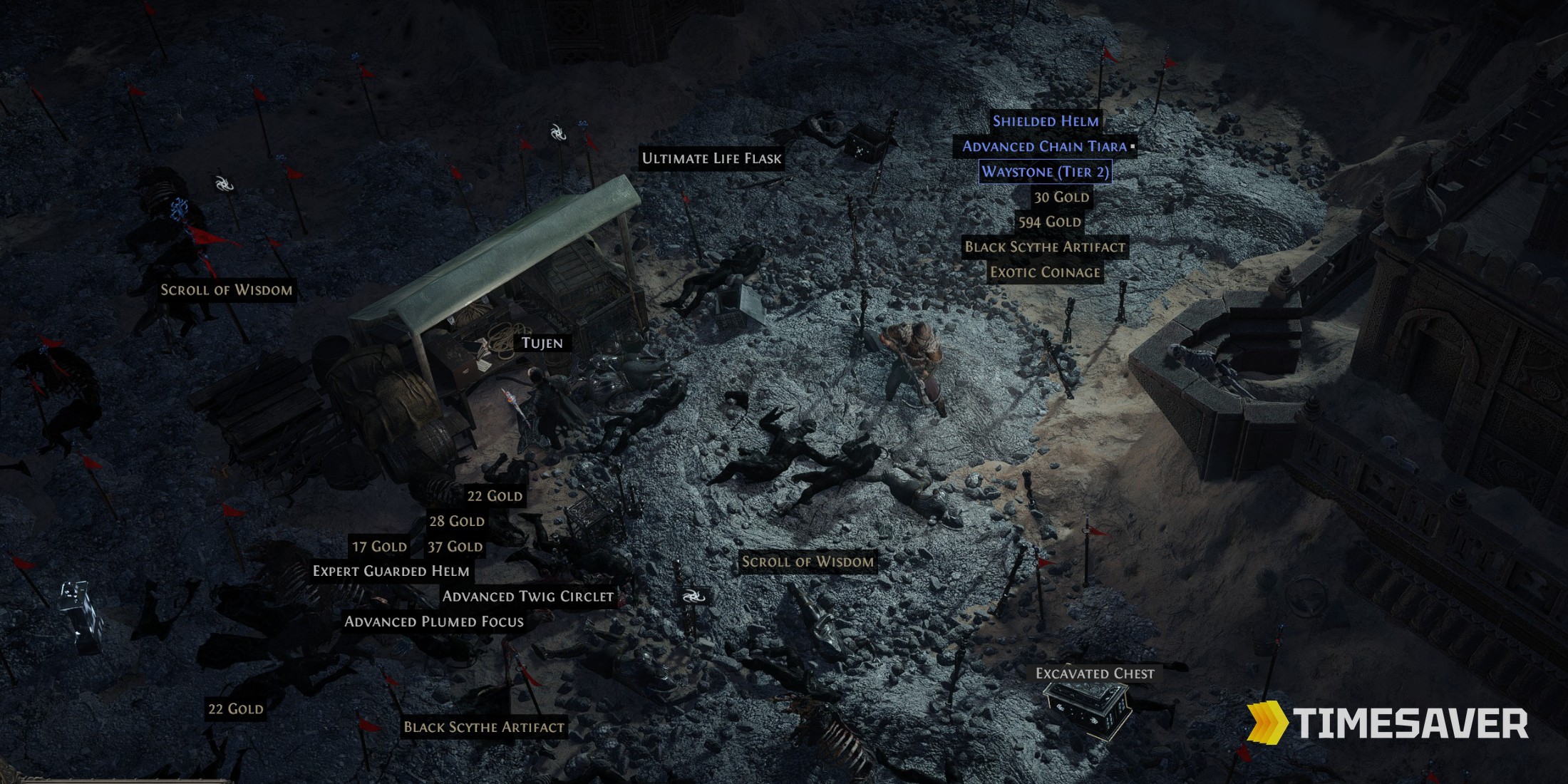
On top of the four faction artifacts there's Exotic Coinage, a multi-vendor currency accepted by Gwennen, Tujen and Rog. Dannig is the hub: spend Sun Artifacts with him to convert between the other artifact types so you can feed whichever vendor you're focusing. New players should anchor on Dannig and Tujen first — Tujen's haggling is the most beginner-friendly way to turn artifacts straight into raw currency.
How do explosives and Remnants work?
This is where most of your profit (or death) comes from. After unearthing the site you get a limited number of explosives — start small and increase the count via the Atlas tree — each with a blast radius shown as a green circle. You place them in a connected chain, then detonate.
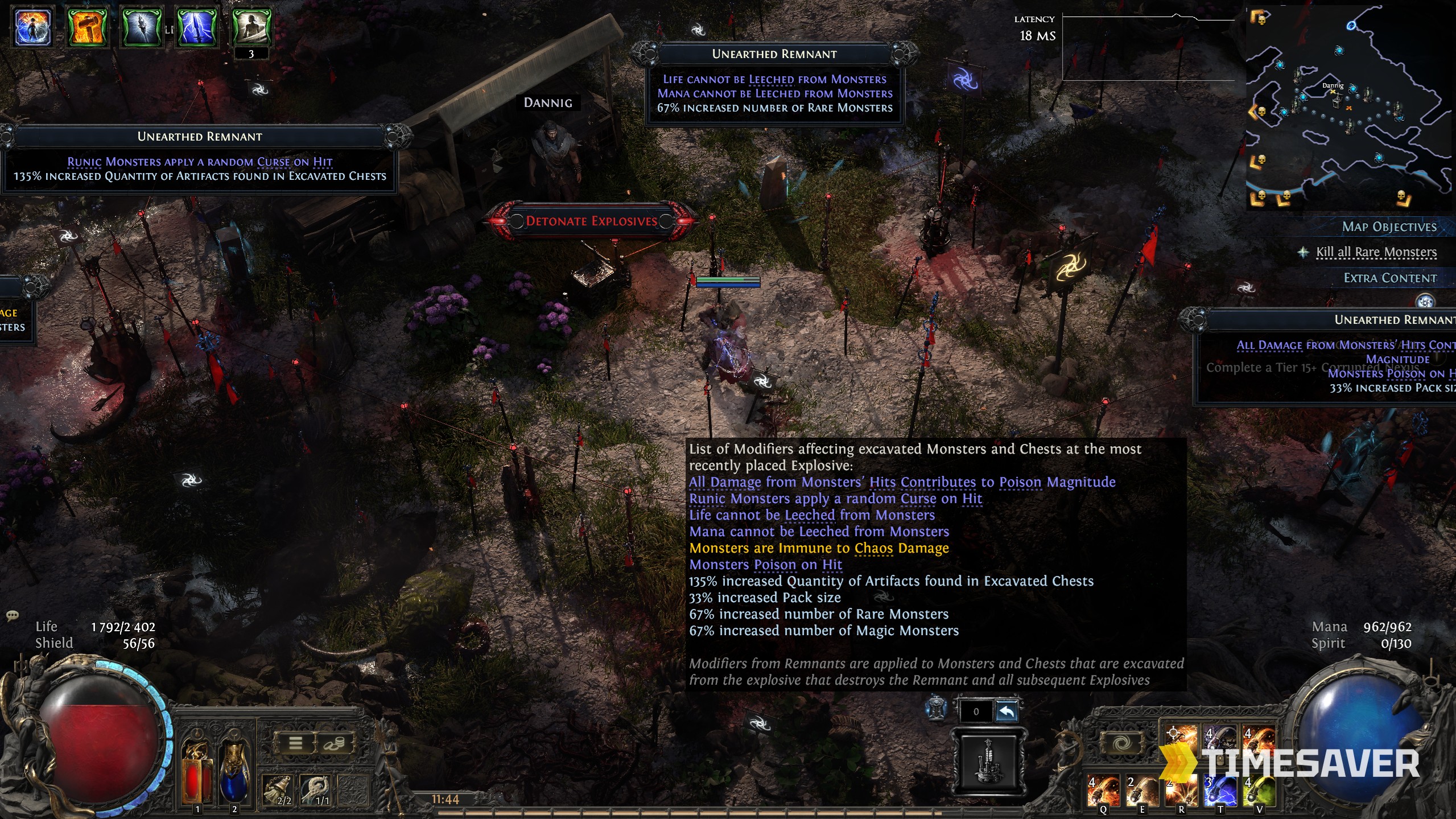
Remnants are the multiplier. They're markers that apply modifiers to the monsters a blast unearths — more artifacts, extra Runic Monsters, added rewards — but they also make those monsters harder. The key rule, verbatim from the PoE Wiki:
"All Unearthed Remnants that are affected by the explosion will only apply its modifiers to the Runic Monsters that spawn after the Remnants explode."
In plain terms: chain a reward-Remnant into the same detonation as the monsters and chests you're cracking open, and that buff lands on the loot. Skip the Remnants and you're leaving most of your artifacts in the ground. The trade-off is real — stacking too many "monsters are dangerous" Remnants into one chain is exactly how you get body-blocked and one-shot. Read the Remnant mods before you commit the chain.
What are Expedition artifacts and how do you turn them into currency?
Artifacts are the whole point. Every Runic Monster you blow up drops them, and they're your buying power with the vendors above. Your conversion options, ranked by how reliably they make money:
- Tujen (haggle): the steadiest. Spend Black Scythe Artifacts to haggle down currency items — including orbs you can use or sell directly. Lowest variance, best for a beginner bankroll.
- Rog (craft): spend Order Artifacts to step-craft armour and shields. Great when you know which bases sell; more skill-dependent.
- Gwennen (gamble): spend Broken Circle Artifacts on unidentified weapons. This is the lottery — most are junk, but a single high-tier unique can be worth many Divine Orbs.
- Dannig (exchange): convert artifact types with Sun Artifacts so you're never stuck with the wrong currency for the vendor you want.
The flow that compounds: detonate efficiently → bank artifacts → haggle steady currency from Tujen, gamble overflow with Gwennen → sell what you don't use for Exalted and Divine Orbs on the Trade site. Exchange rates move every league, so check live values on poe.ninja before you commit a big artifact stash to one vendor.
How do Logbooks and the Grand Expedition work?
Standalone map Expeditions are the appetizer. The real farm is Logbooks. In maps of Tier 10 and above, Runic Monsters have a chance to drop an Expedition Logbook. Bring it to Dannig and he opens a dedicated Expedition area — a self-contained zone that's one big, juiced excavation rather than a single altar in a map.
In 0.5, GGG tied this into the league's broader endgame via the Grand Expedition, layering more sectors and rewards onto Logbook running so it scales as a dedicated farming strategy rather than a side activity. Logbooks come with their own area level and modifiers, so the higher the tier, the bigger the artifact and currency payout — and the better your odds at the pinnacle boss. If you're still pushing Atlas progression to unlock higher tiers, our Atlas guide covers how to get there fastest, and a leveling boost can skip the campaign grind entirely.

PoE2 - Items
Skip the grind — get Items
How do you beat Olroth, the Expedition pinnacle boss?
Olroth, Origin of the Fall is the Expedition pinnacle, and he spawns inside Logbooks — not in regular map Expeditions. You need a high-level Logbook (around area level 79+) for a realistic shot at him appearing, so this is genuinely endgame content gated behind your Atlas progress and Logbook supply.
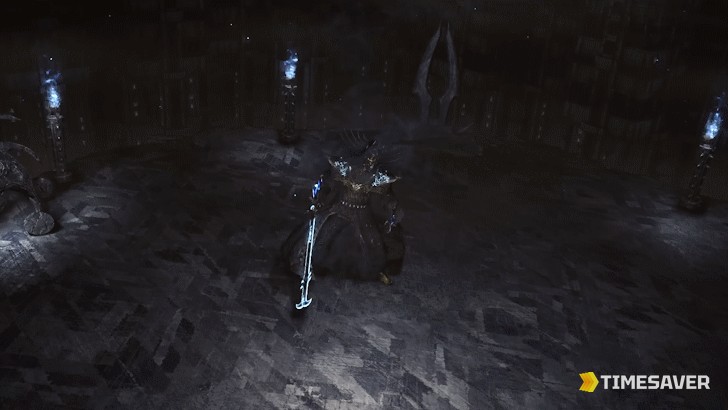
Beating Olroth grants Expedition Atlas Passive Points — the nodes that make every future Expedition more profitable — and a chance at his signature uniques, including Svalinn, Keeper of the Arc, Olroth's Resolve, Olrovasara, and Heroic Tragedy. Because he's a true pinnacle with a demanding moveset, this is exactly the kind of fight players farm a pinnacle boss carry for when they want the rewards and the Atlas points without the deaths.
What's the best Expedition Atlas tree setup for farming?
You don't need exact node names to build it right — prioritize these categories on the Atlas passive tree, in order:
- More explosives — the single biggest quality-of-life and loot upgrade; more charges = bigger chains = more artifacts per encounter.
- Increased artifact quantity / rarity — scales your actual income directly.
- More Runic Monsters / Expedition packs — more monsters unearthed means more drops per blast.
- Logbook drop chance — feeds your deep farm so you're never short on Logbooks to run.
- Remnant effect / extra Remnants — multiplies rewards, but pair it with enough defenses to survive the harder packs.
Stack a focused Expedition tree with Tablets that add Expedition to your maps, run Tier 10+ to keep Logbooks flowing, and you've got a closed currency loop: maps feed artifacts and Logbooks, Logbooks feed bigger artifacts and Olroth, Olroth feeds Atlas points that make the whole thing richer.
Is Expedition worth farming in PoE2 0.5?
Yes — it's arguably the most consistent currency farm in Runes of Aldur, and that's the key word. Unlike drop-luck strategies, Expedition pays out artifacts every single encounter, and you control the conversion. The downsides are honest: it has the steepest learning curve of any mechanic (four vendors, chain placement, Remnant math), and a greedy chain can end a juiced map instantly. But once the loop clicks, it's reliable income you can run on autopilot.
If you'd rather skip straight to the buying power, timesaver.gg sells PoE2 currency, orbs and boss carries & leveling directly — fast, secure, and the time you save grinding Expeditions is time you spend actually playing your build.
Get there faster with timesaver.gg
- PoE2 Currency (all orbs) — divine · chaos · exalted · more, instant delivery, best rate.
- PoE2 Divine Orbs — trusted, fast, the high-end trade currency.
- PoE2 Exalted Orbs — fast & secure crafting staple.
- PoE2 Leveling & Boss Carries — skip the grind, pinnacle kills by pro players.
Frequently asked questions
Where do Expedition artifacts come from? From the Runic Monsters you unearth when you detonate the excavation. Chaining Remnants into the same blast increases how many artifacts those monsters drop.
Which vendor should a beginner use first? Tujen. Haggling Black Scythe Artifacts for currency is the lowest-variance way to turn Expedition loot into orbs. Use Dannig to convert spare artifacts into the type you need.
How do I get Expedition Logbooks? Runic Monsters in Tier 10+ maps have a chance to drop them. Take a Logbook to Dannig, who opens a standalone Expedition area to run.
How many explosives do I get? A small starting amount that you increase through the Atlas passive tree — more explosives is the top farming priority because longer chains hit more markers and Remnants.
Where does Olroth spawn? Only inside Logbooks, and you'll want a high-level one (around area level 79+) for a real chance at him. He drops Expedition Atlas points and uniques like Olroth's Resolve and Svalinn, Keeper of the Arc.
Is buying PoE2 currency safe? Buying from a trusted marketplace like timesaver.gg with instant delivery is the fast route — but keep your blog reading and in-game trading legit, and treat live exchange rates (poe.ninja) as the source of truth before any big conversion.
Mechanics current as of patch 0.5.x "Return of the Ancients" (Runes of Aldur league). Artifact and currency values shift every league — verify live on poe.ninja and the official PoE2 Trade site before committing a large stash.