Quick answer
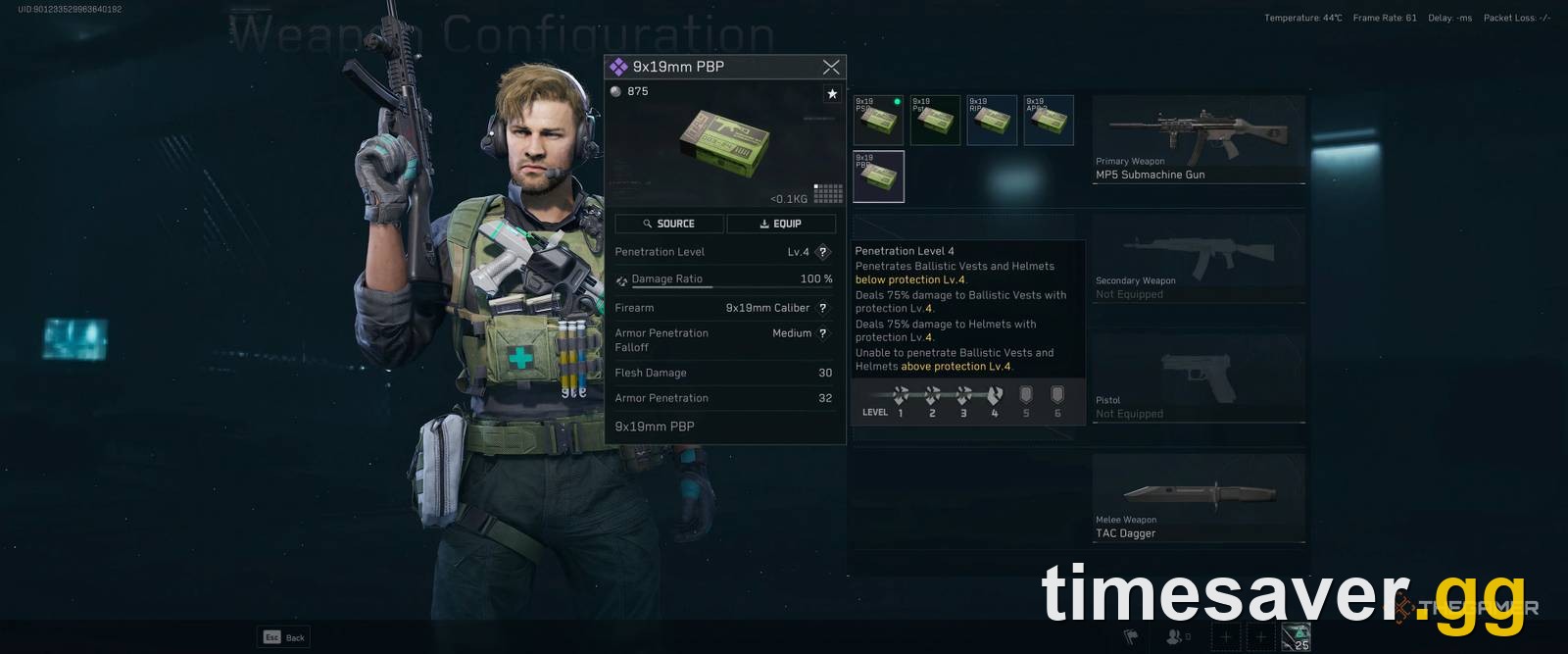
In Delta Force's Operations mode, ammo and armor are both ranked 1–6, and the level gap between the bullet you fire and the vest it hits decides how much damage reaches flesh. If your ammo level is higher than the enemy's armor, the bullet ignores the vest and deals full flesh damage. If they're equal, roughly 25% bleeds through to HP and the rest chews the armor's durability. If the armor level is higher than your ammo, the round is stopped cold — you only damage the vest until it breaks. Two other numbers matter: Damage Ratio (how much of your weapon's base damage lands on bare flesh — some low-tier rounds actually do more than 100%) and penetration falloff (rounds lose piercing power at range). Your weapon's base Damage stat is the primary driver; ammo modifies armor damage and penetration on top of it.
Key takeaways
- Ammo and armor each have 6 levels (1–6), color-coded gray → green → blue → purple → gold → red. The match-up between them is what matters, not the tier alone.
- Three outcomes: ammo > armor = full flesh damage · ammo = armor = partial (~25% flesh, rest to durability) · armor > ammo = bullet stopped, armor-only damage until it breaks.
- Damage Ratio ≠ penetration. Damage Ratio is the % of base damage applied to flesh; some gray/green rounds hit 110% on bare targets while higher tiers sit at 100%. High-tier ammo is not automatically "more damage."
- Same-tier fights leak ~25% flesh damage through the vest — you can still be killed through matched armor if the gunfight lasts.
- Bring ammo one level above the armor you expect. Against a lobby in blue (Lv.3) vests, Lv.4 ammo trivializes them; against gold/red (Lv.5–6), you need Lv.5–6 rounds or you're just scratching paint.
- This system is a core Operations mechanic and does not reset between seasons — but exact per-round numbers shift with balance patches, so verify a specific round in the in-game firing range.
How does ammo work in Delta Force?
Delta Force's Operations mode is an extraction shooter, so it borrows the layered ammo-and-armor model from that genre rather than the flat time-to-kill of a battle royale like Warzone. As TheGamer's breakdown puts it, "Ammo and armor in Delta Force isn't quite as opaque as it is in Tarkov, but it's more complex than you'd find in a battle royale."
Every bullet you fire runs through the same check. The game compares the penetration level of your ammo against the protection level of the armor it hits, then applies your weapon's base damage, the ammo's Damage Ratio, and range falloff. Get the level match-up right and a cheap gun melts an expensive vest. Get it wrong and you'll empty a magazine into someone's chest for almost nothing.
There are four values doing the work:
- Ammo Level (Penetration Level, 1–6): how well the round pierces ballistic vests.
- Armor Level (1–6): how much protection the vest offers.
- Damage Ratio (%): how much of the weapon's base damage lands on bare flesh.
- Base Weapon Damage: the biggest single factor in how hard you hit.
How do armor levels and penetration levels interact?
Armor comes in six levels, and its protection increases with the number. When a round connects, the game resolves one of three cases:
- Ammo level = armor level (matched): the vest stops some damage but loses durability, and about 25% of the damage still bleeds through to your HP as flesh damage on every hit. Matched fights are winnable — you're chipping HP and armor at the same time.
- Armor level > ammo level: the vest fully stops the bullet. Your target takes zero flesh damage and only their armor durability drops. You cannot hurt their health until that armor breaks.
- Ammo level > armor level: the round ignores the armor entirely and deals full flesh damage. This is the "instant kill" feeling — Lv.5 ammo against a Lv.4 vest behaves almost as if they had no armor at all.
One player summed the piercing rule up cleanly on r/deltaforce: "Ammo one tier or more above the armour (for example tier 5 ammo against tier 4 vest) penetrates the armour instantly and does full flesh damage."
Two important footnotes:
- Armor only protects what it covers. Vests protect the chest, abdomen and/or shoulders depending on the model — arms, legs and (usually) the head are always flesh. A high-tier vest doesn't save someone from a headshot or a leg-meta spray.
- Broken armor = no armor. Once durability hits zero, the vest stops mattering and every follow-up round does full flesh damage regardless of level. That's why sustained fire beats matched armor over time.
What is Damage Ratio in Delta Force?
This is the number most players misread. Damage Ratio is the percentage of a weapon's base damage that a specific round applies to bare flesh — not a penetration stat. Per the in-game ammo panel description: to see it exactly, "visit the firing range, open the ammo selection window, and check the Flesh Damage value. Rounds of the same caliber generally deal the same damage unless their Damage Ratio is above or below 100%."
Here's the counter-intuitive part that trips up new players: higher-tier ammo is not always higher damage against unarmored targets. Community testing (guides-factory, corroborated on the r/DeltaForceGlobal ammo threads) found that some Lv.1 gray and Lv.2 green rounds carry a 110% Damage Ratio versus 100% on blue, purple and gold — meaning against a downed or unarmored enemy, the "cheaper" round can actually hit harder. The trade-off is penetration: those low rounds do nothing against a Lv.4+ vest.
As one player explained the logic on the ammo-ratio thread: "Damage ratio means how much of the base damage of the gun will be dealt to HP using this bullet." So the takeaway is a mental split:
- Damage Ratio = how hard you hit flesh.
- Penetration Level = whether you're allowed to hit flesh at all through armor.
You want enough penetration to bypass the armor you expect to face, and then the best Damage Ratio you can get for that job — not blindly the highest tier.
Which ammo should you actually use?
There is no single "best" round, because the right choice is a function of the armor you expect and the money you're willing to lose. A practical framework:
- Early runs / Easy maps (bots, unarmored or Lv.1–2 targets): cheap Lv.1–2 ammo is fine, and thanks to Damage Ratio it can out-damage pricier rounds on soft targets. Don't overspend.
- Mid-tier lobbies (Lv.3 blue vests common): step up to Lv.3–4 ammo. Lv.4 against blue is a lopsided win.
- High-value runs (gold/red Lv.5–6 armor): you need Lv.5–6 rounds or you're just draining durability while they one-tap you. This is where good ammo pays for itself.
- Fast-firing SMGs: the interaction is why Team Jade balances ammo per-gun. Players flagged that gold .45 on a ~1,000 RPM SMG like the Vector was strong enough that its flesh damage was tuned down — "the gold .45 is a weird exception because it was too powerful and fast firing with guns like the Vector." High fire rate × high-penetration ammo is the combo the devs watch.
Remember the primary driver: the ammo panel itself notes that "the weapon itself is the primary determinant… it's the weapon's inherent Damage stat that largely determines how much harm you can cause." Ammo tunes the edges; the gun sets the ceiling.
Does penetration change at range?
Yes. Penetration Falloff reduces a round's piercing power the farther it travels, and the amount varies by armor class — you can find it on each round's in-game "Details" page. Combined with normal damage falloff (your weapon deals its maximum up close and never less than its minimum at max range), this means the same ammo that shreds a vest at 15 meters can fail to penetrate it across a lane. SMG rounds fall off hard; rifle and battle-rifle rounds hold penetration much longer, which is a big part of why long engagements favor higher-caliber weapons.
Ammo vs armor: a quick reference
| Situation | What happens | Practical read |
|---|---|---|
| Ammo level > armor level | Armor ignored, full flesh damage | Ideal — behaves like they're unarmored |
| Ammo level = armor level | ~25% flesh bleeds through, rest hits armor durability | Winnable, but slower; sustained fire wins |
| Ammo level < armor level | Bullet stopped, armor-only damage | Bad — you can't touch HP until the vest breaks |
| Any level, broken armor | Full flesh damage | Keep firing; a cracked vest is no vest |
| Any level, uncovered limb/head | Full flesh damage | Aim for what armor doesn't cover |
Levels and the ~25% matched-bleed figure reflect the Operations armor/ammo system as of Season "Reorientation" (live since September 8, 2026). Exact per-round Damage Ratio and penetration values change with balance patches — confirm a specific round in the firing range before you commit a loadout to it.
FAQ
What do the ammo colors mean in Delta Force? The color is a shorthand for the round's level: gray is Lv.1, green Lv.2, blue Lv.3, purple Lv.4, gold Lv.5 and red Lv.6. Higher levels penetrate higher-tier armor. Armor uses the same six-level scale, so the color of your ammo versus the color of their vest tells you at a glance who wins the exchange.
Is higher-tier ammo always better? No. Higher tiers penetrate better, but against unarmored or lightly armored targets some Lv.1–2 rounds have a higher Damage Ratio (around 110%) and hit flesh harder than gold does at 100%. Buy for the armor you expect to face, not for the highest number — and never overspend cheap Lv.1 lobbies.
What is Damage Ratio versus Penetration Level? Damage Ratio is the percentage of your weapon's base damage that reaches bare flesh; Penetration Level is whether the round can get through armor to reach that flesh in the first place. You want enough penetration to beat the vest, then the best Damage Ratio for the job. Check both in the firing range's ammo details.
Can you still get killed through matched armor? Yes. When ammo and armor are the same level, roughly 25% of each hit's damage still bleeds through to your HP while the rest damages the vest. A long enough gunfight will kill you through equal armor, and once the vest's durability breaks you take full flesh damage from every round.
Where can I check an ammo type's exact stats? In the firing range: open the ammo selection window and read the Flesh Damage value and the round's Details page, which lists penetration and Penetration Falloff. Because Team Jade rebalances ammo per patch, the firing range is the only source that's always current.
Does the ammo system work the same in Warfare? The core level-matching logic is shared, but Operations and Warfare use separate weapon stat tables and Team Jade tunes them independently — so treat ammo choices per mode and don't assume an Operations number carries over to Warfare.
The bottom line
Delta Force's ammo system rewards reading the room. Match your penetration level to the armor you expect, lean on Damage Ratio (not tier) when targets are soft, respect falloff at range, and remember that broken or uncovered armor is no armor at all. Master the level match-up and a budget gun starts winning fights it has no business winning — which, in an extraction shooter where every run risks your gear, is exactly the edge you want.
Looking for more Operations breakdowns? Browse our other Delta Force guides for extraction routes, economy tips and season coverage.