Farming Prime parts is the single most reliable way to build every Prime Warframe and weapon in the game and to earn Platinum without spending a cent — but only if you run the right relics on the right nodes. This guide covers the full loop as of Update 43: Jade Shadows: Constellations (the Styanax Prime era, August 2026): where to farm each relic tier, how to open relics for the best odds, which Prime parts are worth Ducats versus Platinum, and how to trade them safely inside the rules.
Quick answer: Prime parts come from Void Relics cracked in Void Fissure missions. Farm Lith at Hepit (Void, Capture), Meso/Neo at Ukko (Void, Capture) or Io (Jupiter, Defense), and Axi at Xini (Eris, Interception). Refine relics to Radiant with Void Traces for the best rare-drop odds, run fissures in a full squad so you can pick from all four rewards, then either exchange duplicate parts for Orokin Ducats (Baro Ki'Teer's currency) or trade them for Platinum with other players. Always check warframe.market for current prices and warframe.com/droptables for live drop rates.
What are Prime parts and Void Relics?
Prime gear — Warframes, weapons and companions — is the gold-trimmed, Orokin-era version of standard equipment, with better stats and Mastery value. You don't buy Prime parts from a shop; you build them from blueprints hidden inside Void Relics.
The official wiki defines them plainly: "Void Relics are Orokin objects that can be opened to reveal valuable treasure enclosed within by completing Void Fissure missions. They are the principal means of acquiring Prime parts and Forma Blueprints, as well as Ducats from exchanging Prime parts in Relays" (wiki.warframe.com).
There are four standard relic tiers, and each drops parts for a different set of Primes:
| Relic tier | Typical contents | Where it fits |
|---|---|---|
| Lith | Early-access Prime parts, common frames/weapons | Lowest tier, fastest to farm |
| Meso | Mid-tier Prime parts | Bridges Lith and Neo |
| Neo | Higher-value Prime parts | Where a lot of tradeable value lives |
| Axi | Top-tier, most sought-after parts (often the Warframe blueprint) | Slowest, highest reward |
(There is also a fifth type, the Requiem Relic, but those are for Kuva Lich murmurs, not Prime parts — don't confuse them.)
Each relic holds six possible rewards at three rarities: common, uncommon and rare. Which one you get depends on the relic's refinement level and a bit of luck — which is exactly what you can influence.
How does the Prime parts farming loop work?
Digital Extremes documents the loop itself on the Prime Access page. Simplified, it's four steps:
- Get relics. Void Relics drop from mission rewards, Syndicate Standing, bounties, and can be traded from other players.
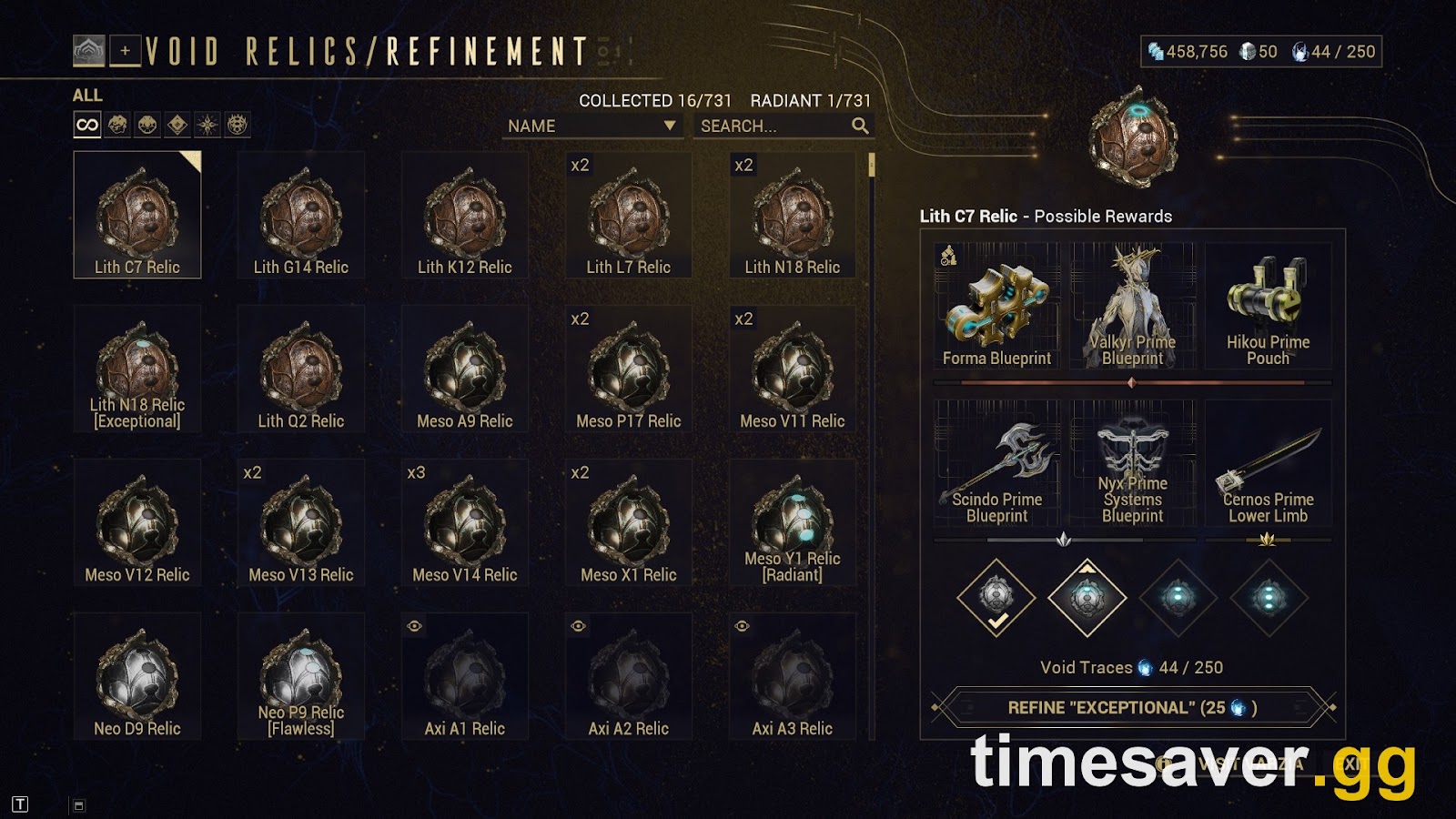
- Refine (optional but recommended). Spend Void Traces in the Void Relic Segment to upgrade a relic from Intact → Exceptional → Flawless → Radiant, improving the odds of the rare reward.
- Crack the relic. Equip it and run a Void Fissure mission of the matching tier. Corrupted enemies drop Reactant — you need 10 Reactant to open your relic before extraction.
- Pick your reward and build. At the end of the mission you choose one of the rewards. In a full four-player squad you see all four players' rewards and pick the best one — this is why grouping is the single biggest efficiency lever in relic farming.
Void Traces themselves drop while you crack relics, so the system is self-sustaining: run fissures, bank Traces, use Traces to Radiant your best relics, run those for better odds. Your Trace storage cap scales with account progress — the formula is (Mastery Rank × 50) + 100, so a Mastery Rank 13 player can hold 750 at once.
Where are the best relics to farm?
Relic sources rotate, but the community-standard fastest nodes have been stable for years because they're short Capture and Defense missions with heavily relic-weighted drop tables. These are your go-to farms:
| Relic tier | Best node | Planet / mission | Why |
|---|---|---|---|
| Lith | Hepit | Void — Capture | Near-guaranteed Lith on completion; ~2–3 minute runs |
| Meso | Io | Jupiter — Defense | Meso every 5 waves; huge squads always available |
| Meso / Neo | Ukko | Void — Capture | Single fast Capture that can drop either tier |
| Neo / Axi | Xini | Eris — Interception | Rotation B/C rewards; usually a full public squad |
For Capture nodes (Hepit, Ukko) you're in and out in a couple of minutes, making them ideal when you just need volume. For Axi relics you'll generally run endless missions (Defense/Interception/Survival) to reach the B and C reward rotations where the higher tiers appear.
A speed frame makes all of this faster. As one popular farming guide bluntly puts it: "Speed matters more than damage in most relic run scenarios. Fast missions mean more runs per hour." Volt, Gauss and Wisp are common picks for Capture spam; Rhino or a defensive frame keeps you alive long enough to grab all 10 Reactant on higher-level Corrupted enemies.
If you want to grind Prime parts inside tougher, resource-rich content, running fissures on the Steel Path adds +100% resource drop chance and stacks Steel Essence on top of your relic rewards — worth it once your build can handle the +100 enemy levels.
How do you open relics for the best rewards?
The refinement tier you crack a relic at changes the rare-drop odds dramatically. Before you burn Void Traces on every relic, refine only the ones whose rare reward you actually want (usually the Warframe blueprint or a high-value weapon part):
- Intact — free, base odds. Fine for common parts you just want for Ducats.
- Exceptional (25 Traces) / Flawless (50 Traces) — better rare odds for a moderate cost.
- Radiant (100 Traces) — the maximum, best chance at the gold-rarity reward. Save these for the parts you plan to sell for Platinum.
Two more rules that separate efficient farmers from the rest:
- Always run in a squad of four for targeted farms. Four players each cracking the same relic gives you four shots at the reward and lets you pick the best of the four — roughly quadrupling your effective odds for the part you want.
- Radiant Share runs (four players all bringing the same Radiant relic) are the community's standard way to farm a specific rare part quickly. Look for "Rad share" recruiting in-game or on the official forums Trading Post.
Check DE's own published drop tables at warframe.com/droptables for the exact percentages on any relic before you commit Traces — those are the only authoritative rates, and they update with every hotfix.
Which Prime parts should you sell?
Every Prime part has two exit routes: exchange it for Orokin Ducats, or trade it to another player for Platinum. Knowing which is which is how you turn a pile of duplicates into value.
Ducats are earned only by selling Prime parts and blueprints at a Void Trader kiosk in a Relay. The value scales with the part's rarity on its relic:
| Part rarity | Ducat value |
|---|---|
| Common (bronze) | 15 |
| Uncommon (silver) | 45 |
| Rare (gold) | 100 |
| Cross-rarity (common+uncommon) | 25 |
| Cross-rarity (uncommon+rare) | 65 |

Ducats spend on Baro Ki'Teer, the Void Trader, who "arrives every two weeks and stays 48 hours," rotating exclusive mods, weapons, cosmetics and Prime parts. A practical routine: dump your common duplicate parts for Ducats every time you're capped, and keep a Ducat reserve so you can buy whatever Baro brings. One caution — when Baro stocks an item, its Platinum price on the player market often crashes, so sell tradeable parts before he arrives if you can.
The parts worth trading for Platinum instead of dissolving into Ducats are the newer, in-demand ones — recently released or recently unvaulted Primes, and rare-slot parts for popular frames and weapons. Older, oversupplied common parts are usually worth more as Ducats than the handful of Platinum they'd fetch.
How do you turn Prime parts into Platinum safely?
Platinum is Warframe's premium currency, and you never have to pay real money for it — you can earn it entirely by trading Prime parts to other players. Here's how to do it inside the rules:
- Where: the Trading Post in a Clan Dojo, or Maroo's Bazaar on Mars.
- Requirements: Mastery Rank 2 minimum and TennoGuard 2FA enabled on your account. Both are hard gates — with 2FA off, the game simply won't let you trade (this is the most common "cannot trade" cause).
- Limits: your daily trade count equals your Mastery Rank (MR15 = 15 trades/day), and each trade allows six items per side, twelve total. Platinum takes only one slot regardless of amount.
- Tax: the receiving player pays a Credit tax scaled by rarity, plus a hub surcharge — +10% fixed at Maroo's Bazaar, but 0–100% (often 0%) in a Clan Dojo. Trading in a cheap Dojo saves real Credits.
For pricing, most Tenno use warframe.market as the community price reference — it's the de-facto board the whole community checks, though it is not operated or endorsed by Digital Extremes. Use it to sanity-check what your part is worth, then list it in your Dojo or the official forums Trading Post.
One critical safety rule. Digital Extremes' own support team is explicit about third-party sellers: "You might see players (either in-game or on various websites) offering special deals on discounted Platinum. Note that these Platinum sellers are not legitimate" (support.warframe.com). The EULA bans secondary markets and third-party "leveling" services outright, and DE does not reverse trades — every trade is final and your responsibility. Player-to-player trading through the in-game Trading Console is the only legitimate way to move Platinum, and it's more than enough: a few good Prime part sales a week comfortably funds slots, Forma and cosmetics.
Pair this loop with a steady relic income — and if you're still building your currency base, our guide to farming Aya covers how to pull vaulted Primes back into circulation for even more tradeable parts.
FAQ
What is the fastest way to farm Prime parts in Warframe? Run short Capture fissures for volume — Hepit (Void) for Lith and Ukko (Void) for Meso/Neo — in a full four-player squad so you can pick from all four rewards. For specific rare parts, do a Radiant Share run where all four players bring the same Radiant relic. Always crack the relic tier that matches the fissure (Lith fissure needs a Lith relic).
How many Reactant do I need to open a relic? You need 10 Reactant per relic, dropped by the Corrupted enemies that spawn during a Void Fissure mission. Grab them before you extract, or the relic won't open. In a squad, each player collects their own 10.
Should I sell Prime parts for Ducats or Platinum? Trade newer, in-demand, and rare-slot parts to other players for Platinum (check warframe.market for the going rate). Dissolve older, oversupplied common duplicates into Ducats (15 common / 45 uncommon / 100 rare) to spend on Baro Ki'Teer. If a part is worth only a few Platinum, it's usually better as Ducats.
Why can't I trade my Prime parts? The two usual causes are Mastery Rank below 2 or TennoGuard 2FA not enabled — both are required to trade at all. You may also have hit your daily trade limit (equal to your Mastery Rank). Note that crafted Prime parts cannot be traded — only the blueprints can; if you accidentally started a build, cancel it in the Foundry to recover the blueprint.
Do I have to pay real money for Platinum? No. You can earn all the Platinum you need by trading Prime parts and other tradeable items to other players. DE's support page warns that third-party "discounted Platinum" sellers are "not legitimate," and buying from them violates the EULA — in-game player trading is the only safe route.
How often does Baro Ki'Teer come, and what should I buy? Baro Ki'Teer arrives at a Relay every two weeks and stays for 48 hours. Keep a Ducat and Credit reserve so you can grab his rotating stock — mods, weapons, cosmetics and occasional Prime parts. Check what he's bringing before he lands, since sought-after items can crash in player-market value once he stocks them.
Facts verified against warframe.com, wiki.warframe.com, warframe.com/droptables and support.warframe.com as of Update 43: Jade Shadows: Constellations (August 2026). Drop rates and market prices shift with hotfixes and Prime Access cycles — always confirm current values on the official drop tables and warframe.market before a big farm.