Portals are the single biggest time-saver in Valheim, and the first quality-of-life upgrade every player should chase after the first boss. A working portal network turns a 10-minute boat trip into a two-second walk through a glowing ring — but only if you understand tags, know exactly which items refuse to teleport, and build the right kind of portal for the job. This guide covers building, naming, and pairing portals, the full list of what you can and can't carry through, the endgame Stone portal that breaks the metal rule, and the hub design players actually use. Everything below is verified against the Valheim Wiki and current on patch 1.0.15 (September 18, 2026) — the live 1.0 build.
Quick answer: how do portals work in Valheim?
A portal teleports you instantly to any other portal that shares its exact tag. You build two portals, type the same name into both, and they pair up — step in one, come out the other. Tags are case-sensitive and capped at 10 characters; two portals left blank both count as "no tag" and connect to each other.
Key facts:
- Recipe (Wood portal): 10× Greydwarf eye, 20× Finewood, 2× Surtling core — built at a Workbench.
- Unlocked the moment you first pick up one each of Finewood, Surtling core, and a Greydwarf eye (so, early Black Forest).
- Tags are case-sensitive, max 10 characters; same tag = paired portal. Blank connects to blank.
- Ores and metals cannot be teleported through a normal portal — the game's core progression brake.
- The Stone portal (Ashlands-tier) can carry ores, metals, and other blocked items.
- Teleporting takes about 8 seconds, and you are invulnerable the whole time.

How do you build a portal in Valheim?
You need a Hammer, a Workbench in range, and the materials. The Wood portal costs 10× Greydwarf eye, 20× Finewood, and 2× Surtling core. Greydwarf eyes drop from Greydwarves in the Black Forest, Finewood comes from birch and oak trees (a Bronze axe fells birch), and Surtling cores are looted from Burial Chambers and Surtlings around fire geysers.
The recipe unlocks automatically the first time you carry one of each ingredient, so most players get their first portal shortly after killing Eikthyr and moving into the Black Forest. A portal needs a Workbench nearby to be placed, but — importantly — it does not need a Workbench nearby to keep working. That means you can plant a portal deep in a dangerous biome, walk away, and it stays live.
A few build details worth knowing:
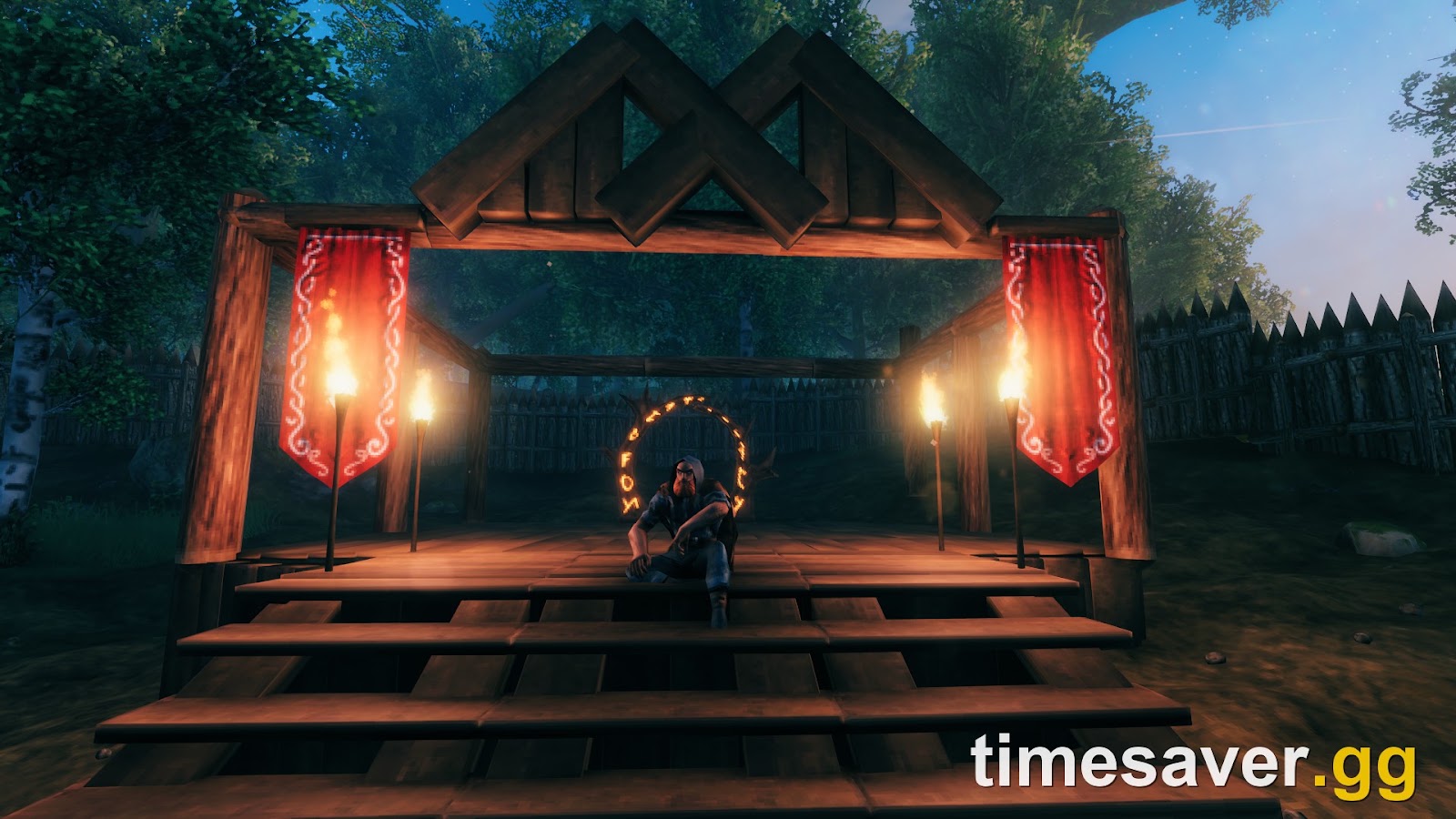
- The portal has a front and a back. It works from either side, but approaching from the back requires you to stand much closer before the connection indicator lights up. The "front" is the outward-facing point on the base.
- Portal durability is 400, and it takes no rain damage, so an exposed portal won't rot the way an uncovered wood wall does.
- You can walk through while encumbered (over your weight limit). This is what makes portals better than a Cart for hauling wood, stone, and crops.
How do portal tags work?
When you interact with a portal, you can type a tag — a short name. Any two portals with the identical, case-sensitive tag automatically connect. The character limit is 10, and letters, numbers, and special characters are all allowed. Leave the field blank and the portal has "no tag," which pairs with any other blank portal.
The rule that trips people up: each portal only ever links to one partner. If you build four portals all tagged `mine`, they pair off in the order you set the tags — the first two connect, the third and fourth connect, and the two pairs are separate networks. To re-point a portal, just change its tag; it instantly drops its old partner and hunts for the new match.
Because the game matches on an exact string, a stray capital letter is the number-one reason a "broken" portal isn't connecting. `Base` and `base` are two different destinations. Keep a simple, consistent naming scheme — many players use one shared hub tag plus a rotating "away" portal (more on that below).
What can't be teleported through a portal?
This is the mechanic the entire mid-game is built around. All ores and their smelted metal bars cannot pass through a normal portal. Any item with a small blue-portal-crossed-in-red icon is blocked. The full "can't be teleported" list on current patch:
| Category | Blocked items |
|---|---|
| Copper line | Copper, Copper ore, Copper scrap, Tin, Tin ore, Bronze, Scrap bronze |
| Iron line | Iron, Iron ore, Iron scrap (Scrap iron) |
| Silver line | Silver, Silver ore |
| Black metal | Black metal, Black metal scrap |
| Ashlands metal | Flametal, Flametal ore |
| Other | Dragon egg, Mechanical spring, Charred cogwheel, Iron pit, Dvergr extractor, Hildir's chests |
That is why Valheim forces you to sail. Mining a Mountain full of silver or a Swamp full of iron means hauling it home by Longship or Cart, not portalling it. The design is deliberate: portals trivialize travel, so ore has to move the slow way to keep exploration meaningful.
The workaround most players use: build a portal at the mining site so you can ferry your body, food, and gear back and forth freely while the ore waits in a chest, then make one boat run at the end to collect the metal. All portal-building materials themselves teleport fine, so you can always carry a spare portal kit into a new biome.
What is the Stone portal, and how is it different?
The Portal – Stone is the endgame answer to the metal problem. It becomes available a short way into the Ashlands biome and, unlike the wood version, it can teleport the blocked items — ores, metals, Dragon eggs, Hildir's chests, and Mechanical springs all pass through.
- Recipe: 10× Greydwarf eye, 30× Grausten, 2× Molten core — built at a Stonecutter (not a Workbench).
- Durability 1000, resistant to ash damage, and roughly twice the footprint of a wood portal — plan an area four walls high, four 2×2 tiles wide, two 2×2 tiles deep.
- As of Ashlands patch 0.218.21 it can be placed on any stone floor, not just Grausten.
There is one asymmetric-pairing trap that catches everyone: the portal you step INTO must support what you're carrying. A Stone portal will happily connect to a Wood portal using the same tag, but you can only bring metal out of the pair on the side that has a Stone portal. Carry iron into a Wood portal and it simply won't teleport you. For a network that moves ore both directions, both ends must be Stone.
Portal hub design that actually works
Once you have four or five destinations, a single wall of portals becomes a spaghetti of tags. The pattern most experienced players settle on:
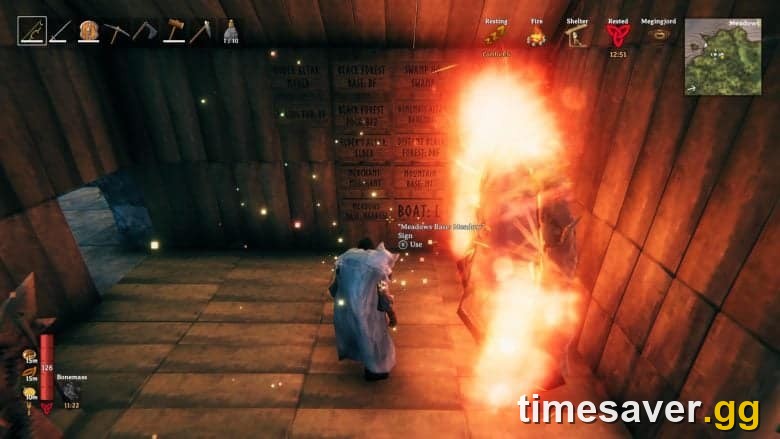
- One permanent hub at your main base with a fixed portal for every key location — `swamp`, `mountain`, `plains`, `mist`, `north`, and so on. These never change.
- One roaming "away" portal you carry with you. Give it a throwaway tag like `a` or `x` and keep a matching partner at the hub. Whenever you're exploring, drop the away portal, and it connects straight home. When you leave, harvest it and re-plant it at the next site.
- Cover your portals. Players consistently note that portals left in the open get harassed — a Greydwarf or a Deathsquito can interrupt you mid-teleport. Tuck them in a shed, a treehouse, or a sunken crypt so nothing spawns on your face when you arrive.
A dedicated portal hub — a ring or corridor of tagged portals in one room — is the single most common "essential build" veterans recommend to newcomers, and it's why base tours are full of them. It costs almost nothing (Greydwarf eyes and Finewood are cheap) and saves hours over a full playthrough.
FAQ
How many characters can a Valheim portal tag be? Up to 10 characters, and tags are case-sensitive. Letters, numbers, and special characters are all valid, so `Base`, `base`, and `BASE1` are three different destinations — mismatched capitalization is the most common reason two portals won't connect.
Why won't my two portals connect? Almost always a tag mismatch (check capitalization exactly) or the fact that a third portal shares the same tag and stole the pairing — remember each portal links to only one partner, matched in the order tags were set. Also confirm both portals are actually built and not just placed as ghost previews.
Can you teleport metal or ore in Valheim? Not through a normal Wood portal — all ores and smelted metals are blocked (look for the blue-portal-crossed-in-red icon). You must sail or cart them home. The Stone portal, available in the Ashlands, is the only portal that lets ores and metals through.
Do you need a Workbench for a portal to work? You need a Workbench in range to place the portal, but not to use it. Once built, a portal keeps working with no Workbench nearby — which is exactly why you can leave one running in a hostile biome.
How long does teleporting take? About 8 seconds, and you are invulnerable for the entire animation — poison and other damage-over-time effects are nullified while you teleport. If the destination is blocked it can take up to 15 seconds while the game finds a free spot above the portal.
Is the portal recipe worth it early? Yes — it's the first thing to build after Eikthyr. The materials (Greydwarf eye, Finewood, Surtling core) are cheap Black Forest loot, and a home portal plus one exploration portal saves you from re-sailing to every site you've already found.
Keep progressing in Valheim
Portals are the backbone of an efficient run, but they're only useful once you're pushing into new biomes and bosses. If you're mapping out where to go next, these guides pair well with a solid portal network:
Ready to expand your world? Line up your next destinations and gear so every new portal actually goes somewhere worth visiting.